
The short answer: One good garland can dress almost every surface in the house — mantel, staircase, front door, windows, table and tree. Buy faux where it must last all season, fresh for the mantel and table where you smell it, and make one DIY strand for the spot people photograph. Measure first: a swagged surface needs about one and a half times its straight length, and hang everything on removable hooks, ribbon or floral wire so January leaves no holes.

Why Garland Does More Work Than Anything Else in the Box
A wreath decorates one circle. A tree decorates one corner. A garland goes wherever you point it: along a shelf, up a banister, around a door, down a table, in soft loops around the tree itself. It is also forgiving — a thin spot can be fluffed, a bare patch can hold a bow, and two short strands join into one long one with wire.
Most disappointing garlands fail for two dull reasons: too short, so the swags pulled tight and sad, or hung with whatever was in the drawer, so they sagged or fell on Christmas Eve. This guide fixes both first — what to buy, how much, how to hang it without damage — then walks the strand room by room.
1. Fresh, Faux or DIY: What to Buy First
Fresh garland — real fir, cedar or pine roping — smells like Christmas the moment it comes through the door. Its limits are time and place: in a heated room it looks best for two to three weeks, it drops needles, and it must never touch a heat source or flame. Buy it late, mist it, and put it where noses pass: mantel and table.
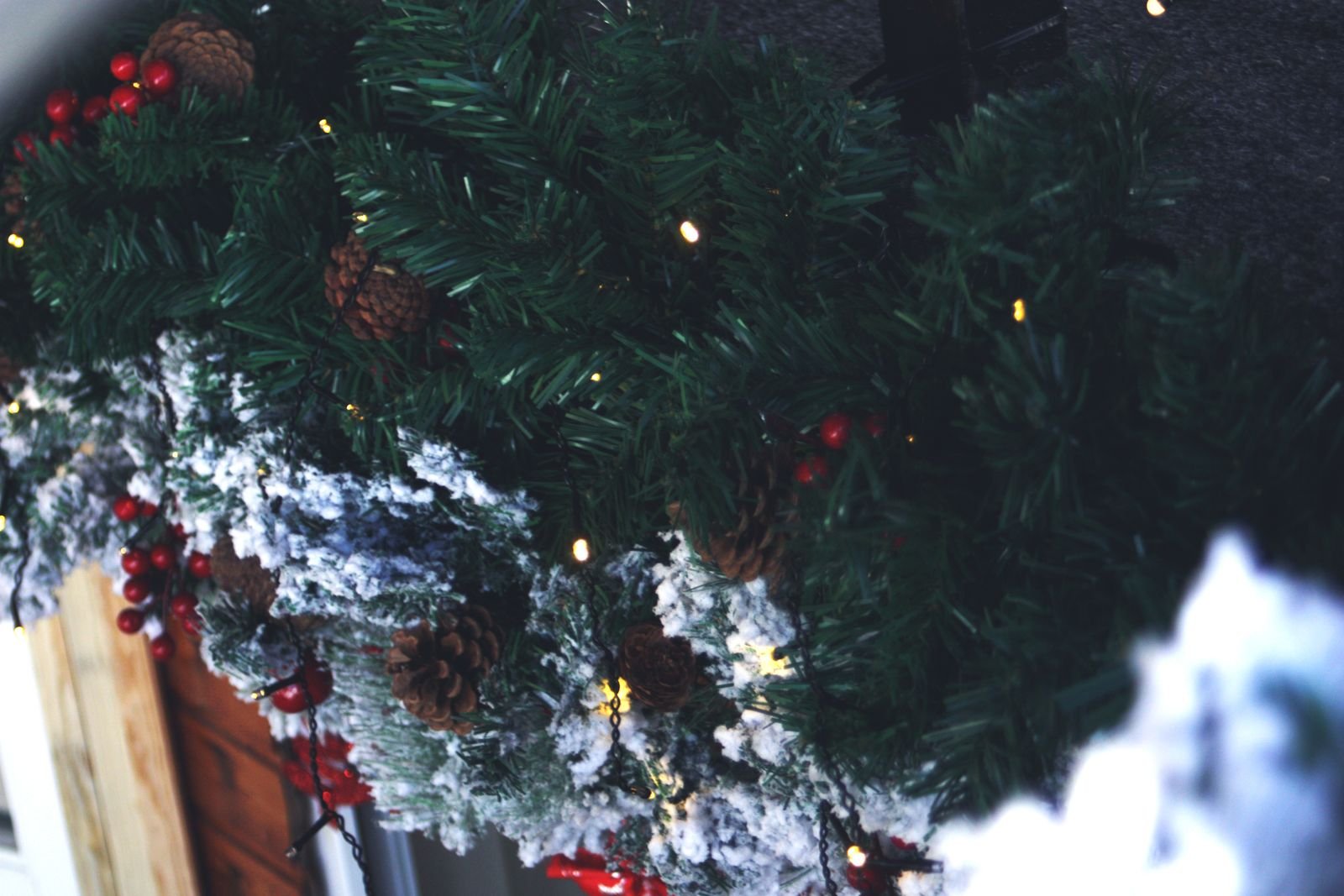
Faux garland is the workhorse. A good one — mixed needle shapes, variation in the green, branches you can bend — goes up in November and returns next year. Put faux where fresh would suffer: staircase, front door, high windows, tree. The flocked strand below shows what to look for: pinecones and berries wired in, lights threaded through, flocking that reads as frost, not dust. One shop test: bend a tip. If it stays bent, it will style well at home.
DIY garland is the third kind, and not a compromise — dried orange, popcorn, paper and felt strands look handmade on purpose. Sections 8 and 9 make two. The sensible house runs all three: faux for structure, fresh for scent, DIY for heart.
2. The Mantel: Swags, Layers and No Nails
Lay the strand along the shelf and let it swag — dip in the middle, rise at the corners — rather than pulling it straight. A straight garland reads like a shelf edge; a swagged one reads as decorating. Anchor both ends and the centre, then layer: fairy lights woven through, pinecones and baubles in clusters of three, stockings last.
Hang it without damage: removable adhesive hooks rated for the weight, hidden behind the greenery, or tie it to stocking holders and let their weight anchor it. Keep greenery clear of the firebox, and real flame nowhere near branches. The close view below is the texture to aim for: cones on top, lights glowing from inside the branches. Our Christmas mantel decor ideas go deeper on stockings and styling once the garland is up.

3. The Staircase and Banister: The Swag Rule
A staircase garland is where under-buying shows fastest. Measure the banister, then buy one and a half times that length for gentle swags, or twice it for deep magazine dips. Attach at every third or fourth baluster with floral wire, ribbon or padded ties — never bare wire on painted wood, and never block the handrail, which people still need to hold.
Work top down, and finish at the newel post with one big moment: a bow, a bauble cluster, a lantern on the step below. The railing below — a porch railing, dressed by the same method — shows the rhythm: even swags, spaced baubles, one oversized bow. Our Christmas staircase decor ideas cover banister shapes and landings in full.

4. The Front Door: Frame It, Do Not Just Wreath It
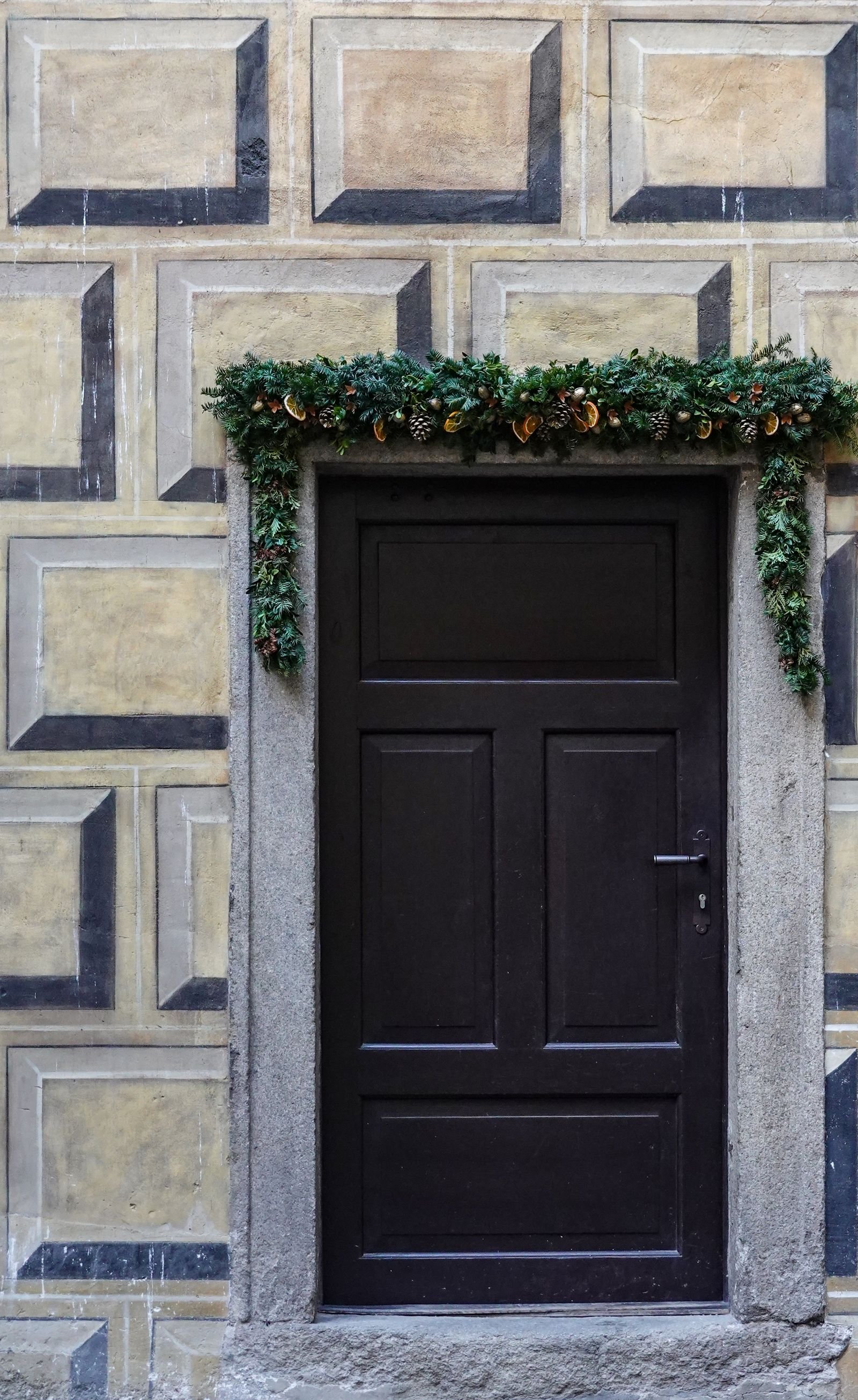
A wreath alone is lovely. A garland framing the whole door is the house people slow down for. Run the strand up one side, across the top and down the other — an upside-down U — and let the ends finish a little unevenly, which looks grown rather than installed. Fix it with outdoor removable hooks, or masonry clips on brick.
The doorway below is the natural version: mixed greenery across the top, trailing down both sides, finished with dried orange slices, pinecones and small gold baubles — nothing that fades or needs a plug. Outdoors, faux or hardy fresh greenery wins; December weather wilts a delicate strand in days. Add a wreath at the centre only if the greens match — our Christmas wreath ideas pair wreaths with door colours. Battery lights on a timer solve the no-socket problem: on at dusk, off at bedtime.
5. Windows and Mirrors: The Frame Trick
Windows and mirrors are flat, plain and everywhere — perfect garland frames. Around a mirror, the glass reflects the greenery and lights back into the room, doubling the effect. Around a window, it frames the winter view and glows against dark glass at night.
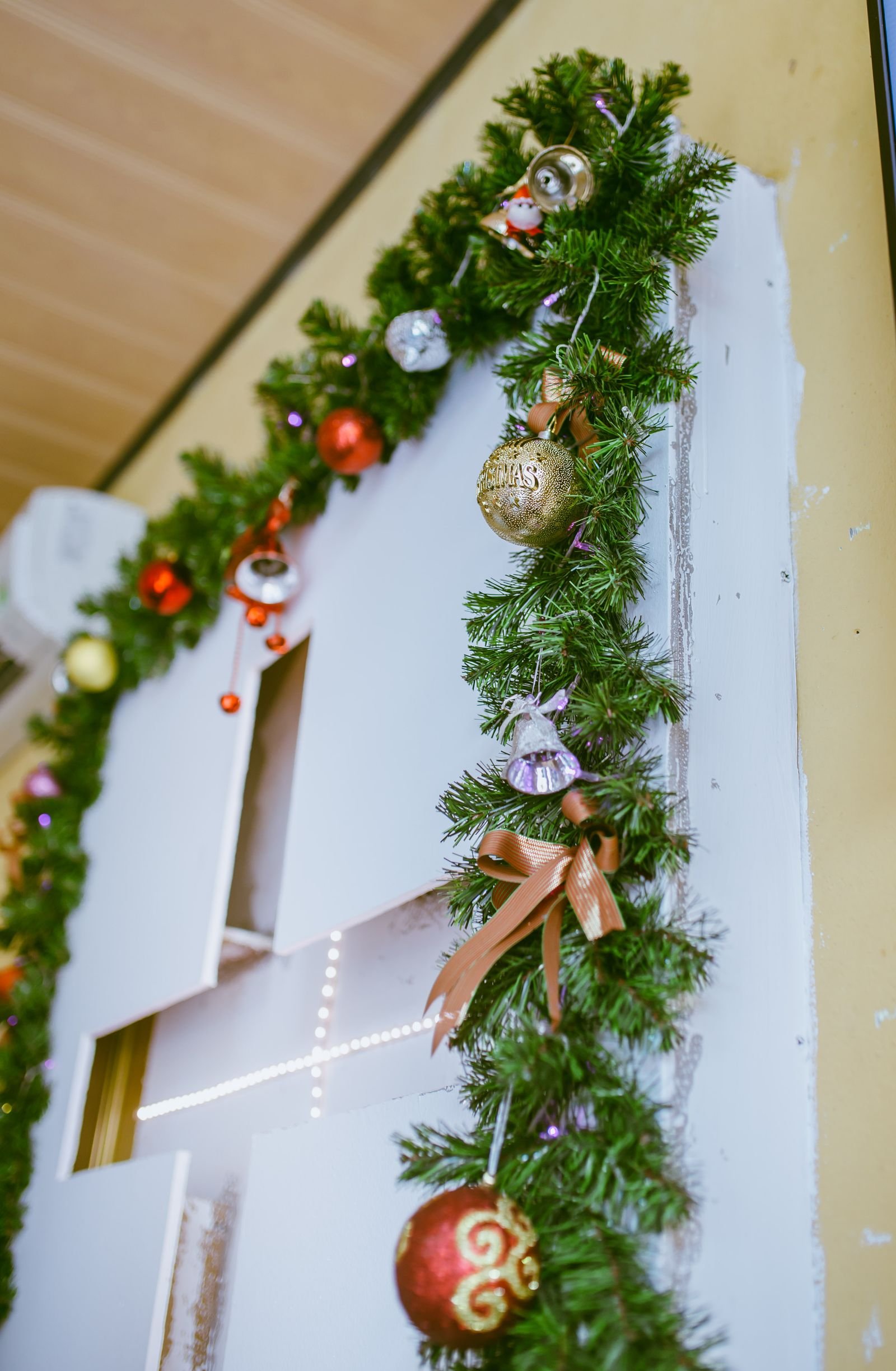
Use the lightest fixings of all: small clear removable hooks at the corners, or suction hooks on the glass itself. Keep the garland slim — a single strand — because a fat one swallows the frame. Dress it sparingly: the framed garland below carries baubles, bells and bows spaced wide apart, so the green still leads. A hallway mirror, the window over the kitchen sink: the spots guests mention, precisely because nobody expects greenery there.
6. The Dining Table: A Runner You Do Not Have to Iron
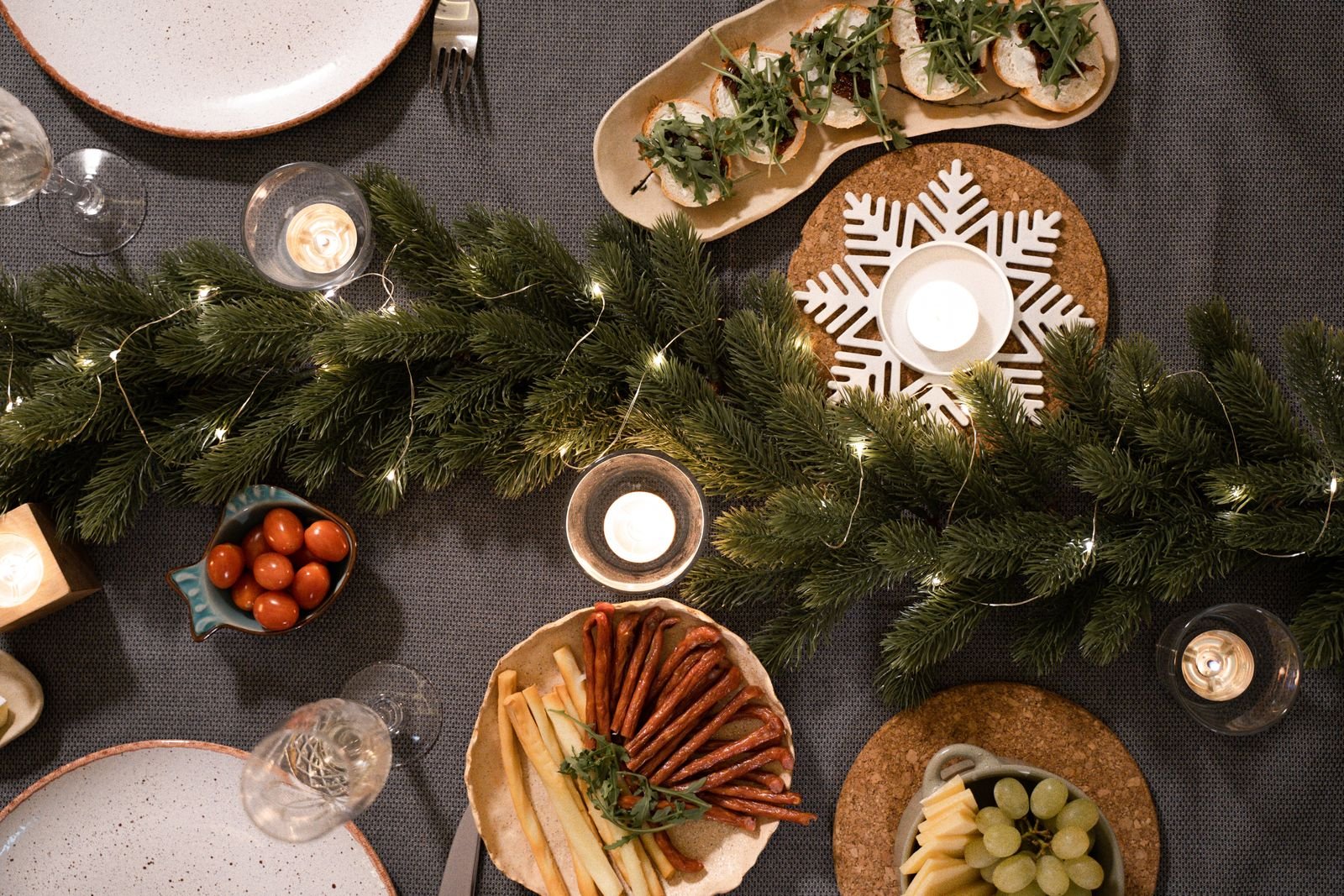
Laid flat down the table’s centre, a garland is runner, centrepiece and candlelight support in one. Use a slim strand or loose branches overlapping like roof tiles, keep it below seated eye level, and weave in fairy lights or tealights in glass holders — glass between flame and branch, always, or battery tealights and no worry at all.
The overhead view below shows why it works at a real dinner: garland through the middle, dishes around its edges, candles inside the greenery line, nothing too tall to talk across. Fresh greenery earns its place here — cedar under warm plates smells wonderful — but check for sap and needles before the food lands. Short table? Coil a short strand into a ring with a candle at its centre. Leave the ends trailing just over the edge: that overhang makes it look styled, not placed.
7. The Tree: Garland Goes On Second
On the tree, garland has an order: lights first, garland second, baubles third. Drape it in swags between branch layers, or spiral it loosely top to bottom, tucked just inside the branch tips so the tree keeps its shape. It should add a line the eye can follow, not a tangle.
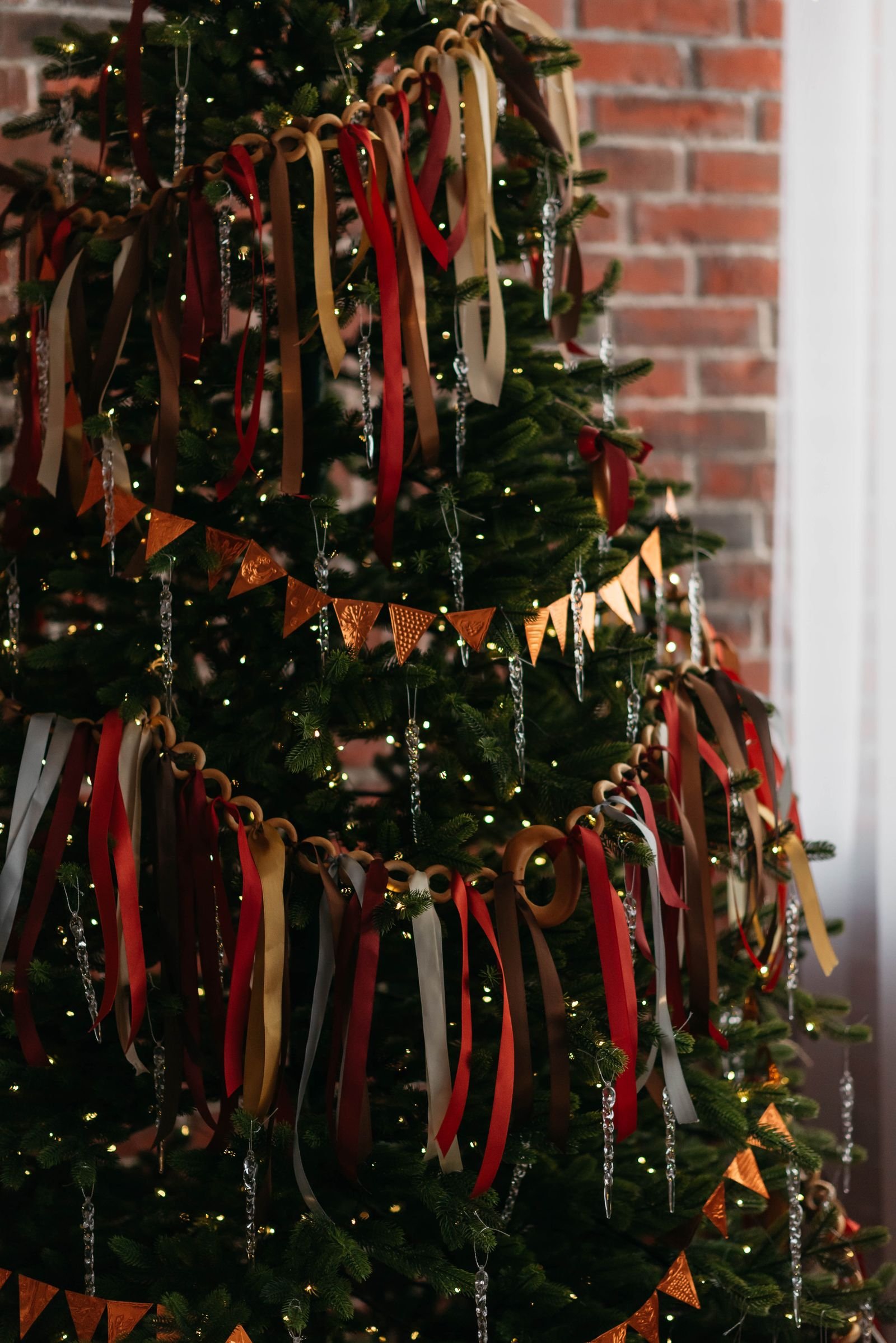
Length surprises people: a 6-foot tree takes roughly 18 to 27 feet of garland, so those three short strands in the box were never enough. The tree below takes the ribbon road — ribbons and copper flag bunting in clear horizontal bands, icicles hung after. Proof a tree garland need not be greenery: it has to be continuous, even and deliberate. Thin tree? Tuck it deeper for fullness. Full tree? Keep it near the surface.
8. DIY Dried Orange Garland (and Its Popcorn Partner)
Slice three or four oranges into rounds about a quarter-inch thick, blot them well, and dry them on a rack in a low oven — around 200°F / 95°C — for three to four hours, turning once, until dry, light and translucent in the centre. Thread them on twine with a large needle, spacing them with wooden beads, cinnamon sticks or bay leaves.
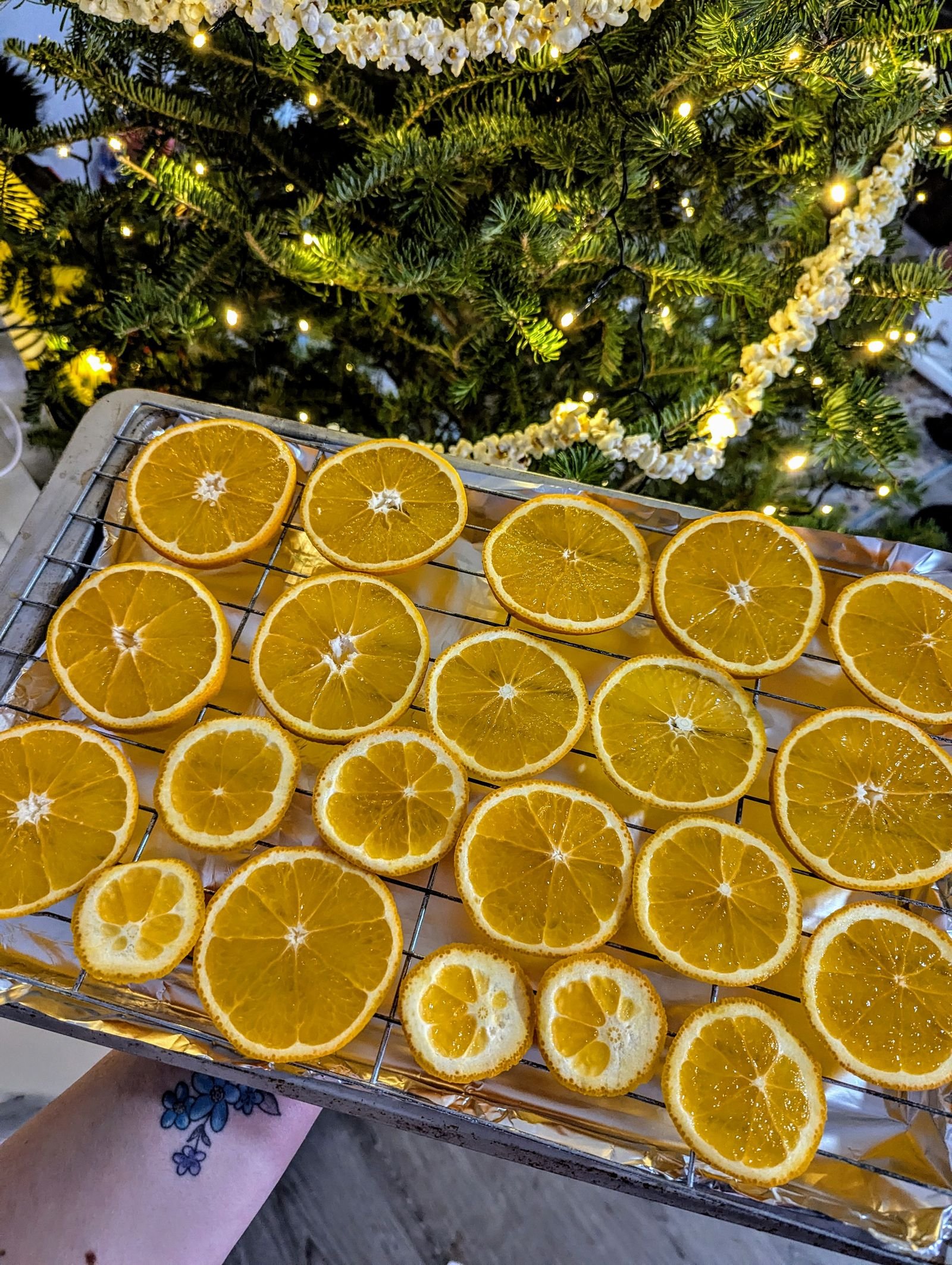
The tray below is mid-project: slices drying in front of a tree wearing the garland’s oldest partner, a popcorn strand — popped corn on strong thread, cranberries between for red. Orange slices dried properly store in a tin and return next year; popcorn is a one-season pleasure, best made with kids and hung where no dog can reach. Hang the orange strand across a window or along the door garland from Section 4, where light through the slices does something no shop-bought decoration can copy.
9. DIY Paper and Felt Garlands: The Snow-Day Strand
Paper and felt garlands are the lightest, cheapest and most forgiving of all — and the only kind a child can make start to finish. Cut one repeated shape — trees, stars, snowflakes, circles — from kraft paper, card or felt, and sew or glue the shapes along twine at even intervals. Felt needs no hemming and survives storage; paper is crisper and folds flat.
The strand below is the template worth copying: kraft trees and folded stars on twine, family photos pegged between the shapes, so the garland doubles as a card display. That double job is paper’s strength — it carries photos, cards and children’s drawings better than greenery can. Hang it where weight matters: a child’s bedroom wall, over a desk, along a headboard. Two small hooks is all it needs.

How Much Garland Do You Need? The Length Cheat-Sheet
| Surface | How to measure | Garland to buy | Fixing that leaves no damage |
|---|---|---|---|
| Mantel | Shelf length, plus drape at both ends | Shelf length × 1.5 (a 5 ft shelf needs about 9 ft) | Removable hooks, stocking holders |
| Staircase / banister | Banister length | Length × 1.5 for soft swags, × 2 for deep swags | Floral wire, ribbon, padded ties |
| Front door frame | Up, across and down (about 16–18 ft for a standard door) | One 18 ft strand, or two 9 ft joined | Outdoor removable hooks, masonry clips |
| Window or mirror | Around the frame | Frame perimeter, plus 1 ft spare | Small clear hooks, suction hooks on glass |
| Dining table runner | Table length | Table length, plus 1 ft overhang each end | None — it lies flat; glass holders for candles |
| Christmas tree | Tree height | About 3–4.5 ft of garland per foot of tree (18–27 ft for 6 ft) | None — tuck into branches |
Christmas Garland Questions
How long should a garland be for a mantel?
About one and a half times the shelf length. A standard 5-foot mantel needs roughly 9 feet of garland to swag in the middle and trail at both ends; two 6-foot strands joined with wire give you spare to double up the middle.
How do I hang a garland without nails or damage?
Removable adhesive hooks rated above the garland’s weight, hidden behind the greenery, handle mantels, mirrors and door frames. On a banister, use floral wire, ribbon or padded ties. On brick, masonry clips grip the mortar line. Everything comes off in January without a mark.
Is fresh or faux garland better?
Each wins somewhere. Fresh smells wonderful and looks softest, but lasts two to three weeks indoors and drops needles — best on the mantel and table, bought late. Faux costs more once and lasts for years — best on stairs, doors, windows and the tree.
Can I put a garland on a real Christmas tree and a faux one?
Yes — the method is identical. Lights first, garland second in swags or a loose spiral, baubles last. A 6-foot tree needs about 18 to 27 feet. Bead, ribbon, popcorn and greenery strands all work; keep the line continuous and even.
How do I store garland so it lasts?
Coil faux garland loosely — never crushed — into a large box or bag, decorations removed, somewhere cool and dry. Dried orange garlands store flat in a tin with paper between layers; fresh garland does not store, and goes to compost in January.
Buy the faux strand this week, order the fresh one a few days before you want it, and put one afternoon aside for oranges and twine. Three kinds of garland, six surfaces dressed — a house that looks finished from the front door to the far end of the table.