There is a particular morning, usually sometime in March, when I take the winter wreath down and the front door looks suddenly, accusingly bare. All winter that door had something to say. Now it just stands there in the pale light like it has forgotten how to be cheerful. That bare-door moment is exactly why I love spring wreath season — no other single change does so much, so fast, for so little money. You hang one circle of flowers and the whole house looks awake again.
If you are standing where I stood, holding the old one by its tired ribbon, our winter wreath ideas will keep it company in storage — but it has earned its rest. Below are the spring wreath ideas I actually rotate through, style by style, with the honest notes nobody puts on the product page: what each one costs, how long it lasts, which doors it flatters, and which ones quietly fall apart by May. This is a decorating guide, not a craft exam. Every style here can be bought ready-made or loosely assembled in an afternoon, and none of them requires a hot-glue-gun qualification.
First, Get the Size Right
Before any style talk: measure. A wreath that is too small looks like a postage stamp on an envelope, and one that is too big swallows the door and bangs against the glass every time it closes. I learned this with a magnificent 30-inch peony wreath on a narrow door — it was beautiful, and it shed petals into the hallway for a month.
- The two-thirds rule. A standard front door is 36 inches wide. A wreath of 22 to 26 inches — roughly two-thirds of the door’s width — looks generous without crowding. That is the size to buy if you only ever buy one.
- Slim doors and sidelights. On a 30 or 32-inch door, drop to 18 or 20 inches. The wreath should clear the door’s panels and never overlap the frame.
- Hang it at eye level, not door level. The center of the wreath should sit around 57 inches from the ground — roughly where a visitor’s eyes land. Most people hang theirs six inches too high, I promise you, and it changes everything when you fix it.
- Mind the storm door. If a glass storm door closes over your wreath, you have about two to three inches of clearance. Slim grapevine and hoop styles fit; fat floral wreaths get slowly flattened into pancakes. Ask me how I know.
Hang it on a proper over-door hook or a ribbon looped from the top of the door, never a nail through the face of the door itself. Your future self, filling that hole, thanks you.
The Full Tulip Wreath: Spring at Full Volume
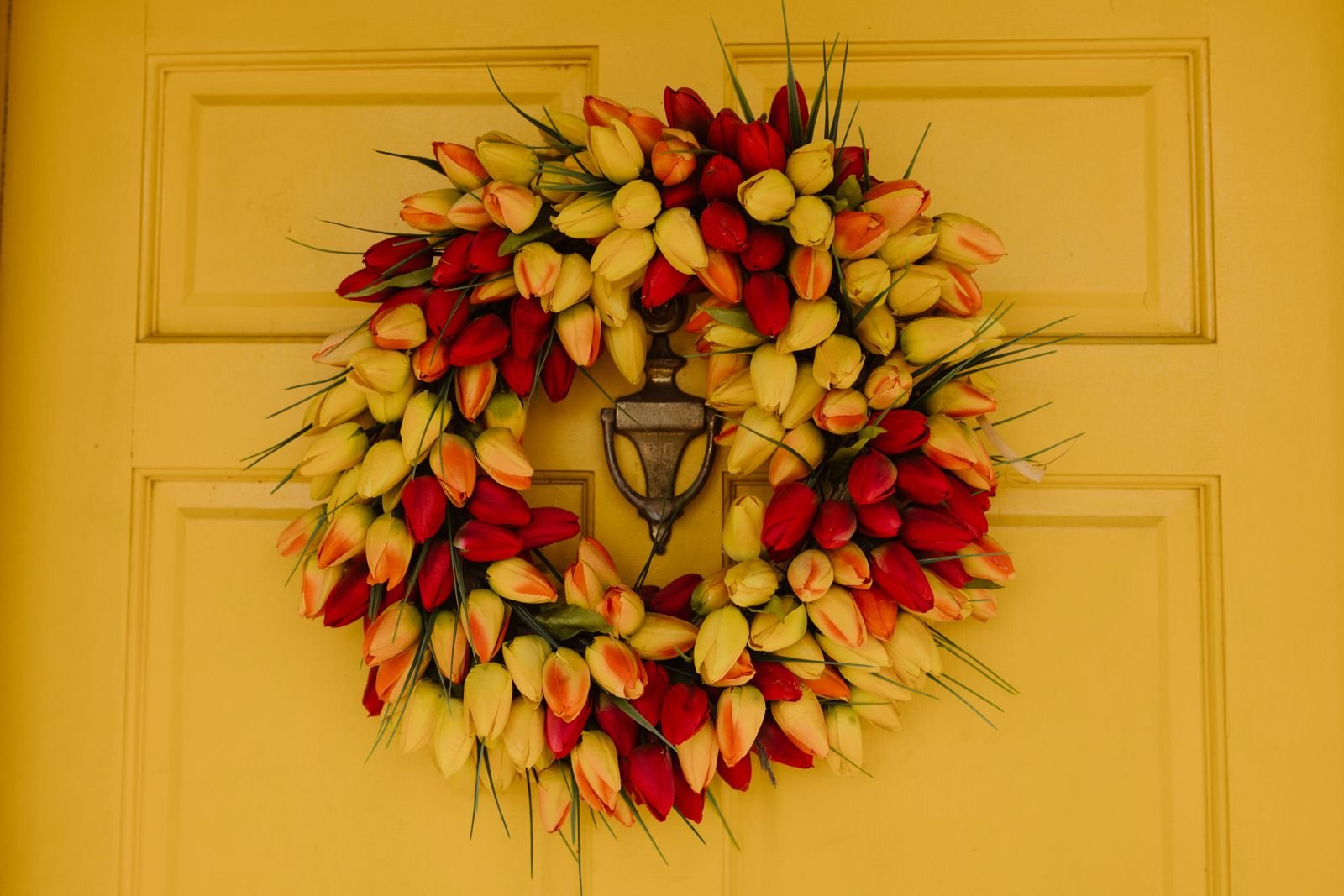
This is the extrovert. A full tulip wreath — dozens of blooms packed shoulder to shoulder around the whole ring — is the one that makes delivery drivers smile, and it is the wreath in the photo at the top of this article, red and yellow tulips against a yellow door, not holding back even slightly. If your house has a quiet street face and you want it to wake up, this is your style.
A few honest notes. Fresh tulips on a door last days, not weeks — tulips keep growing in the vase and they do the same, charmingly and then tragically, in a wreath. So for the door, this is the one style where I recommend good faux without a shred of guilt. The best silk tulips have slightly cupped petals and matte leaves; the worst are shiny and uniform, and you can spot them from the sidewalk. Expect to pay $45 to $80 for one that fools people, $25 for one that does not try to. One color family reads elegant — all cream, all blush. Two or three mixed colors read joyful. Both are correct; match your nerve.
The Eucalyptus Hoop: Calm, Green and Modern
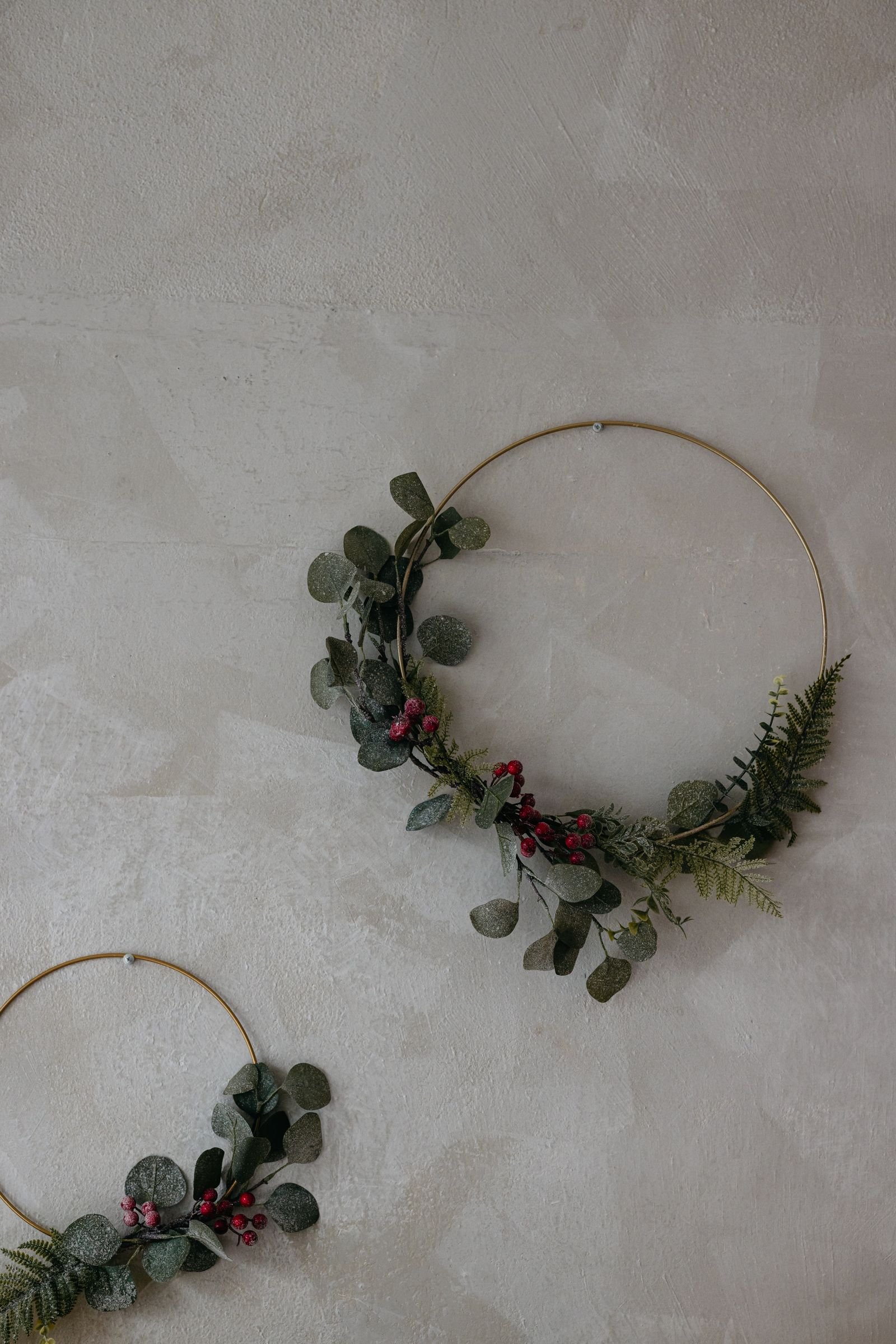
At the opposite end of the volume dial sits the greenery hoop: a slim brass or wooden ring, eucalyptus and fern gathered along the lower third, the rest of the circle left beautifully empty. It suits modern doors, black doors, and anyone whose decorating instinct whispers rather than shouts.
What I like most is the lifespan. Fresh eucalyptus dries in place and still looks intentional a month later, just softer and more silvery. Faux versions are nearly indistinguishable here because the leaves are matte by nature. A hoop is also the kindest style to a storm door — barely an inch deep — and the cheapest to make yourself: a $6 hoop, two stems, floral wire, ten minutes. If the full floral wreaths feel like a hat you would never wear, start here. You will not feel dressed up; you will feel finished.
Grapevine and Wildflowers: The Relaxed One
The grapevine wreath is the friend who never tries too hard. A twisted vine base, left partly bare, with wildflower-style blooms tucked in clusters — cornflowers, daisies, ranunculus, whatever looks like it was gathered rather than arranged. It is the most forgiving style to assemble yourself, because “slightly uneven” is the entire aesthetic.
Two tricks keep it looking gathered-not-messy. First, work in clusters of three to five blooms and leave real gaps of bare vine between them; the gaps are what make it read as wildflowers instead of a florist’s leftover bin. Second, keep the palette to what grows together in one field — yellows, whites and one blue, say — rather than the whole rainbow. Grapevine bases cost $8 to $15 and last for years, so this is also the style to redecorate seasonally: spring wildflowers now, sunflowers in August, dried grasses in October, same base.
Lemon and Citrus: Pure Cheerfulness
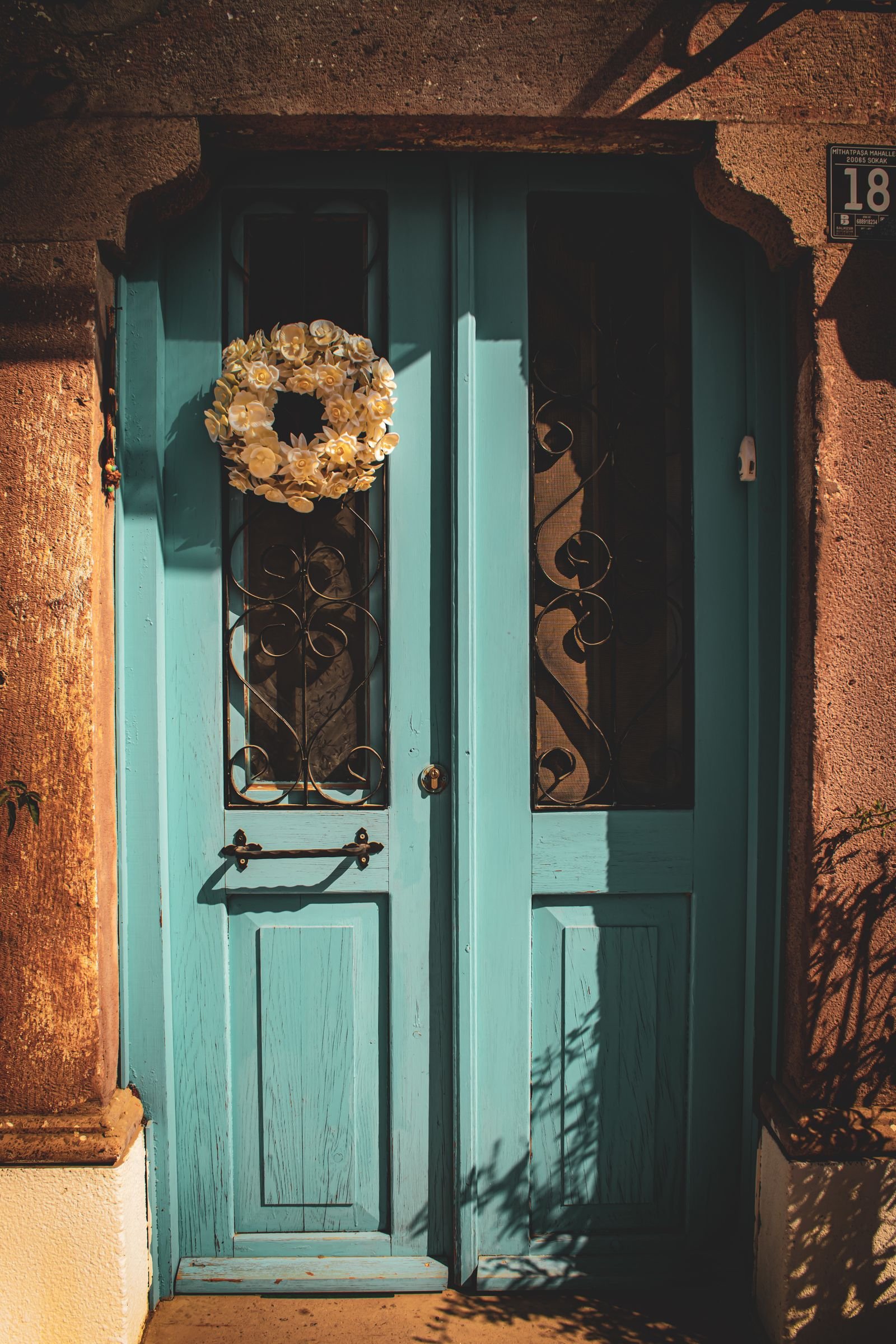
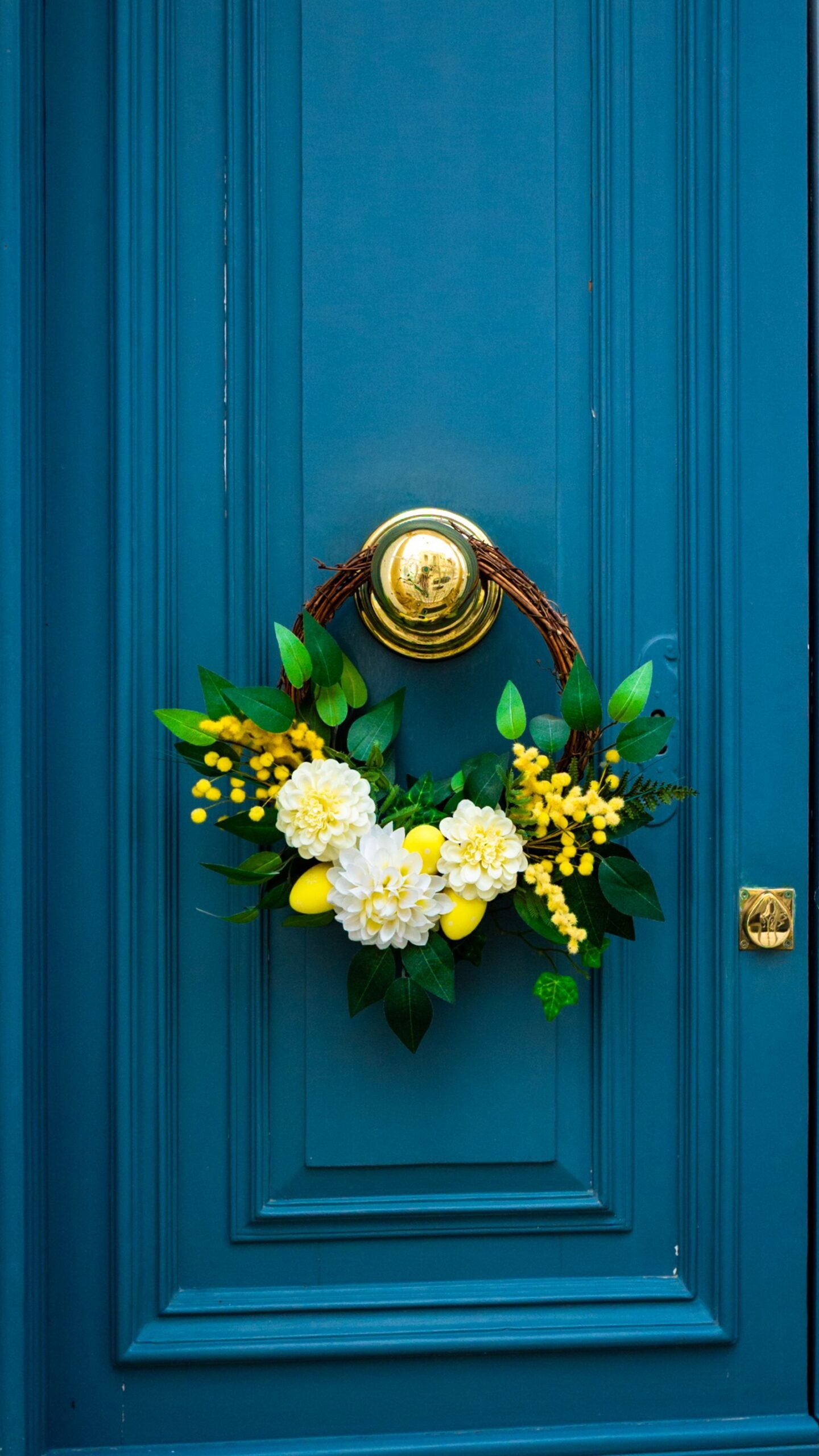
A lemon wreath should not work as well as it does. Faux lemons, glossy green leaves, maybe a few white blossoms — on paper it sounds like a kitchen theme gone rogue. On a navy, black or deep green door it is electric: the yellow does what yellow always does and makes the whole entrance look sunnier than the weather deserves. It is also the longest-lasting of the bright styles, because lemons do not wilt, fade as fast as petals, or mind a rain shower.
Keep it dense — a sparse lemon wreath reads as a garnish — and if you make one, cluster the fruit in twos and threes low on the ring, the way lemons actually hang. Real lemons, by the way, are heavier than you think and bruise the door side first; this is a faux-only style in my house. Budget $35 to $60 ready-made, and expect it to be the wreath neighbors ask about. Ours has been stopped-for twice.
The Dried-Flower Wreath: The One That Lasts
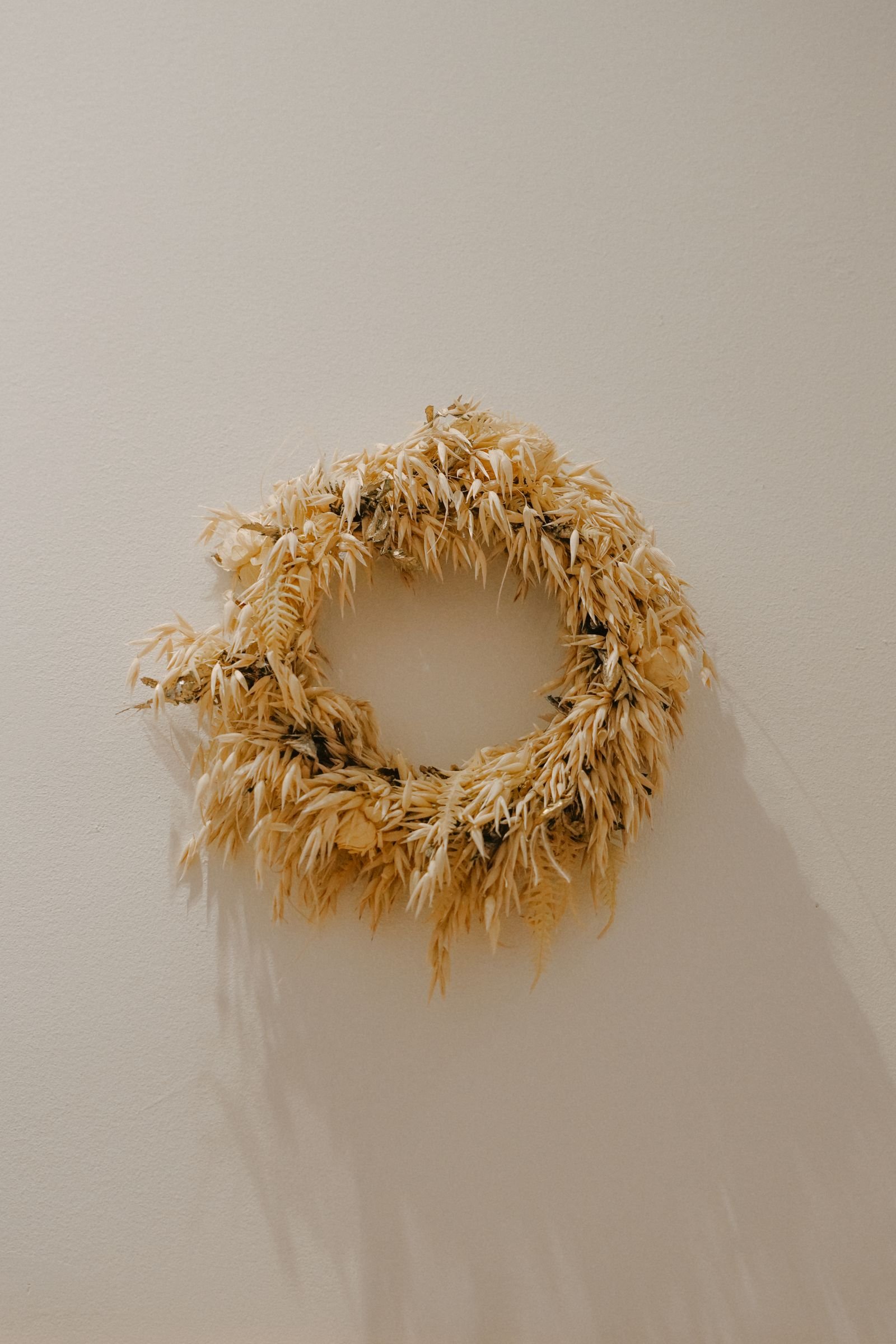
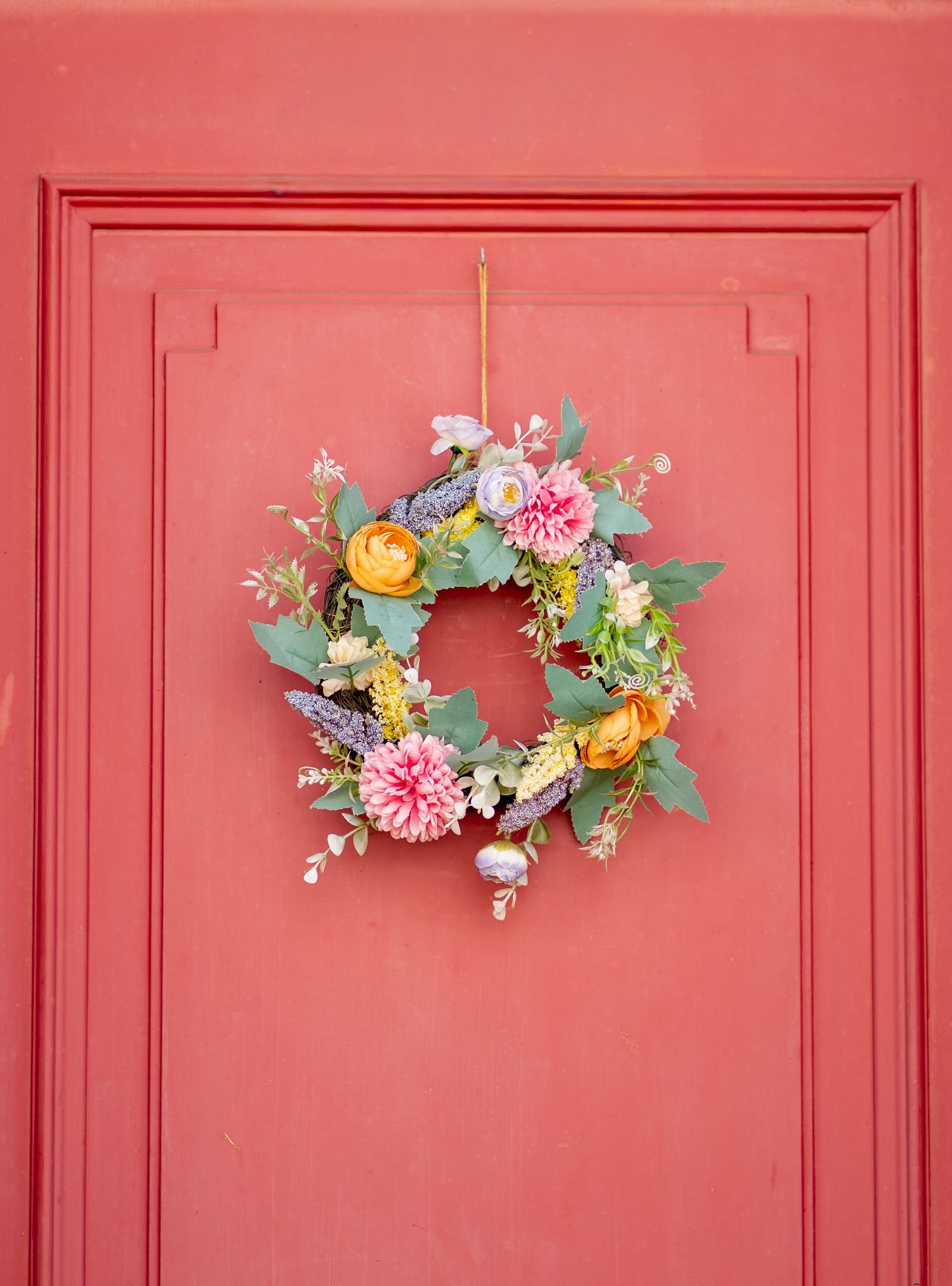
Every other style on this list is a season. The dried-flower wreath is a commitment — strawflowers, bunny tails, dried eucalyptus, statice and grasses, in those soft sun-bleached tones, and it will look essentially the same in October as it does in April. If you buy one good wreath this year and want it to earn its money, this is the one.
The caveats are real, though. Dried flowers are brittle — hang it where it will not be brushed by shoulders and bags, and bring it in ahead of genuinely wild weather, because wind does to dried grasses what it does to umbrellas. Sun fades it slowly, which many of us count as a feature. And keep it for a covered porch or indoors: a week of direct rain will turn it to porridge. Prices run $40 to $90, more than faux florals, but cost-per-month it beats everything else here by a mile.

Foraged Branches: The Almost-Free Wreath
The most compliments I have ever received on a wreath were for one that cost me a walk. Forsythia, pussy willow, flowering quince, cherry or crabapple branches — cut a few days before they fully open, wired loosely onto a grapevine base or bent into a rough circle of their own. The buds finish opening on the door, which means the wreath literally improves for its first week.
Honesty corner: it lasts one to two weeks at its best, the branches drip sap if you cut them too sappy, and you should only ever cut from your own garden or with cheerful permission — never from a neighbor’s hedge at dawn, however perfect it looks. But as a first wreath of the season, while you decide on the keeper, nothing beats free. Feathery plumes and soft catkins give you that loose, gathered look that costs a fortune ready-made.
Not a Wreath Person? Hang a Basket Instead
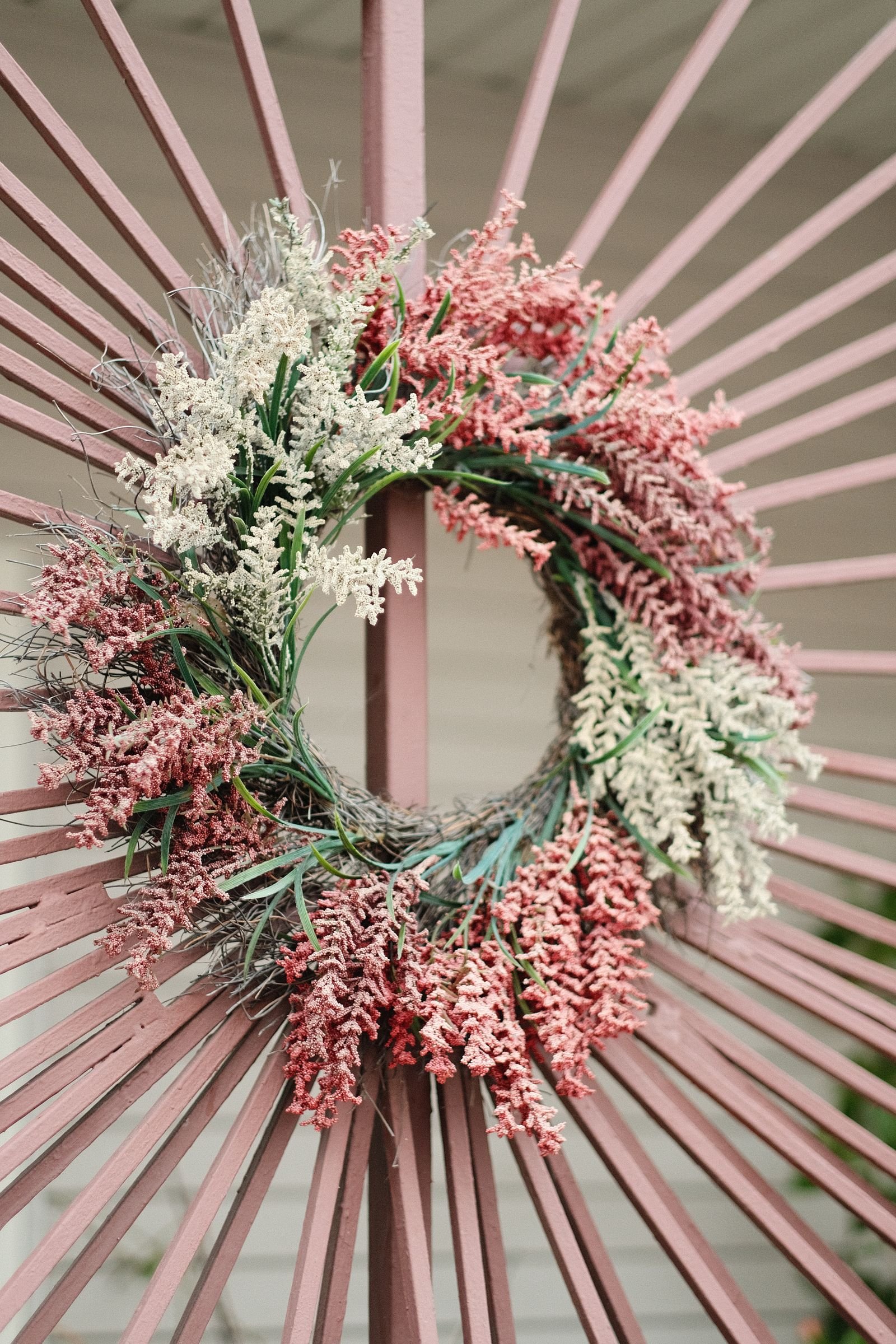
Some doors fight a wreath — narrow doors, doors with big glass panels, doors where a circle just looks like a porthole. For those, hang a flat-backed basket or an old umbrella stand’s prettier cousin: a door basket filled with stems. Forsythia and faux tulips in a wicker basket on the handle is the spring version I keep coming back to; the flowers spill instead of sitting in formation, and you can swap the contents in ninety seconds without touching a hook.
Baskets also solve the storm-door problem differently — a shallow basket fits where a fat wreath cannot — and they are the easiest style to make from things already in the house. If the rest of the porch needs to catch up with your newly dressed door, our spring front porch decor ideas cover the pots, mats and layers that finish the picture.
Fresh or Faux? The Honest Answer
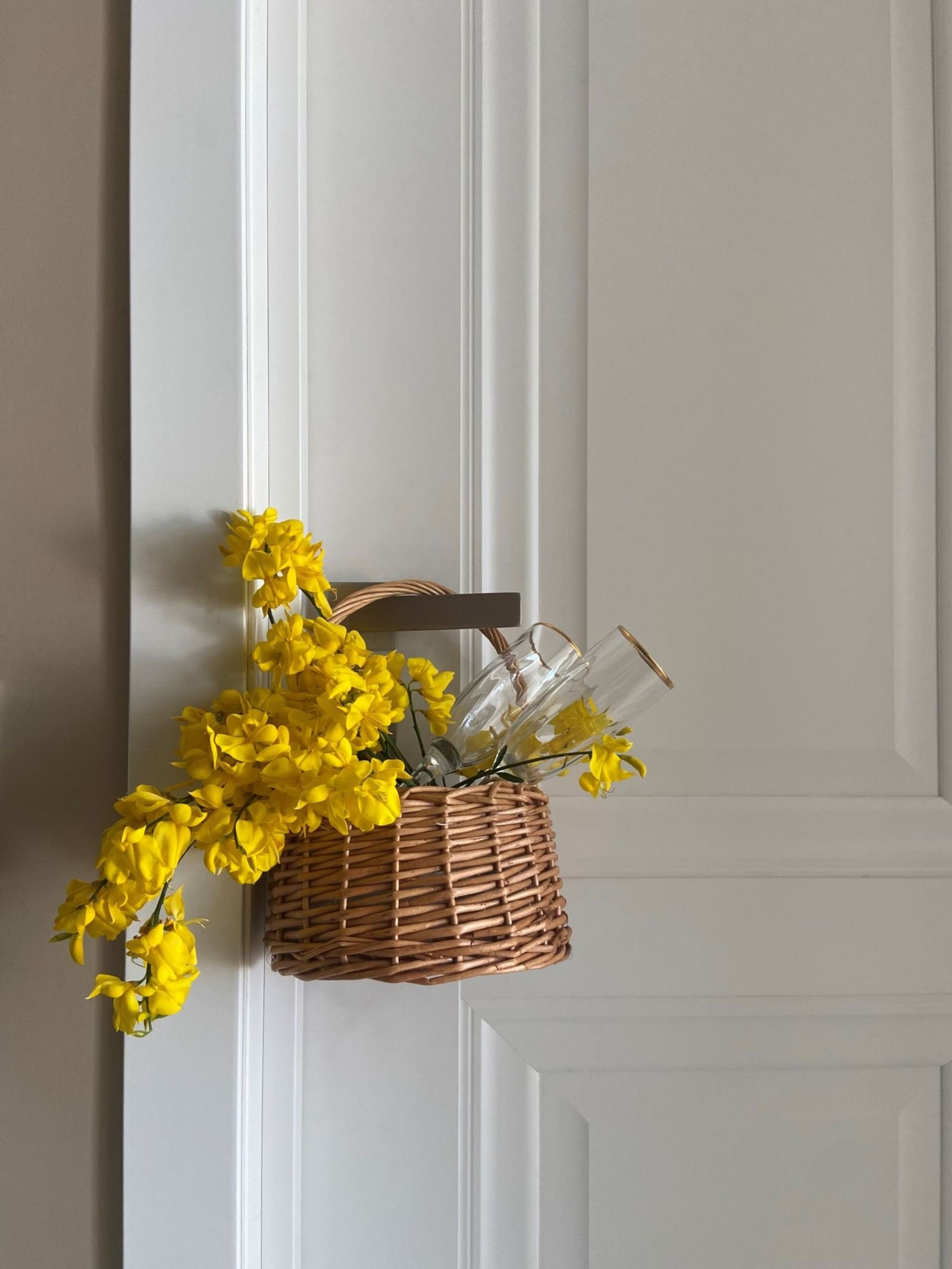
People ask this like there is a correct answer, and there is — it just depends on the flower. Fresh is unbeatable for a party weekend or a photo, and hopeless for a month on a door. My working rules:
- Go faux for tulips, lemons and anything on an exposed door. Good modern fakes are genuinely hard to spot at door distance, and they survive the season.
- Go fresh or dried for greenery. Eucalyptus, olive and ruscus dry gracefully; their plastic versions are the ones that give faux a bad name.
- Mix without shame. A faux floral base with a few real branches tucked in on the day guests come is the oldest stylist’s trick in the book, and it works every time.
Covered Porch or Exposed Door? Weatherproofing That Matters
A covered porch forgives almost everything — fresh, dried, delicate, all fine. An exposed door is a weather station. If your door takes direct rain and afternoon sun, choose UV-stable faux or sturdy greenery, skip dried flowers entirely, and check that the wreath’s backing is wire or grapevine rather than foam, which drinks water and gets heavy enough to slip its hook. A clear matte UV spray, two light coats before hanging, genuinely extends the life of faux blooms — $9 a can, one can lasts years. And whatever the style, take it down before a named storm. Wreaths have flown further than you would believe.
When Spring Moves On: Second Lives Indoors
The saddest thing in seasonal decorating is a good wreath in a bin. When summer arrives, give yours a second life inside before you store it. A greenery hoop over the mantel, a dried wreath on a hallway mirror, the tulip wreath on the inside of the front door where you get to enjoy it — indoor light is gentle, so pieces last another whole season this way. Our spring mantel decor ideas pair beautifully with a hoop or dried wreath moved in from the cold.
Store what is left flat, in a wreath box or a clean bin bag, out of the attic heat if you can. Then, come next March, you will open it to a door that is ready to look awake again — and a house that never really looked asleep at all.