
What a Bow Actually Does to a Wreath
A wreath without a bow is a circle of greenery; with the right bow, it is a welcome. The bow behaves like jewelry: it gives the eye a place to land, sets the color story, and tells everyone at the door whether this house is formal, relaxed, rustic or quietly expensive. Everything else — pinecones, berries, lights — is texture. The bow is the decision.
That is also why a bow is the cheapest way to change a wreath you already own: red velvet this year, plaid next year, a soft cream sash the year after. The greenery stays; the personality swaps in ten minutes. This guide is only about that decision. For the wreath itself — base, size, hanging — our Christmas wreath ideas cover the whole circle.
One rule runs through all nine ways: the bow should be about a third as wide as the wreath — roughly eight inches on a standard 24-inch wreath, tails a third of its height. Buy wired ribbon — it keeps loops open for six weeks — in 2.5 inches for most wreaths, 4 inches for a statement.
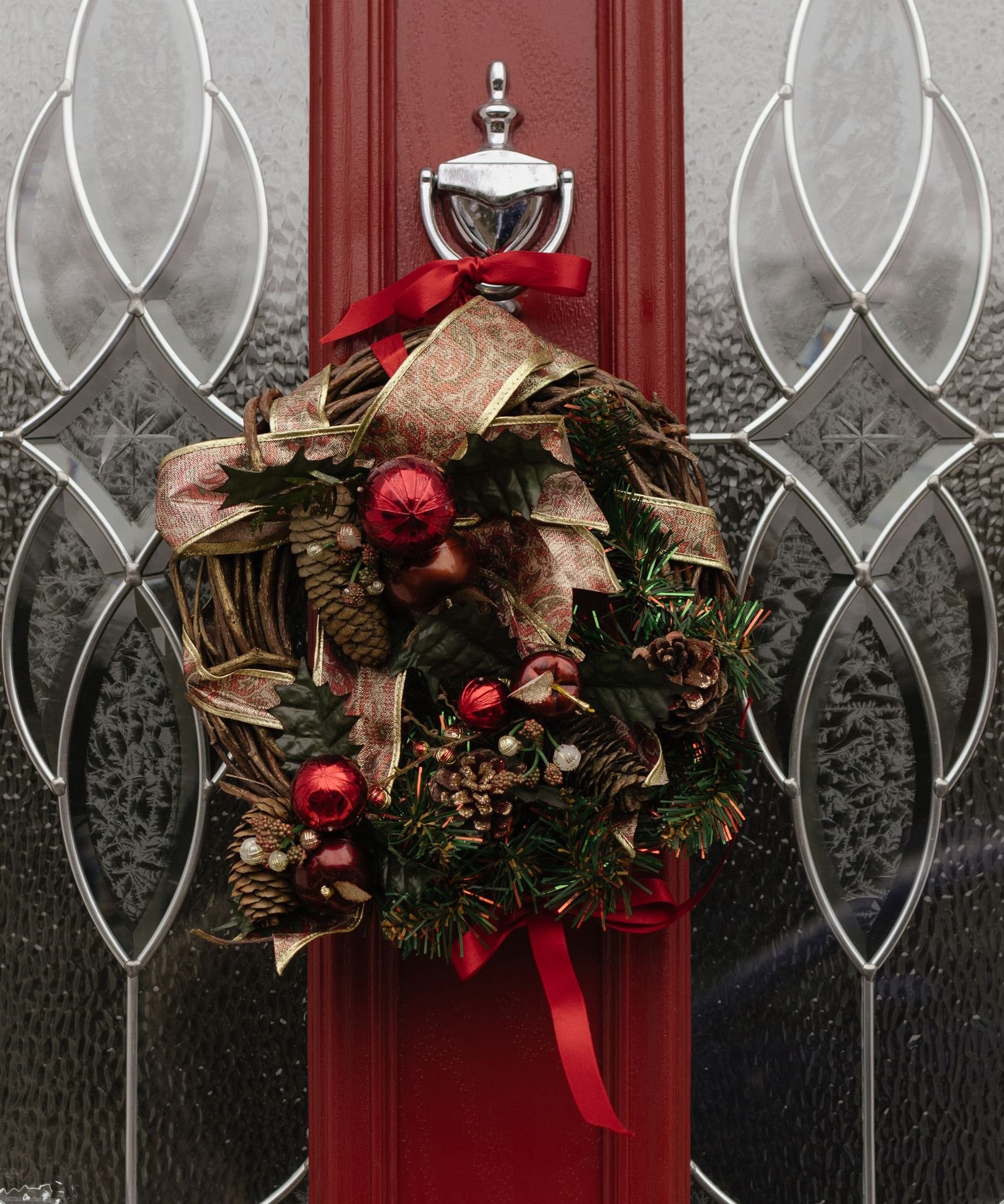
1. The Classic Red Bow, Right at the Top
Start with the bow that has never dated: one full red bow at the top, two tails falling straight down the front. It works on every door color, because it never tries to be clever. Below: a plain evergreen wreath, two pinecones, one red bow against a weathered wooden wall.
Make the loops generous, four to five inches each, tails reaching the middle of the wreath, ends cut at a sharp diagonal. Short tails read like a gift tag; long tails read like a decoration. Use satin or grosgrain rather than velvet: the slight sheen catches winter light. Wire the bow through the frame, not just the foliage, so wind cannot spin it sideways.

2. One Oversized Velvet Bow
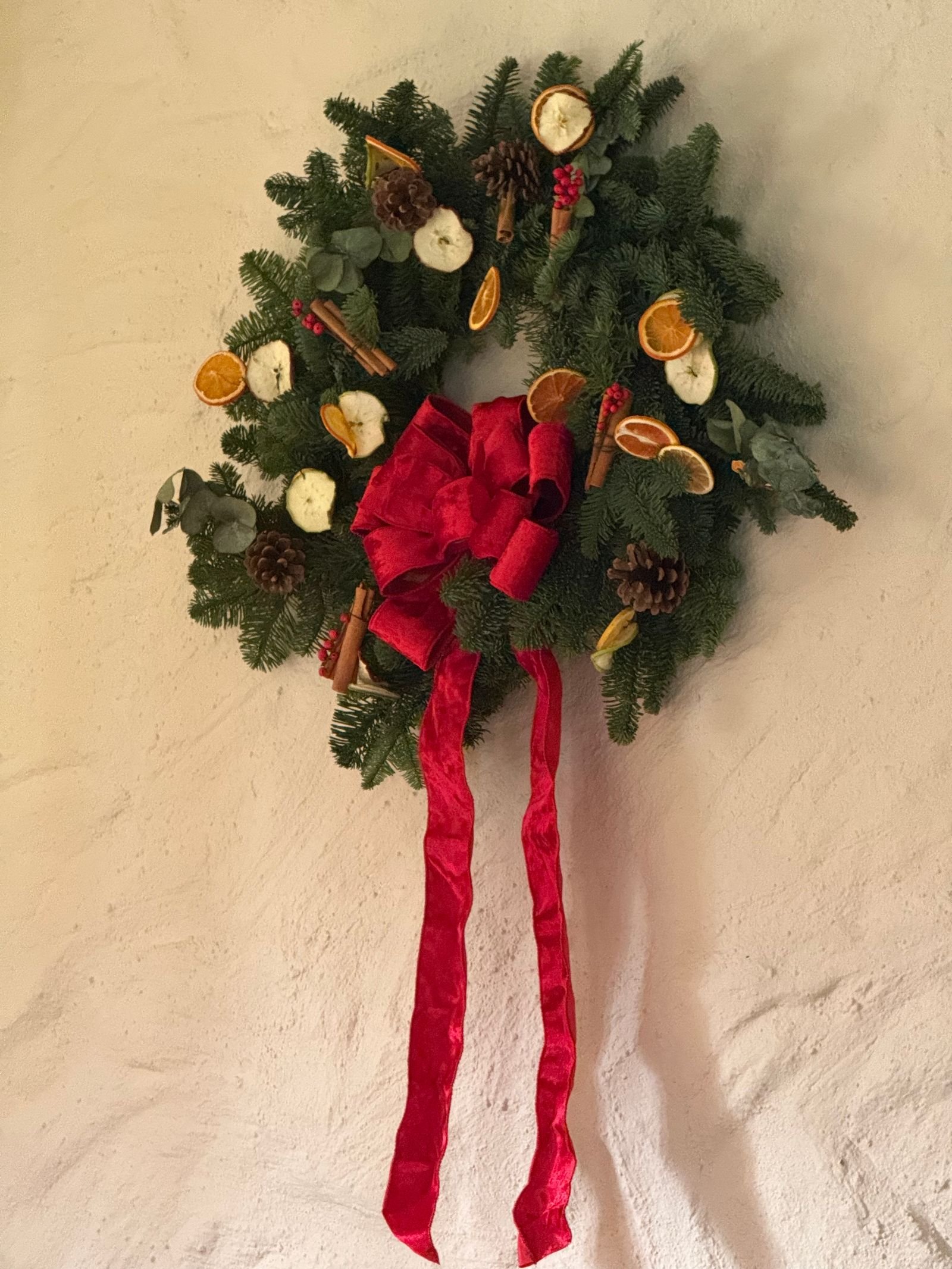
If the classic bow is a sentence, the oversized velvet bow is the whole paragraph: one enormous burgundy or deep red velvet bow, loops as wide as your hand, tails falling nearly to the bottom of the wreath, on otherwise plain greenery. Velvet does the work — it drinks light instead of reflecting it, so the bow reads rich and soft from the street. The wreath below carries gold and silver baubles, dried oranges and red berries, but the eye goes straight to the velvet.
Go wide: 4-inch wired, double-faced velvet, three to four yards. Build the bow in your hand, loop by loop, pinch the center and secure it with floral wire — never tie it directly onto the wreath. Place it low and off-center for a relaxed look, or dead center at the bottom for a formal one. Steam the tails once so they hang straight. Stored flat in tissue, a velvet bow serves five Christmases.

3. Long Tails That Turn a Bow Into a Sash
Sometimes the bow is not the star — the tails are. Here the loops stay modest and the two tails run long, sometimes a full wreath-length down the door. It is the most romantic of the nine, and it suits a tall front door. The wreath below shows it: a full red velvet bow, tails falling well past the greenery over dried oranges and pinecones.
Cut the tails last, after the bow is wired and hanging — gravity shows the true length. Finish the ends in a dovetail V so they look tailored instead of snipped. For a sash look, use the same ribbon for the hanger: one length looped over the door and tied into the bow at the front. Keep the rest of the wreath calm — long tails plus busy ornaments is a crowd.
4. Plaid, for the Cabin-Collected Look
Plaid is the bow for a house that feels gathered rather than decorated. A red-and-green tartan or a black-and-white buffalo check brings instant warmth and a hint of the cabin, the farmhouse, the Christmas morning that smells like pine. It is also the most forgiving pattern: the check hides imperfect loops. The wreath below pairs a plaid bow with cotton bolls, a frosted pinecone, dried orange and fairy lights.
Plaid works best when the rest of the wreath stays natural: plain greenery, pinecones, cotton or dried fruit. If the wreath already has red baubles and gold ornaments, a plaid bow will fight them; if it has berries and cones, the plaid finishes the story. Choose woven ribbon rather than printed, and match the plaid’s scale to the wreath: a big check on a 24-inch wreath, a small gingham on a mini.

5. Match the Bow to the Greenery
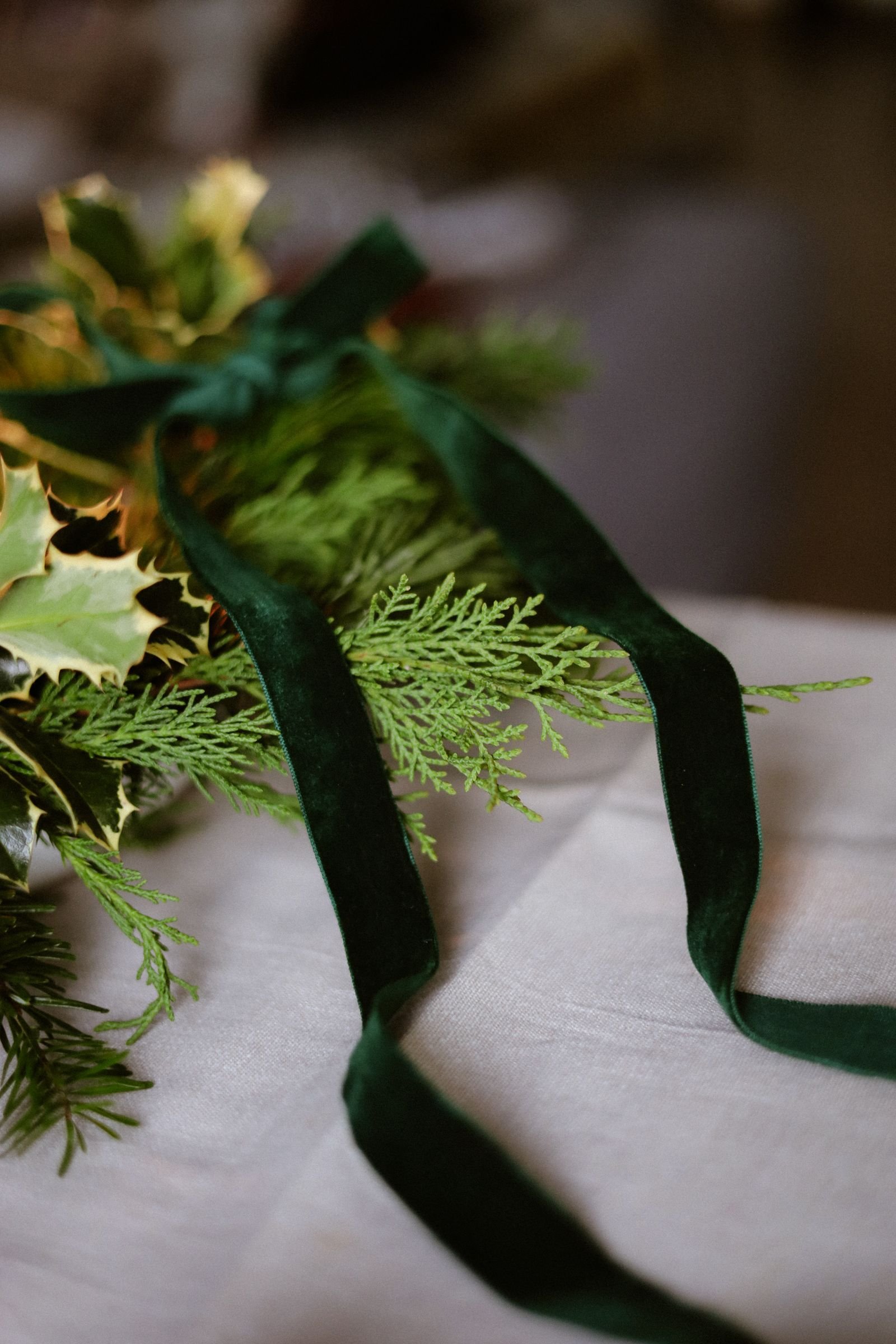
The boldest bow is not always the brightest one. This way goes the other direction: a bow in the same color family as the wreath itself — deep green velvet on deep green fir, or sage ribbon on eucalyptus — so the bow reads as texture rather than contrast. The result is quiet, expensive-looking, and modern. Below, a dark green velvet ribbon is tied loosely over holly and cedar, nearly disappearing until the light catches the velvet.
Tone-on-tone only works when the ribbon’s texture differs from the foliage: velvet against fir, satin against cedar, linen against boxwood. Keep the bow smaller here than you would in red — an oversized tone-matched bow looks like a mistake, while a neat one looks deliberate. This is also the best bow when the rest of the decor is already colorful: when the tree and mantel are shouting, the wreath can whisper.
6. Double Up: Two Bows, One Wreath — or a Matching Pair
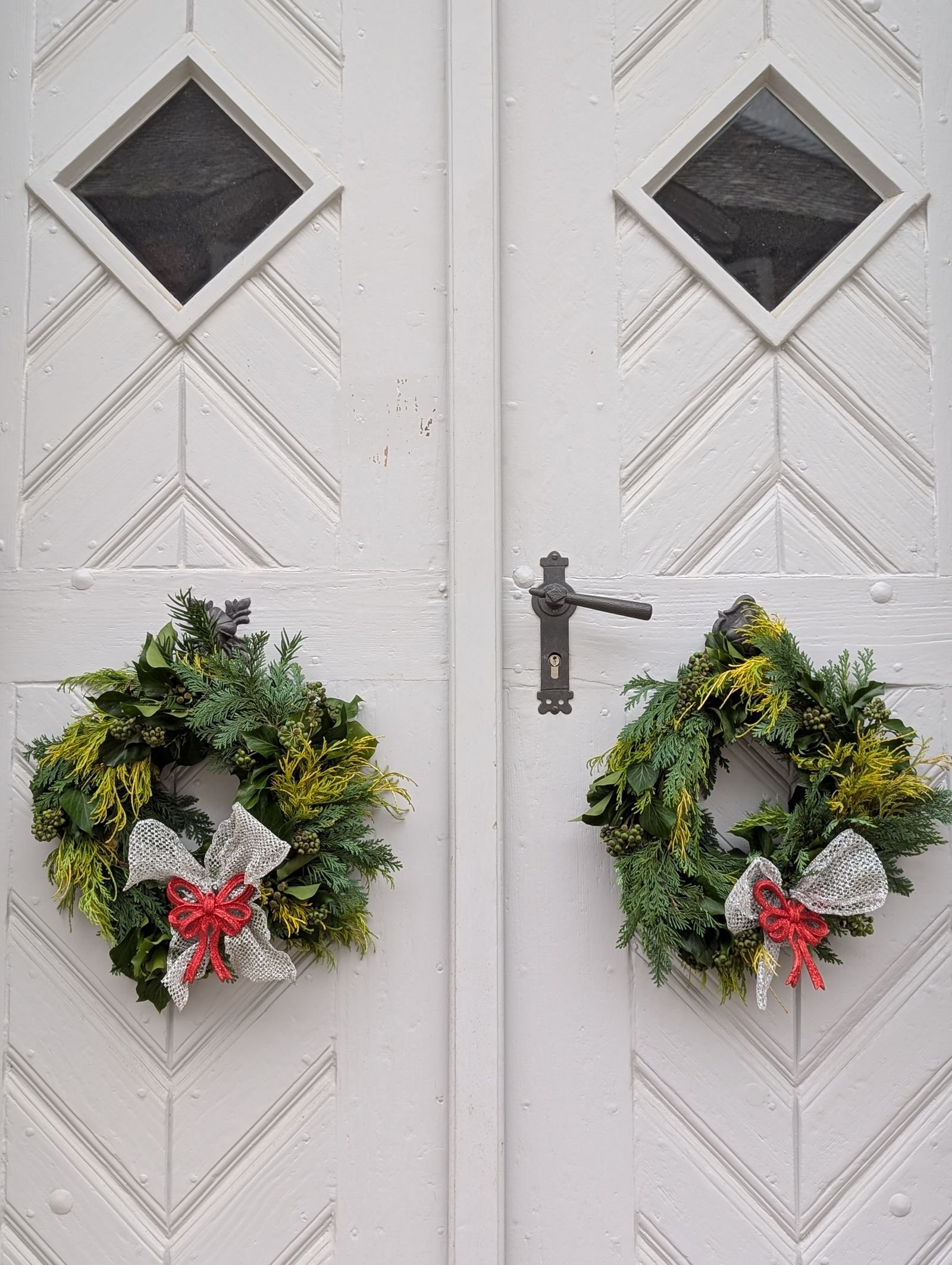
Two bows change the geometry of a wreath entirely. Layer a small bow on top of a large one — a narrow red bow centered on a wide silver mesh bow — and the wreath gains depth it never had. Or hang two matching wreaths on a double door, and the entrance suddenly looks designed. The white double doors below show it: two fresh green wreaths, each with a layered silver bow and a small red bow at its center.
Layering works when the two ribbons differ in at least two ways — width, texture or color. If they are too similar, the layer just looks like one messy bow. For a matching pair, the discipline is sameness: same size, same bow, same height, same tails. Measure from the floor on both doors, and buy both spools at once — dye lots vary, and two “identical” reds bought a month apart often are not.
7. Scatter Small Bows Instead of One Big One
Who says a wreath gets one bow? This way skips the single statement and tucks five or six small bows around the circle, like punctuation marks. It is the lightest, most playful of the nine, and it suits a window wreath better than a formal front door. The arched window below is the idea at full scale: greenery framing the stone arch, small red bows scattered.
Keep the small bows identical — same ribbon, same size, same knot — and space them unevenly, heavier at the bottom third where the eye lands. Three bows clustered close read as a mistake; five spread around the clock read as a pattern. It is the best way to use up ribbon scraps — each bow needs only about eighteen inches — and small bows tuck between baubles where a big bow would cover them. For windows, tie the bows a little tighter — glass reflects.

8. Tie It Yourself: The Bow That Holds Its Shape
Every bow here can be bought ready-made, and every one looks better tied by hand. A hand-tied bow has uneven loops in the right way — one loop a fraction fuller, the tails at slightly different lengths — and that imperfection is what makes it look real. Below: a glittery red bow, loops open and even, tails cut in a clean V, sitting on fresh evergreen like it grew there.
Cut three to four yards of 2.5-inch wired ribbon. Leave a twelve-inch tail, make a four-inch loop, pinch it at the center, and fold the ribbon back for the second loop, then a third and fourth, twisting at the center each time so the right side always faces out. Secure the pinched center with floral wire, not a knot — wire holds, a knot slips. Then fluff the loops, shape the tails, trim the ends at 45 degrees, and push the wire ends through the wreath to twist tight around the frame at the back. Fifteen minutes, once you have done it twice.

9. Dress the Outdoor Wreath for Real Weather
An outdoor wreath lives in wind, rain and snow, and its bow has to survive all three. This last way is about choosing for weather first. Velvet holds up beautifully in cold and snow, as the wreath below proves: real snow on a big red bow, tails still hanging straight. Satin goes limp when wet; thin grosgrain frays after a week of wind.
For an uncovered door, use wired velvet or a heavy outdoor ribbon, and wire the bow to the frame in two places, not one — a single wire lets the bow spin in a gust; two wires hold it square. Tuck the tails clear of the door handle’s swing. After the first storm, brush snow off the loops rather than shaking the wreath, which loosens the wire. A bow that survives December outdoors will look just as good indoors next year.

Three Bow Mistakes to Avoid
- Too small, too high, too tight. A bow under a quarter of the wreath’s width disappears from the street, one wired only into foliage spins in the wind, and one tied drum-tight looks like a parcel. Go a third wide, wire to the frame, keep the loops loose.
- Two patterns fighting. Plaid bow plus patterned hanger plus checked door mat is a shouting match. One pattern per entrance.
- Buying the bow before the wreath. The wreath’s fullness, color and size decide the bow. Hang the bare wreath, look at it from the street, then choose the bow.
The Ribbon to Buy First
If you are buying one spool this year, make it 2.5-inch wired velvet in deep red or burgundy, four yards. It ties all four bows in this guide. The second spool is a plaid in your house’s colors; the third, a 1.5-inch gold or cream ribbon. Three spools, under thirty dollars, dress every wreath you own.
Christmas Wreath Bow Questions
What size bow should I put on a Christmas wreath?
About a third as wide as the wreath — roughly eight inches on a standard 24-inch wreath — with tails a third of its height.
What is the best ribbon for a wreath bow?
Wired ribbon — the wire keeps loops open all season. Velvet is the richest and the best outdoors; satin suits a classic look; plaid hides imperfect tying.
Where should the bow go on a wreath?
At the bottom center for the classic look, at the top for a formal welcome, or low and off-center for a relaxed feel — wherever the eye lands first.
How do I attach a bow to a wreath so it stays put?
Push the wire ends through the wreath and twist them tight around the frame at the back — in two places outdoors. Never rely on glue or on tucking the bow into the foliage.
Can I reuse the same bow next year?
Yes — store it flat in tissue paper, tails straight, where nothing sits on top. A good velvet bow lasts five seasons.
A wreath is a circle, with no beginning and no end — which is why the bow matters so much. It is the one place where the circle stops and says something. Choose the bow that sounds like your house, wire it on properly, and the wreath you own will look brand-new. For the full entryway — planters, lanterns, mat — our Christmas entryway decor ideas finish the welcome, and the Christmas mantel decor ideas carry the same ribbon story inside.