
Pink at Christmas makes some people nervous, and honestly, that is fair. Done badly, it turns a living room into a birthday party. Done well, it is the softest version of Christmas there is: blush instead of scarlet, rose gold instead of brass. Pink sits right next to red on the color wheel, so it belongs to the holiday family — it just speaks more quietly.
The secret is that pink works hardest when it is not the whole room. Give it one tree, one table, one corner of the bedroom, and let the rest of the house stay neutral — with the shades and finishes that keep pink elegant instead of sugary.
1. Pick Your Pink First
Before you buy or unpack a single ornament, choose one pink and commit to it. Pink is a whole family, and mixing the whole family is what makes a room look confused. Blush is the palest, almost a neutral — the safest choice in a bright room. Dusty rose is blush with the brightness turned down, grown-up and cozy against cream and warm wood. Raspberry and deep rose are the rich end, closer to burgundy, and they carry an evening room the way red does.
Pick one main pink, one partner color, and one metal, then repeat only those three through the whole house. Blush with cream and rose gold is the classic soft combination; dusty rose with deep green and antique gold feels richer; raspberry with burgundy and brass is the moody version. The photograph below is the palette test in one basket: pink and white baubles, a few deep rose glitter balls, pinecones for texture. Mind the finish too: matte, satin and pearl keep pink elegant, while glitter and high gloss tip it into tacky.

2. The Blush Tree: Pink and Gold Done Softly
The tree is where pink either earns its place or loses it, and the difference is restraint. Start with warm white lights — always warm white, because cool light turns blush a cold lilac-grey, while warm light keeps it soft and glowing. Then hang your ornaments in three finishes of the same pink family: matte blush balls deep inside the branches, satin rose ones midway out, and one shiny metallic near the tips.
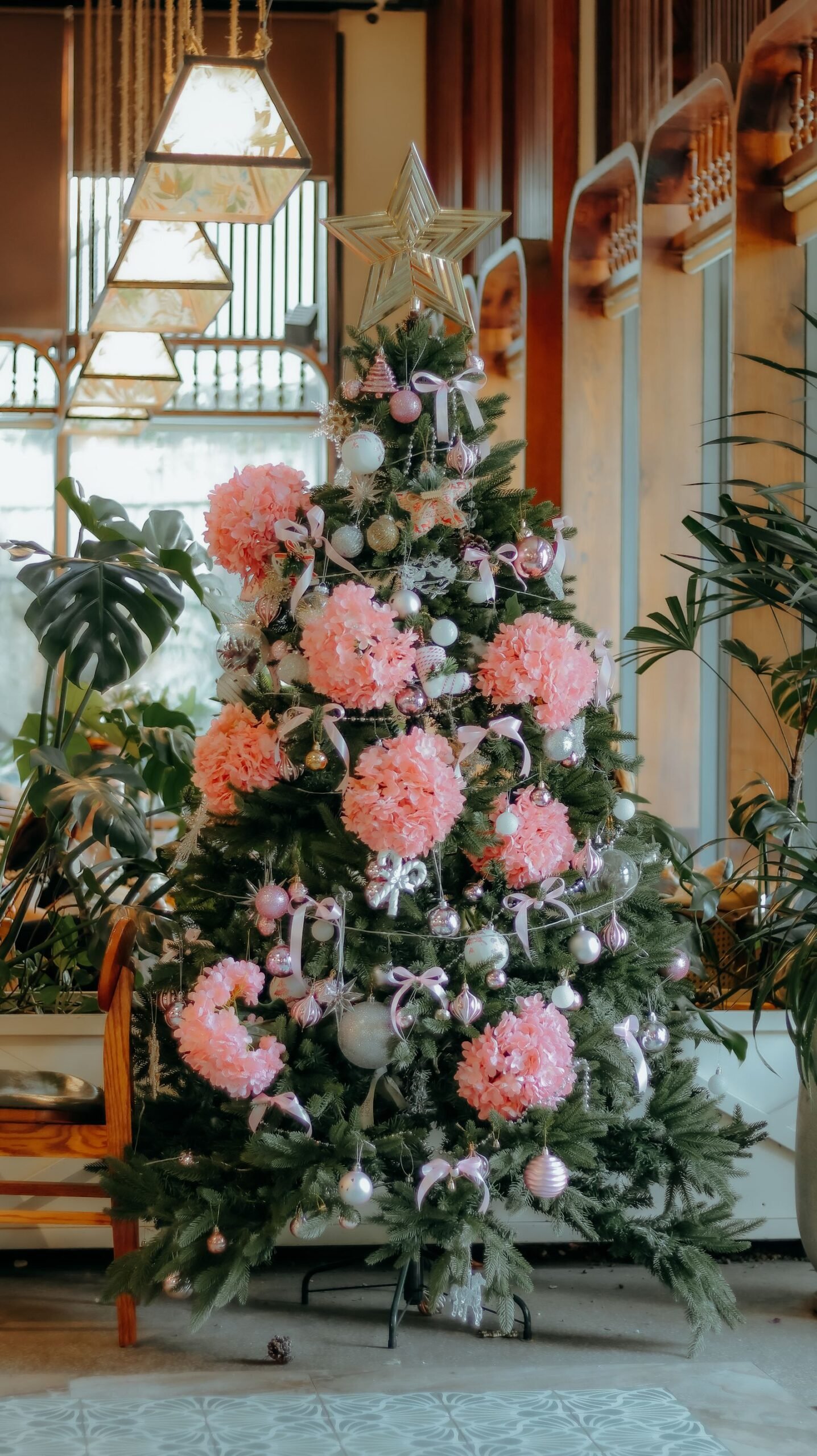
Gold is the partner that stops pink feeling sugary. Rose gold is the natural match — its warm metallic shine flatters blush the way candlelight flatters skin — but champagne and antique gold work just as well. The tree below shows the formula at full strength: blush flowers and pink baubles layered over deep green branches, gold drops and beaded garlands catching the light, nothing bright, nothing shouting.

3. The Flocked Tree: Snow Meets Sugar
A flocked tree is the safest canvas pink has. The powdery white coating reads as snow before anything else registers, and snow is unambiguously winter — so the pink on top of it never has to argue for its place in December.
On a white tree, hot pink suddenly behaves. The photograph below is the proof: glossy raspberry and magenta baubles on frosted branches, a few pinecones, nothing else competing. Use fewer, bolder pieces here, spaced so the white shows between them — about one pink ornament in three branches is plenty. Add white snowflakes, frosted pinecones and a white velvet ribbon, and keep the lights warm white so the flocking glows instead of glaring. A white tree also forgives a smaller budget, because the flocking itself does half the decorating.

4. Let Flowers Do the Talking
Here is the move most pink Christmas guides skip: flowers. A few large blooms tucked into the branches change a pink tree from “decorated” to “designed.” Pink hydrangeas are the easiest choice — one big head fills the space of six baubles, and their soft, cloud-like shape is exactly what a spiky evergreen needs. The photograph below shows why: one hydrangea head, two small satin bows, a silver bauble, and that one branch looks finished all by itself.
Use flowers the way you would use ornaments, not the way you would use a bouquet. Tuck each stem deep into a branch so the bloom sits on the surface like it grew there, and space them unevenly — three on one side, two on the other, one low near the skirt. Three to five blooms on a six-foot tree is the right count; more than that and the tree starts to look like a florist’s window.

5. Ribbon and Bows: The Smallest Big Change
If you buy one thing for a pink Christmas, make it ribbon. A single bolt of pale pink satin ribbon does more than a whole box of new ornaments, because ribbon is the one element that appears everywhere — on the tree, on the wreath, on the gifts, on the chair backs — and repetition is what makes a theme feel intentional instead of accidental.
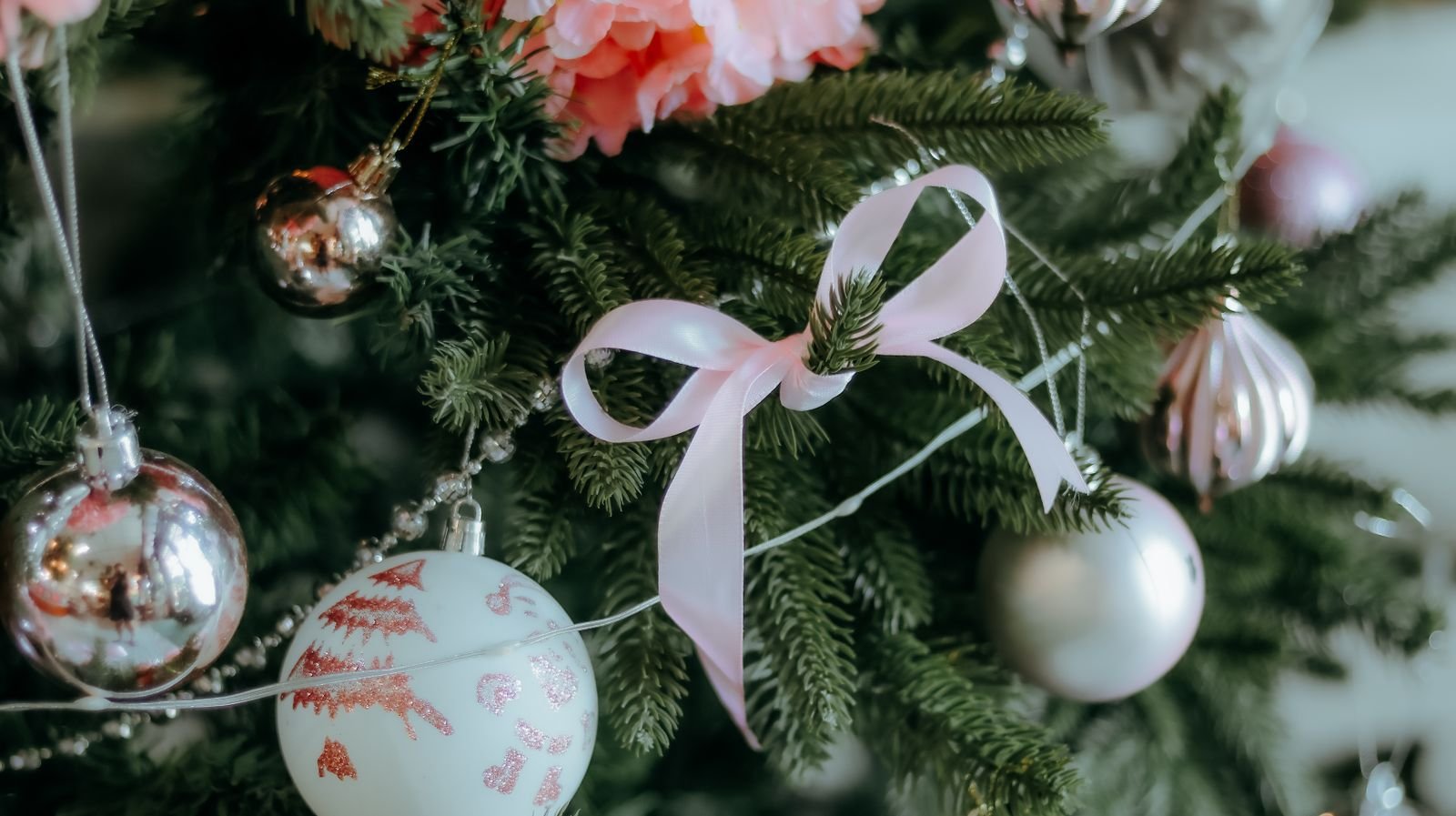
On the tree, tie small bows directly onto the branch tips, the way the photograph below shows: one neat satin bow, loops even, tails cut at an angle, sitting beside a silver bauble. Make twelve or fifteen of them, all the same size, and scatter them through the tree. The same ribbon ties the rest of the house together: a bow on the wreath, a bow on each gift, a bow on the back of each dining chair. Our Christmas wreath ideas show how one oversized bow can carry a whole front door. One caution: keep the bows small on the tree and big everywhere else.
6. The Pink Table
The dining table is where pink stops being a trend and starts being a celebration. It is also the easiest room to get right, because a table is small: a few repeated elements, seen up close, do all the work. Start with a runner, not a tablecloth. A dusty-rose gauze or linen runner, laid slightly loose down the center so it pools a little at the ends, gives you the pink in one stroke and leaves the wood or white linen visible on either side. The photograph below shows the balance: a rose runner, pink plates, pale napkins, gold flatware, and a green tree behind it all.
Layer every setting the way you would any good Christmas table: charger or placemat, dinner plate, folded napkin, and one green thing on top — a sprig of rosemary, a short cedar cutting, a single pinecone. Repeat the same three colors at every seat — blush, cream, gold — and even a simple table looks styled. For the full table method, our Christmas table decor ideas walk through centerpieces, runners and place settings in the order to build them. Keep the centerpiece low, below seated eye level — conversation is the celebration and the decor is the frame.

7. Candlelight, Roses and One Pink Candle
Pink needs warm light more than any other Christmas color. In daylight, blush can look washed out; under warm candlelight, it glows. This is why the pink table works best in the evening, and why one pink taper candle is worth more than a whole string of fairy lights. The photograph below is the whole idea in one frame: a lit pink taper in a crystal holder, pink roses and white hydrangeas beside it, gold-rimmed plates catching the flame.
Use real candles on the table and battery ones everywhere else. A taper in a proper holder, lit only while people are sitting down, is safe and beautiful; a taper left burning on a sideboard while everyone is in the kitchen is not. On the tree and the mantel, use battery micro-lights on a timer. One small bunch of dusty pink roses in a low vase with two or three cedar sprigs is a centerpiece that costs less than a box of baubles. Buy them two days before Christmas Day, and change the water daily.

8. The Pink Bedroom, Done as a Whisper
The bedroom is where pink should be quietest, because the bedroom has one job — sleep — and a loud theme is the enemy of rest. Our Christmas bedroom decor ideas are built on that principle: textiles first, everything on timers, nothing blinking, nothing competing. The pink version follows the same rules, only softer. Think of it as a whisper: one blush throw, one peach cushion, a small tree glowing on its timer.
The photograph below shows the whisper done well. White bedding, one peach velvet cushion, a dusty-rose throw folded at the foot, a gold gift box waiting on the bed, and a flocked tree glowing warm in the corner. Three moves are enough: one blush cushion and a pink throw folded across the foot of the bed; a mini tree on the dresser with battery lights on a timer; and one small thing on the nightstand, a sprig of cedar or three leftover ornaments in a little brass bowl.

9. Wrap It Pink: Gifts That Match the Tree
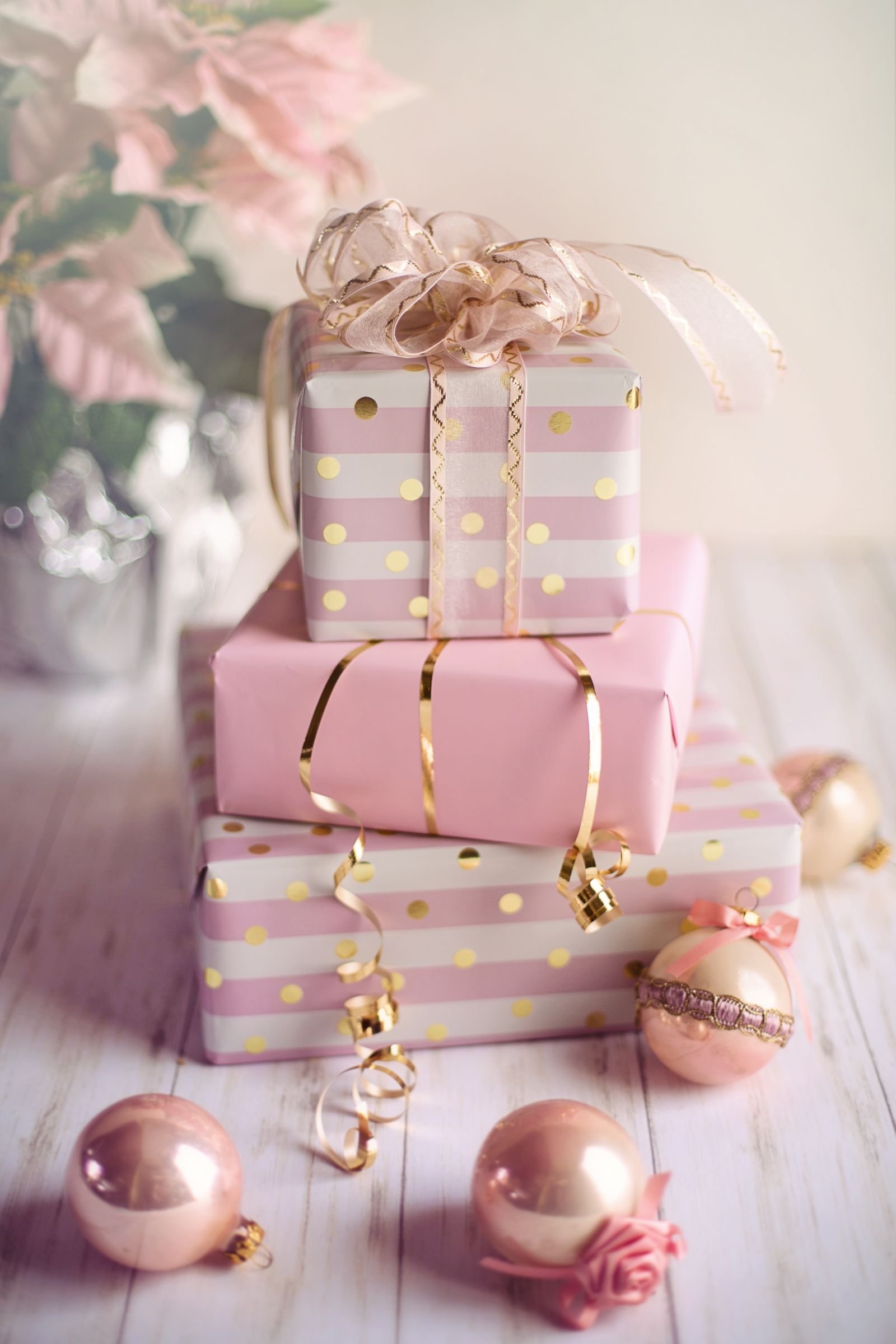
The gifts under the tree are part of the decor for three weeks before anyone opens them, so wrap them in the same palette and the whole room gets better for free. Pink wrapping paper with gold polka dots, solid blush paper with a gold ribbon, white paper with a pink bow — pick one paper and one ribbon and repeat them. The stack below is the formula: pink and white stripes, gold dots, a sheer gold-edged bow on top, and two blush baubles set beside the pile.
This is also the cheapest part of a pink Christmas, because wrapping paper costs very little and you were buying it anyway. The trick is buying it all at once, in one trip, in one palette. One roll of pink paper, one roll of white, one spool of gold ribbon, one spool of pink satin — that is the whole wrapping station for the year. Add one personal touch per gift: a sprig of cedar under the bow, or a handwritten tag in dark ink on cream card.
The Pink Rules, in Short
- One pink, one partner, one metal. Blush with cream and rose gold, dusty rose with green and antique gold, raspberry with burgundy and brass.
- A quarter to a third pink. The neutrals around it do the chic part.
- Matte, satin and pearl finishes. Glitter in small doses only.
- Warm white lights, always. Cool light turns blush lilac-grey.
- Ribbon everywhere, bows small on the tree. One bolt of pink satin ties the whole house together.
- Flowers make it grown-up. Three to five pink blooms on the tree, one small vase on the table.
- Bedroom as a whisper. One cushion, one throw, one mini tree on a timer.
Questions We Hear Every Year
Does a pink Christmas tree look childish?
Not when the palette is tight and the finishes are soft. A blush tree with rose gold and warm white lights reads elegant and romantic; it is the hot pink tinsel, the glitter overload and the five competing shades that read childish.
What colors go with a pink Christmas tree?
Blush pairs best with cream, white and rose gold; dusty rose with deep green and antique gold; raspberry with burgundy and brass. Green is the anchor in every version — it is what keeps pink reading as Christmas rather than spring.
Can I do a pink Christmas without buying a pink tree?
Yes — and it is the cheapest way in. Keep your green tree and add pink only in the ribbon, a dozen blush baubles and the gifts underneath. About twenty-five percent pink is enough.
How do I keep pink Christmas decor from looking too sweet?
Ground it with depth: a few burgundy or deep rose pieces, dark green branches left visible, antique gold instead of bright gold, and matte finishes instead of glitter. Real texture helps too — velvet, linen, pinecones, cedar.
Pink is not the loudest Christmas, and that is the whole point. It is the version of the season that feels like early morning light instead of midday — soft, warm, a little romantic. Start with one pink, one partner and one metal. Put the ribbon on the tree tonight.