
The Room After the Holiday Comes Down
This is not a Christmas bedroom. No tree in the corner, no red, no green garland, nothing that needs packing away by a date on the calendar. This is the bedroom for the long part of winter — January and February, when it is dark before dinner and the room has to earn its coziness every evening without any help from the holiday.
That distinction matters, because the two rooms are built differently. Our Christmas bedroom decor ideas were about sparkle for a few festive weeks; this room is about warmth that lasts two months. And it is a full-room build, not a bed with one pretty thing folded across it. A winter bedroom works — or fails — as a system: how the bed is layered, how the room is lit after dark, how the curtains handle the draft, and what your feet land on in the morning. The same keep-the-cozy, lose-the-holiday thinking runs through our winter decor ideas after Christmas for the rest of the house; here, the bedroom gets its own version.

First, the Honest Rule: Cool Room, Warm Bed
The Temperature Nobody Wants to Hear
Here is the honest part first: you sleep better in a cool room. Most sleep guidance lands in the same place — a bedroom around 65 to 68°F is where most people fall asleep fastest and stay asleep longest. A hot, stuffy room makes a restless night, not a cozy bedroom.
So do not warm the room. Warm the bed. That is the whole strategy here, and why the layering below matters more than your thermostat. A cool room with a properly built bed feels luxurious — crisp air on your face, real weight and warmth over you. Let the layers do the warming; they are very good at it when built in the right order.
Build the Bed as a System
1. Start With Flannel Against the Skin
The first layer is the one you actually touch, and in winter it should be flannel — sheets and pillowcases both. Flannel is brushed cotton, and those raised fibers are why it feels warm the second you get in, instead of the cold shock smooth cotton delivers in January. If you buy one thing for a winter bed, buy this set.
2. Add the Blanket Layer Most People Skip
Between the sheet and the duvet goes the layer most beds are missing: a proper blanket — cotton for a light build, wool for a serious one. This is the adjustable layer, pulled up to your chin on the coldest nights and folded down when the weather softens. It also gives a winter bed its satisfying weight: a duvet alone is all loft and no substance; the blanket underneath is the substance. Choose a weave you can see — waffle, herringbone, plain tight wool — because this layer shows at the fold-down.
3. Let the Duvet Do the Loft
Third comes the duvet, and its job is different from the blanket’s: loft, softness, and the deep, tucked-in look that makes a bed read as winter from the doorway. Use your warmer-weight insert for these months if you own two, and let the cover stay calm — cream, oatmeal, soft white, or warm rust for one rich note. Fold the top down over the blanket layer so both show, and getting in starts to feel like an event.
4. Finish With the Throw — Last, Not Only
Only now does the throw arrive, across the foot of the bed or folded along its lower third — chunky knit, fringed cotton, or the heaviest woven piece you own. Notice where it sits: fourth, not first and only. A throw over summer bedding is decoration pretending to be warmth. The same throw over flannel, a blanket, and a real duvet is the finishing layer of a bed that keeps you warm at 2 a.m. — and because the work is done underneath, the throw is free to be the texture piece: the fringe, the big stitch, the one handmade-looking thing in the room.

Light, Curtains and the Floor
5. Light the Room With Lamps Only After Dark
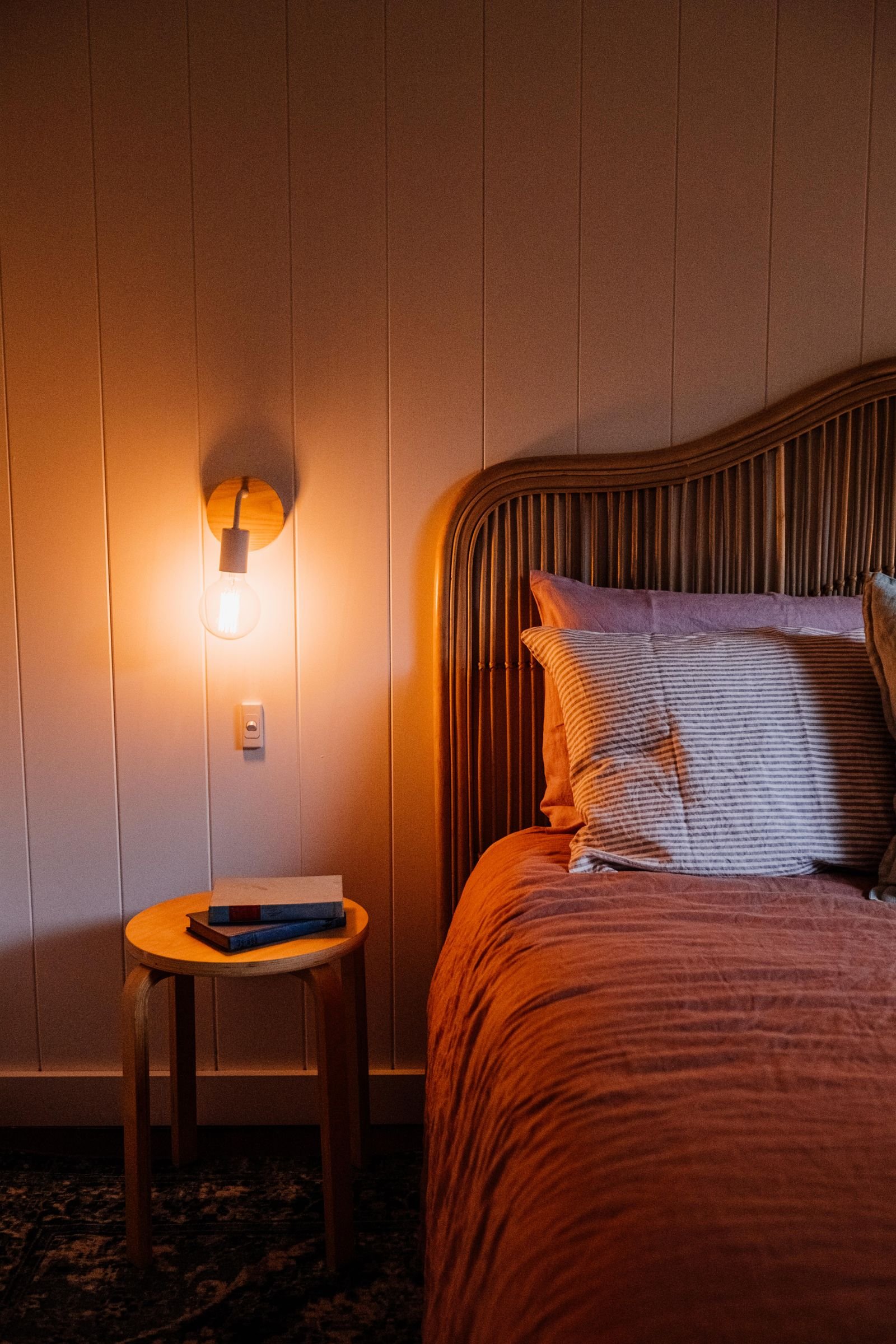
Once the sun goes — and in January that can be before five — the ceiling light is banned. Overhead light is flat and faintly institutional; it makes every bedroom feel colder than it is. Lamps are the winter light: one on each nightstand if you have two, a wall lamp or a small shaded lamp on a stool if you do not. Check the bulb before you blame the lamp — you want warm light, marked 2700K on the box. Two low pools of warm light change the temperature you feel more than two degrees on the thermostat.
6. Close Heavy Curtains at Dusk, Every Dusk
Windows are where a winter bedroom leaks its warmth, and heavy curtains are the fix that also looks good. Choose lined, floor-length curtains with real weight, and make closing them part of the evening — at dusk, when the lamps go on, the curtains come across. The payoffs are threefold: the draft off the glass stops reaching the bed, the room feels enclosed and private, and the fabric adds the sound-dampening layer that makes a winter room feel quiet.

7. Hunt the Draft, Not the Thermostat
Before you spend anything, spend ten minutes with your hand. Run it around the window frame, along the sill, and at the base of the door on a cold evening. Where you feel moving air is why the room feels cold — and it is rarely the heating. A draft stopper, curtains that meet in the middle and reach the floor, and a rug toward a cold exterior wall do more honest work than paying for warm air to escape through the same gaps.
8. Put a Soft Rug Exactly Where Your Feet Land
A winter rug is not placed for the photograph; it is placed for 6 a.m. Slide a generous rug under the lower two-thirds of the bed so it extends on both sides and at the foot — your first step should land on wool or deep soft pile, never on bare cold floor. That first step sets the tone for the whole morning. In a smaller room, one long runner along the side you actually use does the job. Choose warm naturals — jute, oatmeal wool, a faded vintage pattern.

9. Keep Slippers and a Robe Inside the Room’s System
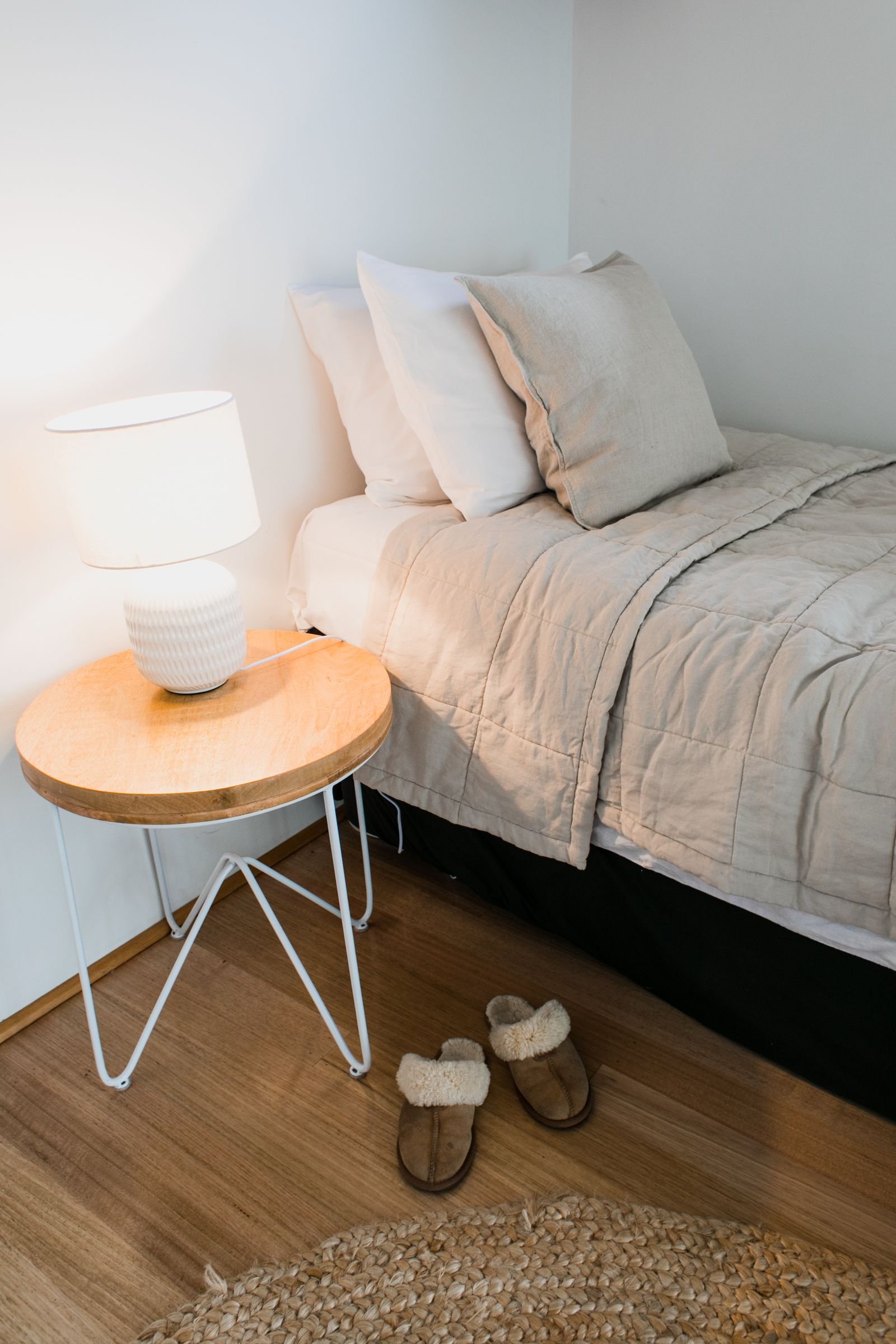
The coldest moments happen outside the covers, so plan for them. Slippers with a real sole live beside the bed, on the rug, where your feet find them without looking. A heavy robe hangs behind the door or over the end of the bed — not in the closet, where it might as well not exist at midnight. These are the bridge between a warm bed and a cool room, and they make the strategy comfortable instead of austere.
The Finishing Layer
10. Give the Room One Winter Scent
Scent is the layer you cannot see in a photograph, and the one you notice first coming back in from a cold evening. Keep it to one note and keep it warm: cedar, vanilla, a little clove, or clean linen. A scented candle lit for the last hour before bed and then put out, a cedar sachet in the linen drawer, or a light linen spray on the blanket layer — any one is enough. Repeated nightly, that one scent becomes the smell of sleep in the room.
11. Build a Nightstand That Works in Winter
The winter nightstand carries a different kit. A carafe of water, because heated indoor air is dry air. Lip balm and hand cream within reach, for the same reason. The book you are actually reading, not a styled stack. And the lamp close enough to switch off without leaving the warm bed — a lamp you have to get up to turn off is a design failure in January.
12. Add Texture Beyond the Bed
A winter bedroom should not be soft in only one place. Echo the bed’s textures once or twice around the room: an upholstered headboard against a cold outside wall, a woven basket holding the spare blanket, a cushioned chair in the corner. If color is what your room is missing, borrow the calm end of the palette — our sage green bedroom ideas show how a soft green wall carries cream and warm wood through winter, without a single festive note. Two echoes are warmth; six are a theme.
13. Keep a Spare Layer Within Arm’s Reach
Every winter bed needs an understudy: one extra blanket, folded in a basket beside the bed or across a chair, that either sleeper can pull over at 3 a.m. without a negotiation, a hallway trip, or a light. This layer ends the classic winter argument — one person runs warm, one runs cold — because warmth becomes personal instead of shared. Fold it back each morning and it stays part of the room, not part of the mess.
14. End the Day With the Five-Minute Close-Down
A winter bedroom is finished by a ritual, not a purchase. Five minutes, in the same order each night: curtains closed at dusk, lamps on and ceiling light off, the throw straightened and the fold-down set, slippers on the rug, scent lit for its one hour, the spare blanket in reach. A room deliberately closed down each evening greets you warm every morning — and that rhythm, more than any single object, is what makes a bedroom feel like winter done well.
Winter Bedroom Questions
What temperature should a winter bedroom actually be?
Cooler than you probably keep it: around 65 to 68°F suits most sleepers best. Keep the room cool and warm the bed instead — flannel, a blanket, a duvet, and a throw, in that order, do the warming far better than a hot room does.
What is the correct order for layering a winter bed?
Flannel against the skin first, then a blanket (cotton or wool) as the adjustable weight layer, then the duvet for loft, then the throw across the foot as the finishing texture. Each layer has a different job; the order is what makes it work.
How do I make a bedroom feel cozy after Christmas without it looking festive?
Remove anything with a date on it — no red, no tree, no holiday patterns — and build warmth from winter itself: layered textiles, lamplight at 2700K, heavy curtains, a soft rug, and one warm scent. None of it needs to come down in March.
What kind of light is best in a winter bedroom?
Lamps only after dark, never the ceiling light, with warm bulbs marked 2700K. Light the room low, from beside the bed, and it will feel warmer even though only the light has changed.
My bedroom has a cold draft. What should I fix first?
Find it before you spend: run your hand around the window frame, sill, and door base on a cold evening. Heavy lined curtains closed at dusk, a draft stopper, and a rug toward the cold wall solve most drafts for very little money.
How can two people share a winter bed if one runs hot and one runs cold?
Build the shared bed to the warmer sleeper’s comfort, then give the colder sleeper a personal spare layer within arm’s reach. Layers are adjustable in a way a thermostat never is.