
The Desk That Eats the Room
A small home office rarely gets a room. It gets a corner of the bedroom, a stretch of landing, a desk wedged against the living room wall — and then it slowly eats whatever space it touches. The laptop stays open, the chargers breed, the paper pile migrates, and by Friday the “office” is a cluttered table you feel guilty walking past in your own home.
The fix is not a bigger desk. It is a smaller system: a surface with strict rules, storage that climbs the wall instead of spreading across the floor, and an ending to the workday that puts the office away. None of this needs a renovation or a matching furniture set. It needs one honest reset, a few homes for the things that currently live nowhere, and five minutes a week to keep it true. If the whole house needs the bigger reset first, our declutter checklist is the room-by-room place to start; the desk is the most satisfying small win inside it.
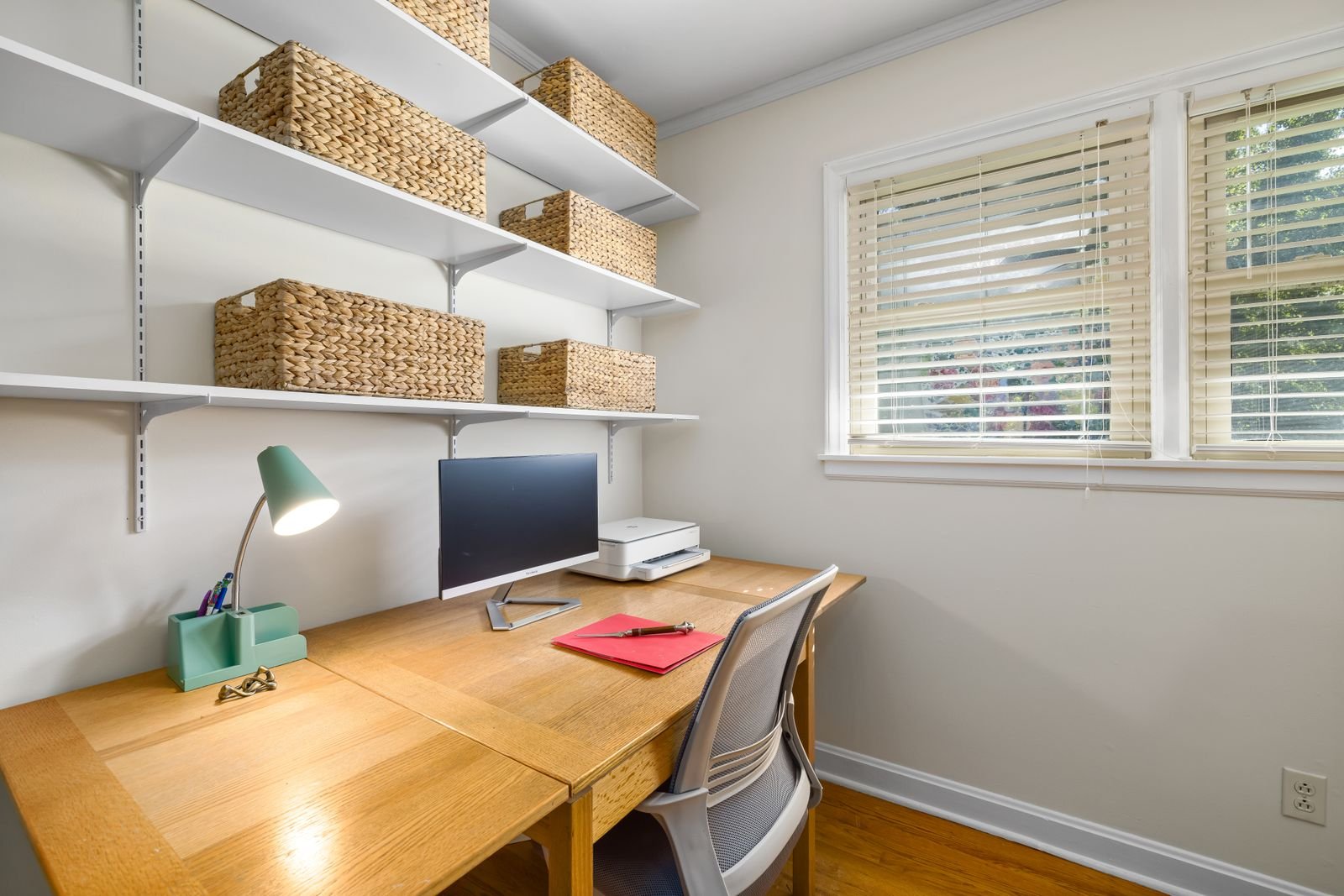
First: The Clear-the-Desk Reset
1. Empty the Desk Completely, Then Sort Without Mercy
You cannot organize a desk in place — the piles hide too much. Take everything off: every paper, charger, mug, notebook and mystery cable goes onto the bed or the floor. Sort into four piles: daily tools, weekly tools, paper that needs action, and things that were never office supplies at all (they just landed there). Wipe the bare desk down. Then only the first pile earns an immediate return ticket; everything else goes back through the systems below, or it does not go back at all.
2. The Desk-Surface Rule: Only Daily Tools Earn the Surface
This is the rule the whole article hangs on. Your desk surface is prime real estate, and rent is paid in daily use. The laptop or monitor, keyboard, one notebook, one pen pot, the lamp — if you touch it every single workday, it may live on the desk. Everything else — the stapler you use twice a month, the reference books, the spare cables — must earn a home somewhere else: a shelf, a drawer, a pegboard, a cart. A clear surface is not minimalism for its own sake; it is what makes a small office feel like a place you can think.
Give Everything a Home Off the Desk
3. Put Wall Shelves Above the Desk
The cheapest square footage in any small office is the wall above it. One or two shelves within arm’s reach hold the weekly layer — reference books, the printer paper, a basket for the bits that cannot stack — while the desk stays clear below. Keep the lowest shelf for things you grab weekly, the higher one for storage you touch monthly, and repeat one basket style so the eye reads calm instead of clutter. Measure before you drill: shelves should start high enough that you never duck under them to sit down.

4. Hang a Pegboard or Wall Grid for the Small Things
Pens, scissors, headphones, tape, chargers — the small tools are what actually colonize a desk, one item at a time. A pegboard or wire grid on the wall in front of you gives every one of them a visible, grabbable home that uses zero surface. Add two or three small bins for the things that cannot hang, keep the board to work tools only (it is not a gallery wall), and leave a few hooks empty on purpose: a board with breathing room stays tidy, a stuffed one becomes vertical clutter.

5. Start the Paper System With One Inbox Tray
Paper does not need a filing cabinet; it needs a front door. Put exactly one inbox tray on the desk or the shelf beside it, and make it the only legal landing place for incoming paper — mail, forms, the note you scribbled on a receipt. One tray, not three piles in three rooms. When the tray is the only entrance, paper stops spreading, because there is nowhere else for it to spread to. Empty it into the next step twice a week, before it becomes a pile with its own weather system.
6. Action Folders and One Reference Box — Broad Categories Only
Behind the inbox, keep the system deliberately coarse: a small set of action folders (To Pay, To File, Waiting On, This Week — four is plenty) and one lidded reference box or file crate for the paper you must keep but rarely touch: contracts, warranties, tax years. Broad categories survive; fussy ones collapse. The moment a system needs twenty labeled folders to work, nobody files anything, and the inbox tray becomes the archive. Coarse and used beats perfect and abandoned, every single time.
7. Tame the Cables Once, Properly
Cable sprawl makes even a tidy desk look chaotic. Do it once, properly: a cable tray or basket screwed under the desk holds the power strip off the floor, velcro ties bundle each run, and a small label on each plug end tells you what it feeds before you unplug the wrong thing. Leave one charging cable deliberately reachable on the surface — the phone charger is a daily tool and earns its place under the rule in idea 2. Everything else disappears under the desk, and the floor under your feet becomes foot room again.
Drawers, Risers and Things That Roll
8. Zone the Drawers by Frequency, Not by Object
If your desk has drawers, stop organizing them by what things are and start organizing by how often you reach for them. Top drawer: the daily and weekly small tools — pens, charger, notebook refills, glasses cloth. Lower drawer or the one beneath: the monthly layer — envelopes, spare batteries, the hole punch. And give every drawer a divider or two small boxes so “zone” does not quietly become “jumble.” Frequency zoning means your hand learns the system in a week, and a system your hand knows is a system that survives busy days.
9. Lift the Screen With a Monitor Riser That Stores
A monitor riser or laptop stand is the rare upgrade that gives twice: your screen rises to eye level, and the space underneath becomes a home — the keyboard slides under it at night, the notebook and the action folders park there by day. Choose one with a drawer or a shelf if you can; even the plain kind reclaims a strip of desk that was previously just air under a screen. On a laptop-only desk, a stand plus a separate keyboard does the same job and ends the hunched-over-the-table posture for good.
10. Add a Rolling Cart That Parks Away
The three-tier rolling cart is the small office’s best friend precisely because it is not furniture — it is storage that visits. Load it by tier: current project on top, supplies in the middle, printer paper and the reference box below. Roll it beside the desk while you work; roll it into a closet, behind a door or under a higher table when you finish. For anyone whose office shares a room, the cart is what lets the whole operation leave the room without carrying anything in your arms.

When the Office Shares a Room
11. No Spare Room? Build a Cloffice
If a spare closet exists, it may be the best office in the house. The closet-office — the cloffice — works on simple basics: remove the door or leave it open, fit a shelf-deep desk surface across the back, put one shelf above it for the weekly layer, and run one power strip in for everything. The clothes rod, if it stays, holds only the out-of-season things pushed to one end. The quiet miracle of a cloffice is the ending: close the door, and work is quite literally shut away.
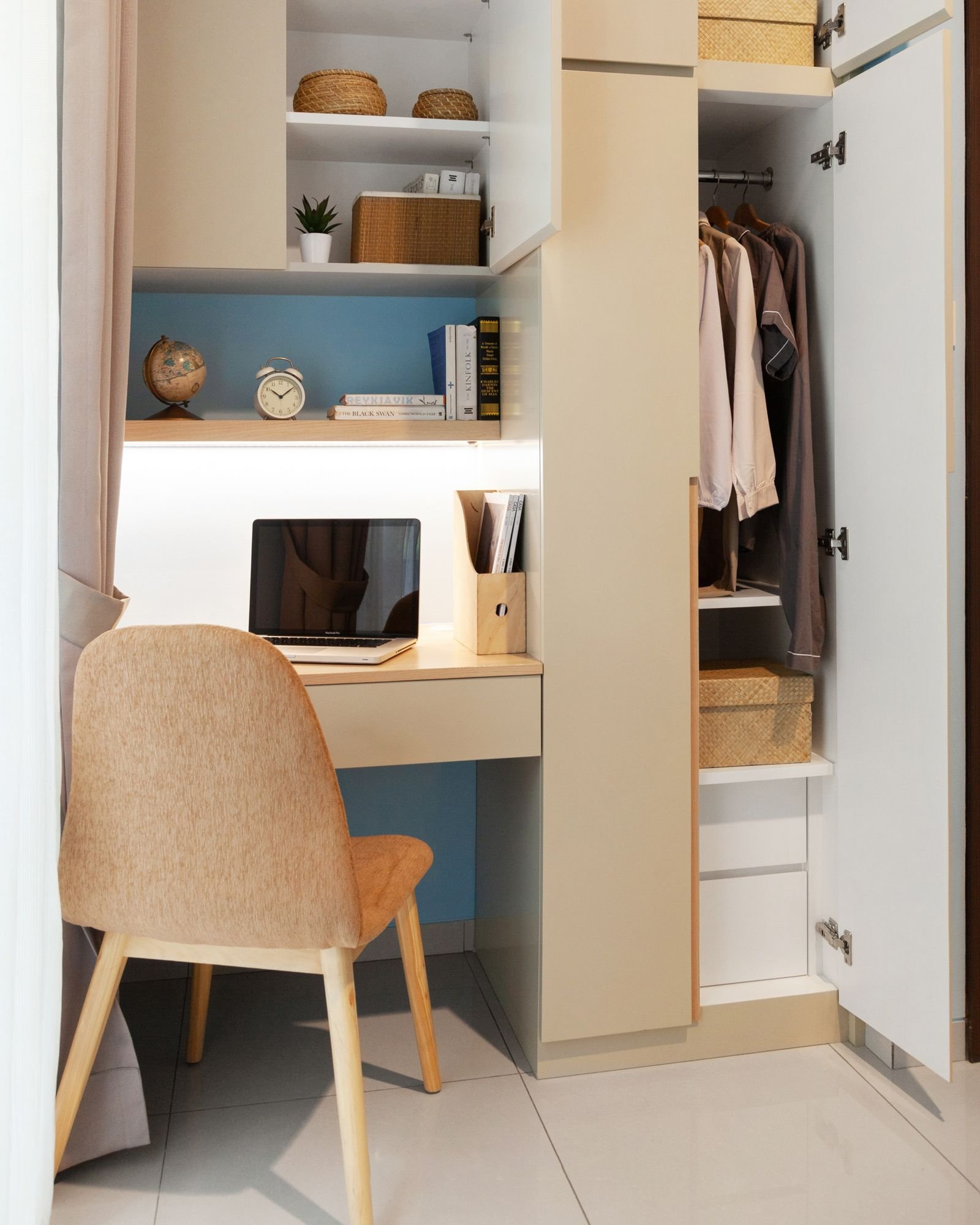
12. Draw a Visible Line Between Work and the Room
Most small home offices live in a bedroom corner, and the corner needs an edge or the work leaks into the rest of the room all evening. The edge can be small: a bookshelf turned sideways, a folding screen, even the rug the desk stands on — anything that tells your eye “office” on one side and “bedroom” on the other. Our small bedroom organization ideas treat the whole room the same way, zone by zone; the desk corner is simply the zone with the strictest border.
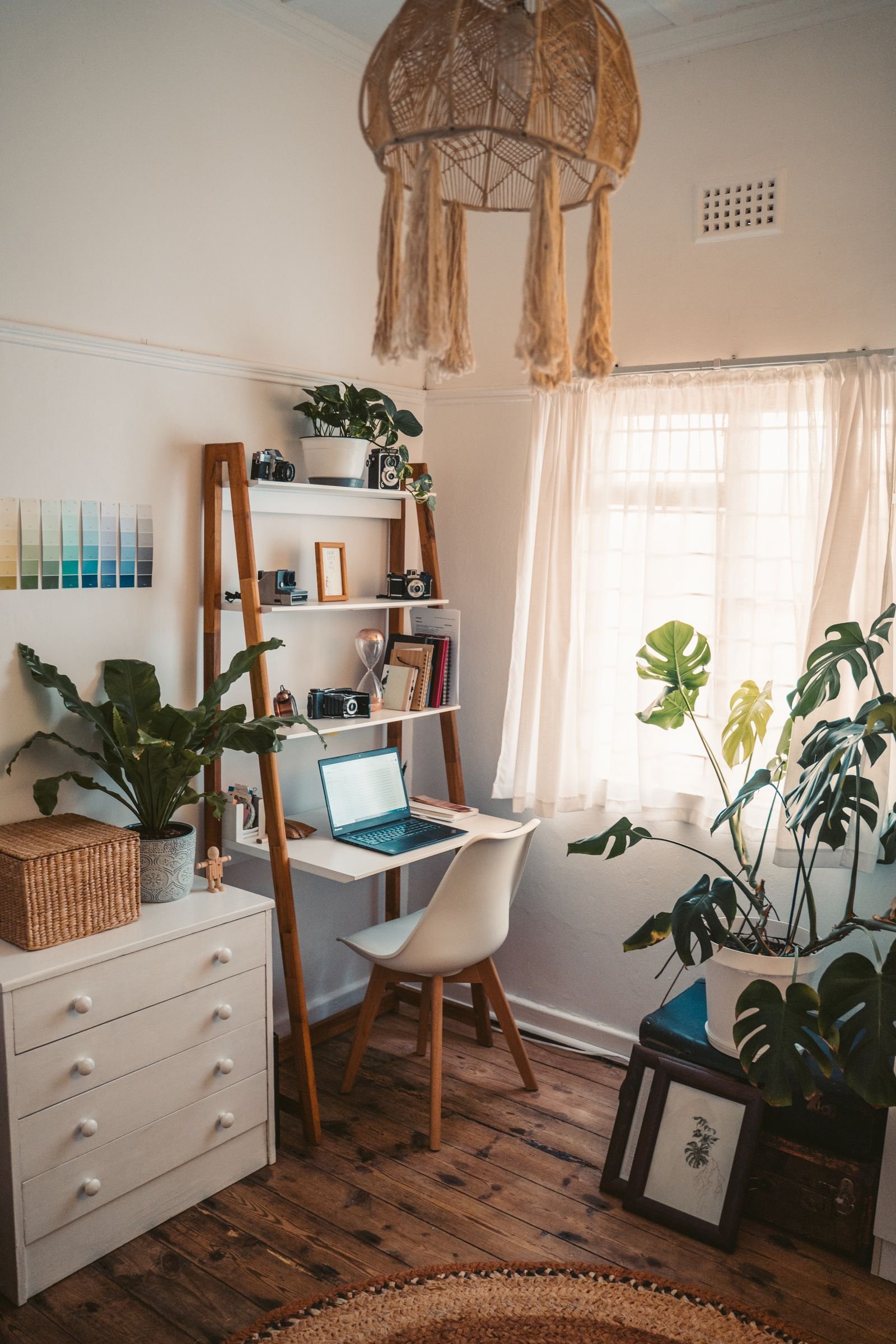
13. End the Day With a Two-Minute Shutdown Ritual
A shared-room office needs an off switch, and it is a ritual, not a product. Two minutes at the end of the workday: laptop closed, notebook shut, inbox tray squared, cart rolled away or chair pushed in, lamp off. The same five moves in the same order, every day. It sounds ceremonial because it is — and it works, because a corner that visibly closes stops asking for your attention at dinner. The shutdown is what turns “I work in my bedroom” back into “my bedroom, where I also work.”
Keep It That Way
14. The Five-Minute Friday Reset
Systems erode one unreturned object at a time, so maintain this one the cheap way: five minutes on a Friday. Return the week’s strays to the shelf, the board and the cart. Empty the inbox tray into the action folders. Coil the one cable that escaped. That is the whole budget — five minutes a week — and it is the difference between a desk that was organized once, in a photograph, and a desk that simply stays clear.
Home Office Questions
How do I organize a home office in a bedroom corner?
Give the corner an edge (idea 12), keep only daily tools on the surface (idea 2), and store everything else vertically — wall shelves, a pegboard, or a rolling cart that parks in the closet at night (ideas 3, 4 and 10). Close it down with the two-minute ritual so the bedroom feels like a bedroom again (idea 13).
What should actually stay on my desk?
Only what you touch every workday: the laptop or monitor, keyboard, one notebook, one pen pot and the lamp. Everything else earns a home on a shelf, in a drawer, on the pegboard or on the cart — that single rule is what keeps the surface clear (idea 2).
How do I stop paper piling up on the desk?
Give paper one entrance and one coarse system behind it: a single inbox tray, four broad action folders, and one reference box for keep-but-rarely paper. Fine-grained filing systems collapse; broad ones get used (ideas 5 and 6).
What is a cloffice, and is it worth doing?
A closet converted into an office: a shelf-deep desk across the back, one shelf above, one power strip, and a door that closes on work at the end of the day. If you have a spare closet, it is the cheapest way to gain a door your office can close (idea 11).
How do I hide desk cables in a small office?
Mount a cable tray or basket under the desk, lift the power strip off the floor into it, bundle runs with velcro ties, and label each plug end. Keep only the daily phone charger reachable on the surface (idea 7).
How long does it take to keep a small office organized?
About five minutes a week, once the homes exist: the Friday reset returns strays, empties the inbox and recoils the escaped cable. The setup takes an afternoon; the keeping takes almost nothing (idea 14).