
The short answer: A TV wall works when you decide first what the screen should do: disappear into a dark or panelled wall, blend in as one rectangle among frames and shelves, or be the star with everything arranged around it. Then hang it at seated eye level — about 42 inches to the centre of the screen — give it a console wider than the screen, hide the cords, and add one softening layer, like plants or warm light, so the wall feels finished when the TV is off.
Most TV walls fail for one reason: the television was hung, and then decorating stopped. The screen sits alone on a pale wall, cords dangling, and the room spends half its life looking at a black rectangle that belongs to nothing. The fix is rarely a bigger TV. It is a decision, made before the drill comes out, about what job the screen has in the room. If the whole room needs attention, start with our living room refresh ideas.
1. First Decide: Disappear, Blend In, or Be the Star
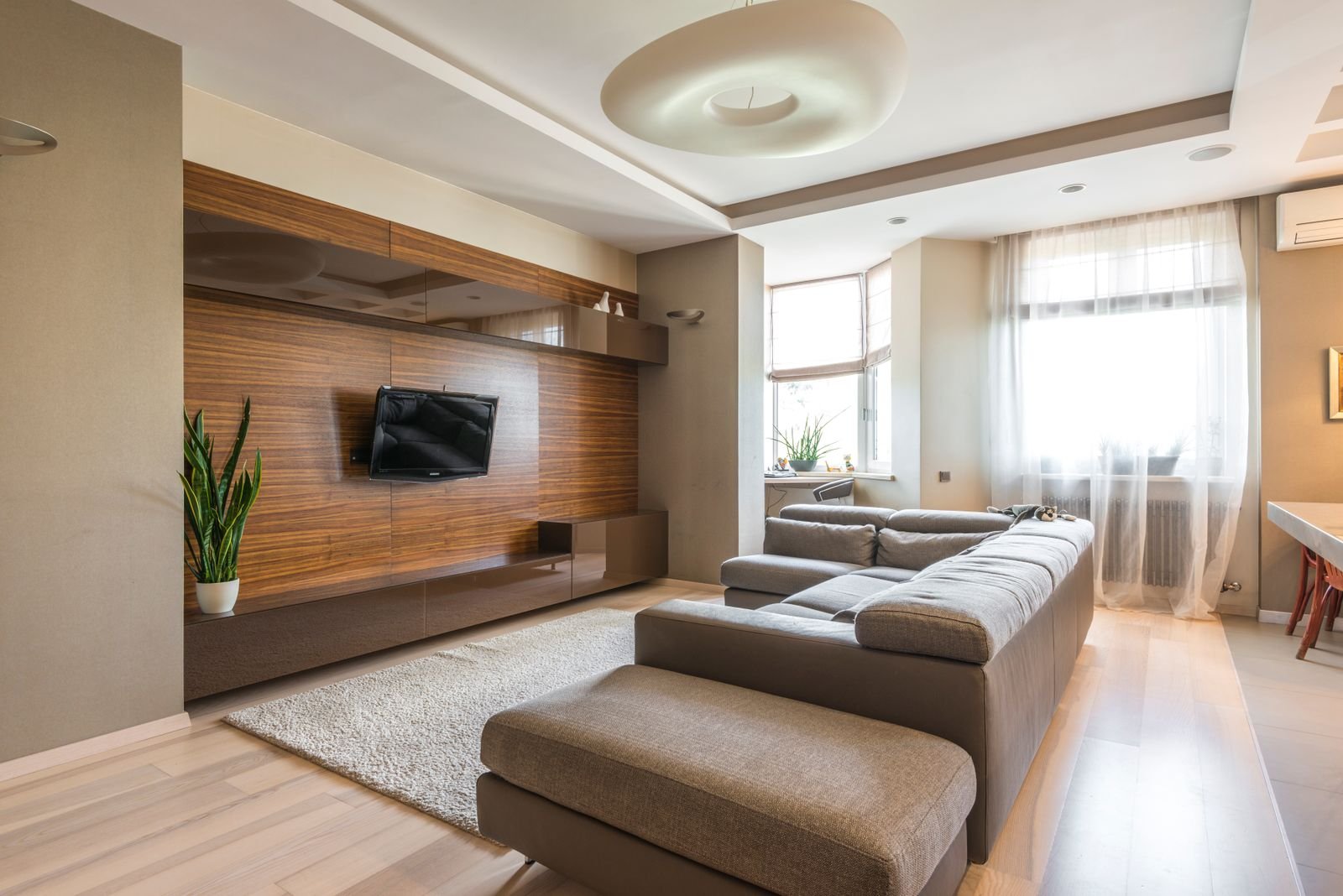
Disappear: dark paint or panelling. Blend in: the biggest rectangle in a gallery. Be the star: centred, symmetrical, lit, like the wood-panelled wall in our featured photo.
None is better. A movie-loving family room usually wants the star treatment. A formal sitting room, or a small room where the TV is used twice a week, usually wants it to disappear. Renters and gallery lovers land on blend-in. The mistake is mixing them by accident. Pick one approach and let every later choice answer to it.
2. Get the Height Right Before Anything Else
The most common TV wall mistake is also the easiest to avoid: the screen hung too high, like a painting in a museum, so everyone watches with their chin lifted. Paintings hang at standing eye level; televisions belong at seated eye level, where your eyes are when you watch. For most sofas that means about 42 inches from the floor to the centre of the screen — a little lower for a low, deep sofa, a little higher for upright chairs.
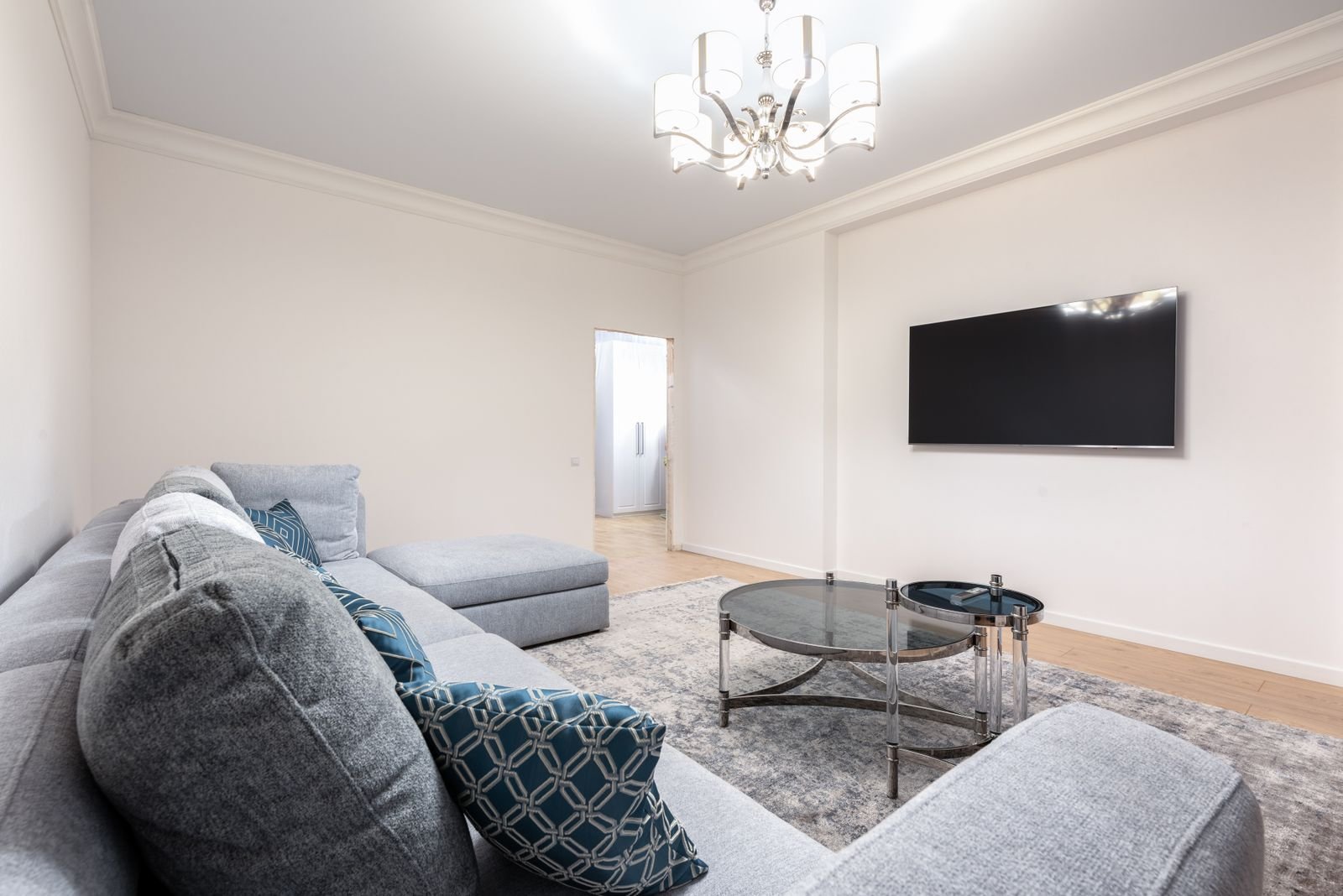
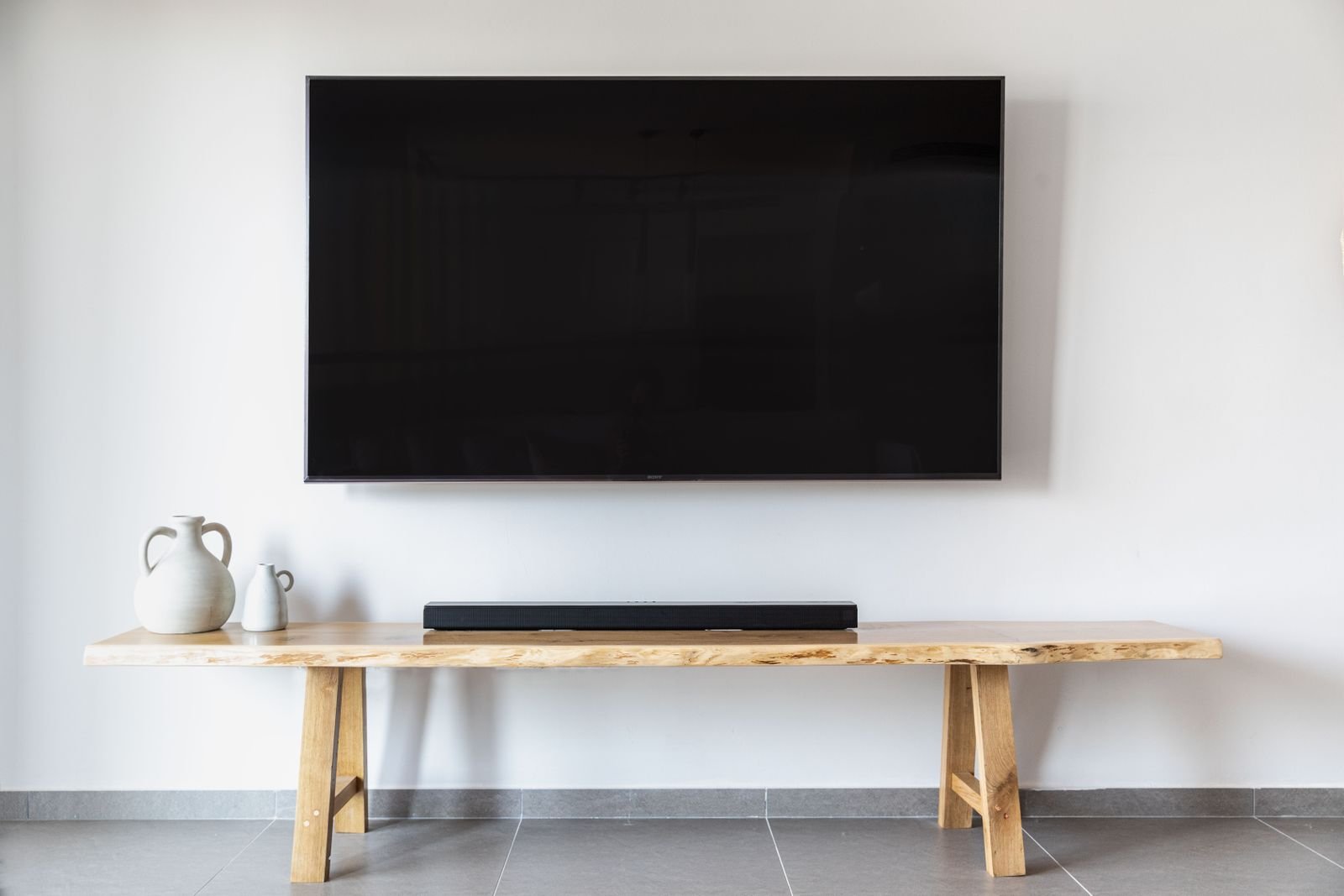
Test it before you drill. Cut cardboard to the size of your screen, tape it up, then sit in your real seat — feet up if that is how you watch — and look at it for a full minute. Comfortable neck, no looking up: that is your height. The setup below gets it right, the screen just above a low bench, its centre where a seated viewer’s eyes rest. Leave roughly 6 to 8 inches between the screen’s bottom edge and the console top, so a soundbar does not crowd it.
3. Dark and Moody: The Camouflage That Actually Works
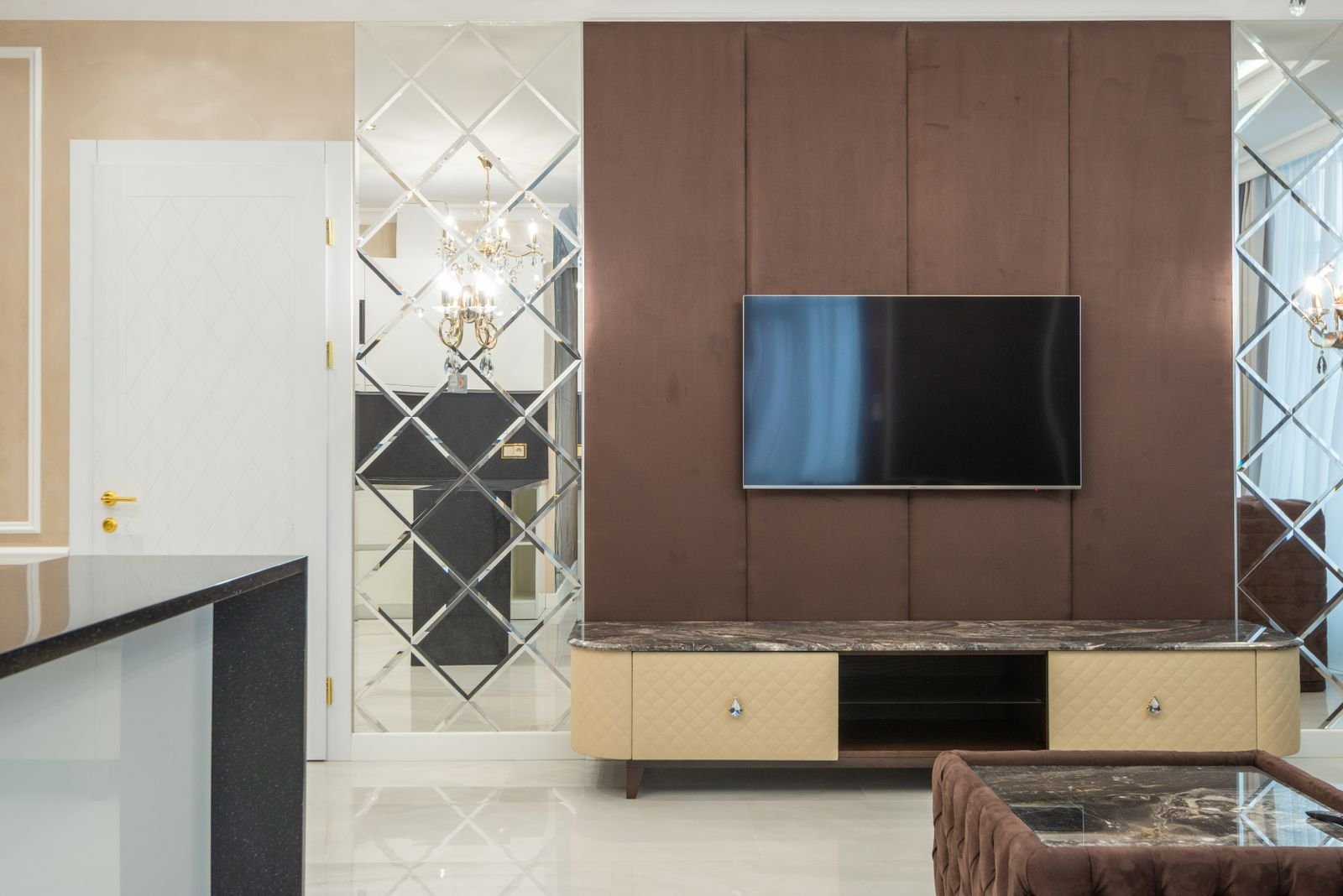
A black screen on a white wall is the highest-contrast object in most homes. Paint that wall dark — charcoal, deep navy, forest, warm chocolate — and the contrast collapses: the screen stops shouting when off, and at night the picture seems to float. The brown panelled wall below is the softer version — not black, just deep enough that the screen reads as one dark panel among others.
Two warnings. Dark camouflage works best on the TV wall only, unless the room is large and bright; one dark wall reads rich, four can read like a cave. And test the colour at night — some charcoals go cold and blue under lamps. Warm darks, with brown or green in them, sit better with wood and warm light.
4. A Gallery Arranged Around the Screen
A gallery wall treats the TV as its largest frame. Keep every frame the same colour — black is easiest, it matches the screen — and spacing consistent, about 2 to 3 inches between pieces, including the screen. Lay it out on the floor first, photograph it, live with the photo for a day, then hang.
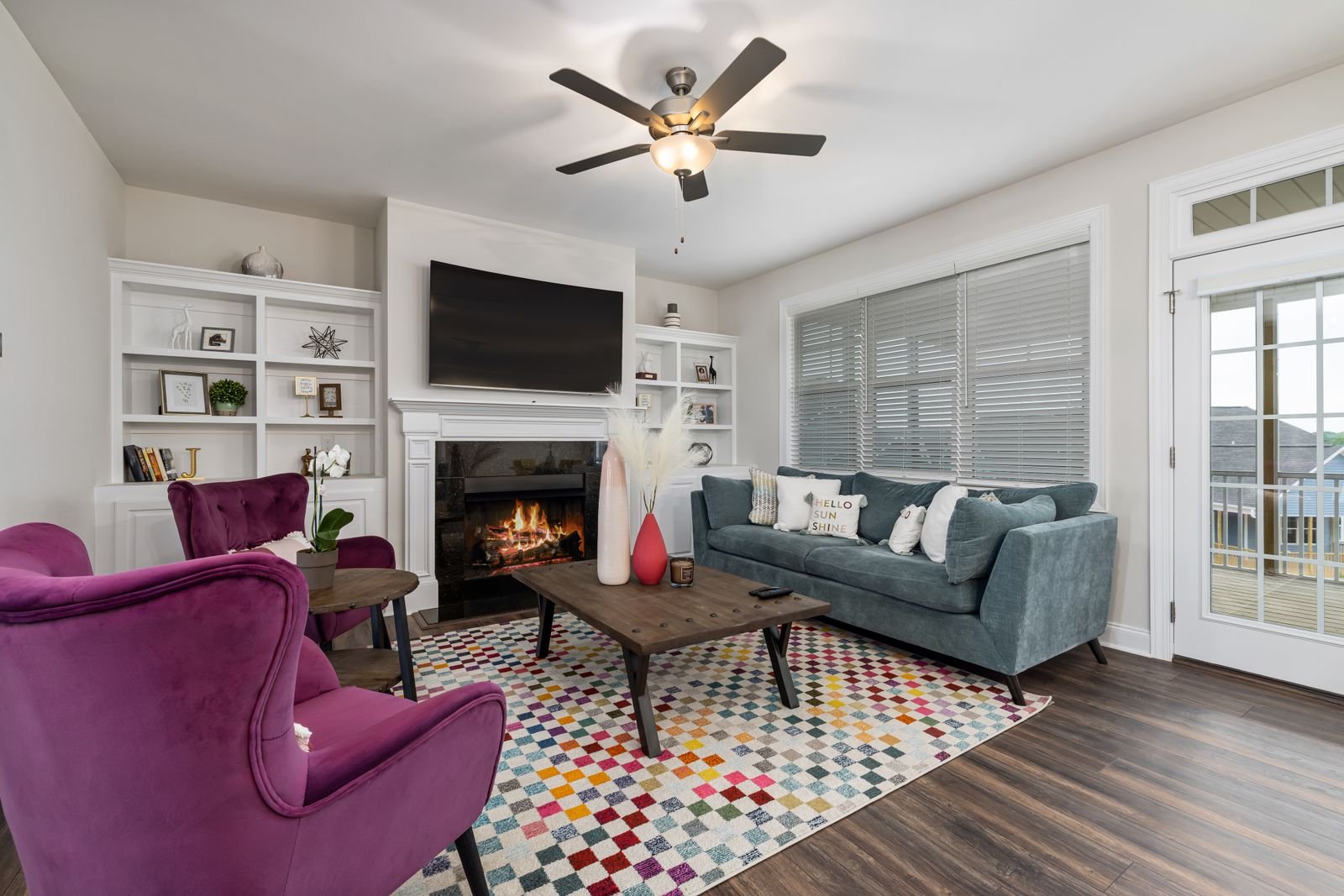
Balance matters more than quantity. One large frame on the lighter side of the screen, a pair stacked on the heavier side, and the eye reads a composition, not a contest. Mix art, photographs and one flat object — a woven piece, a shallow shelf — for texture. The built-ins below do the same job with shelves and frames either side of the screen: the TV is the centre, but it has company, and company makes a screen look chosen rather than stranded. In a tight room, often the best approach (see our small living room ideas on a budget).
5. Floating Shelves and Sconces: Symmetry That Calms a Wall
If a gallery feels busy, symmetry is the calmer route. Two floating shelves at the same height each side of the screen, or a matching pair of sconces, tell the eye the arrangement was planned. Sconces also soften the screen’s hard edges in the evening and cut the glare contrast that makes a bright TV in a dark room tiring. Plug-in sconces need no electrician.
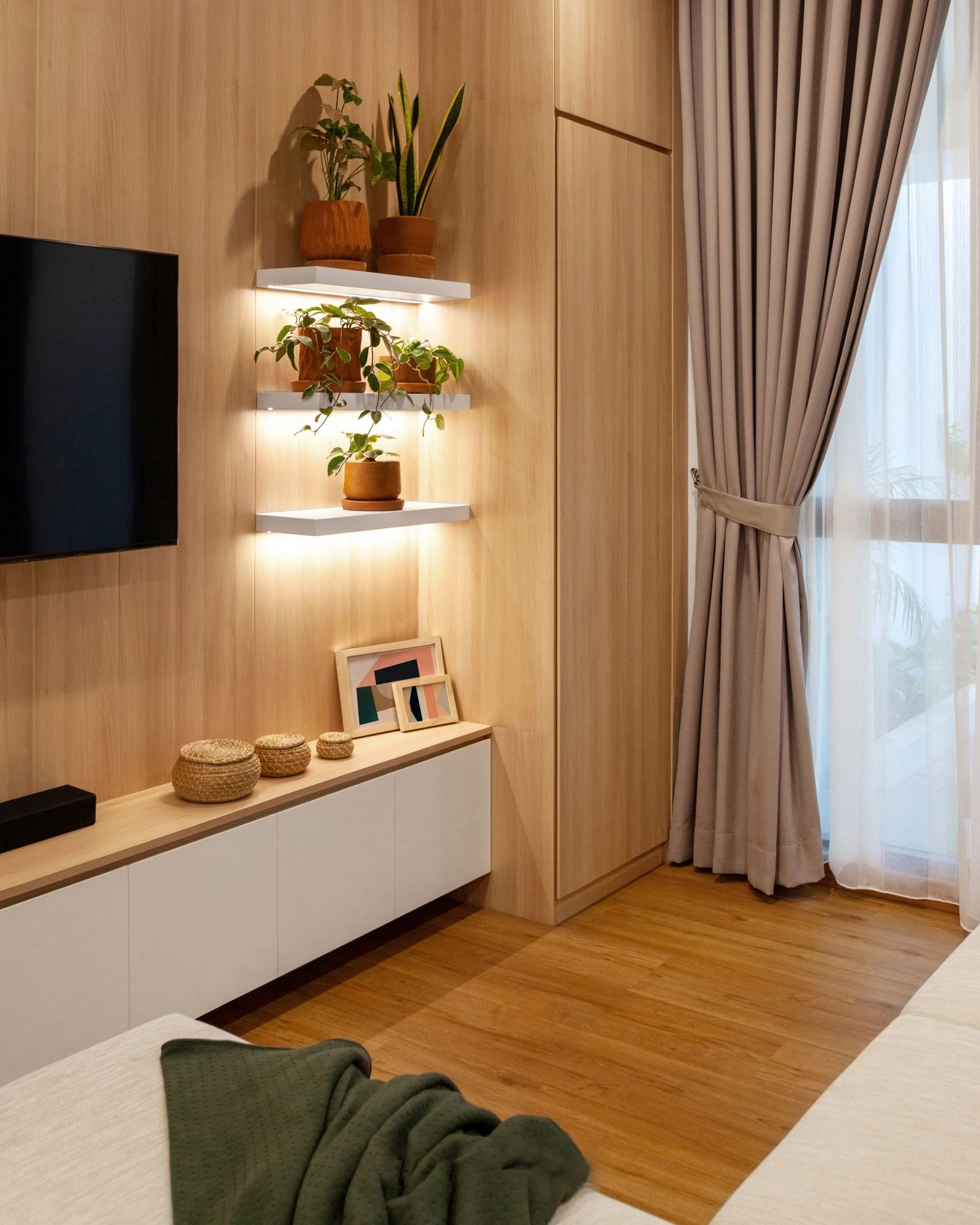
Keep shelf styling light: a plant, a small stack of books, one object you like, then empty space. A shelf packed edge to edge competes with the screen; a shelf with room to breathe frames it. The lit shelves below are the model — three short shelves beside the screen, plants in matching terracotta, warm light washing the wood.
6. Consoles and Cords: The Bottom Half Does the Heavy Lifting
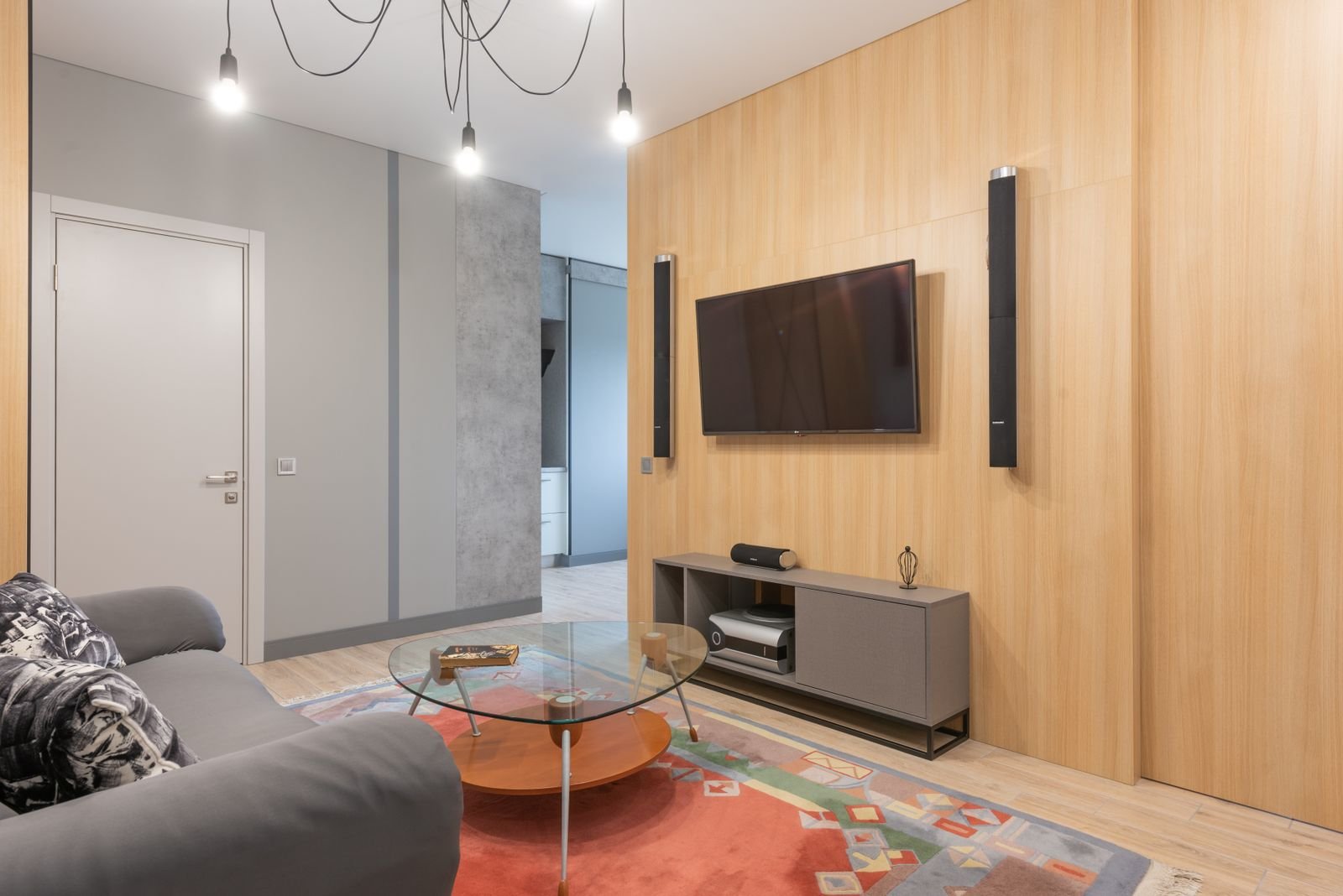
A TV wall is judged from the waist down. The console anchors the screen: wider than the TV — 6 to 12 inches of overhang in total — and low, so the pair reads as one piece of furniture, not a screen hovering over a too-small box. Closed storage earns its keep, because streaming boxes and remotes are not decor. The wall below pairs a wide, low console with tall speakers either side, and no cable is visible anywhere.
Cords are the difference between finished and nearly finished. In-wall kits are cleanest where you own the wall. Everywhere else, run cords inside a paintable cord cover the colour of the wall, and put the power strip inside or behind the console. Never let a cable hang in the gap between screen and console — that one dangling line is what people actually notice.
7. Wood, Slat and Panelled Backdrops: The Star Treatment
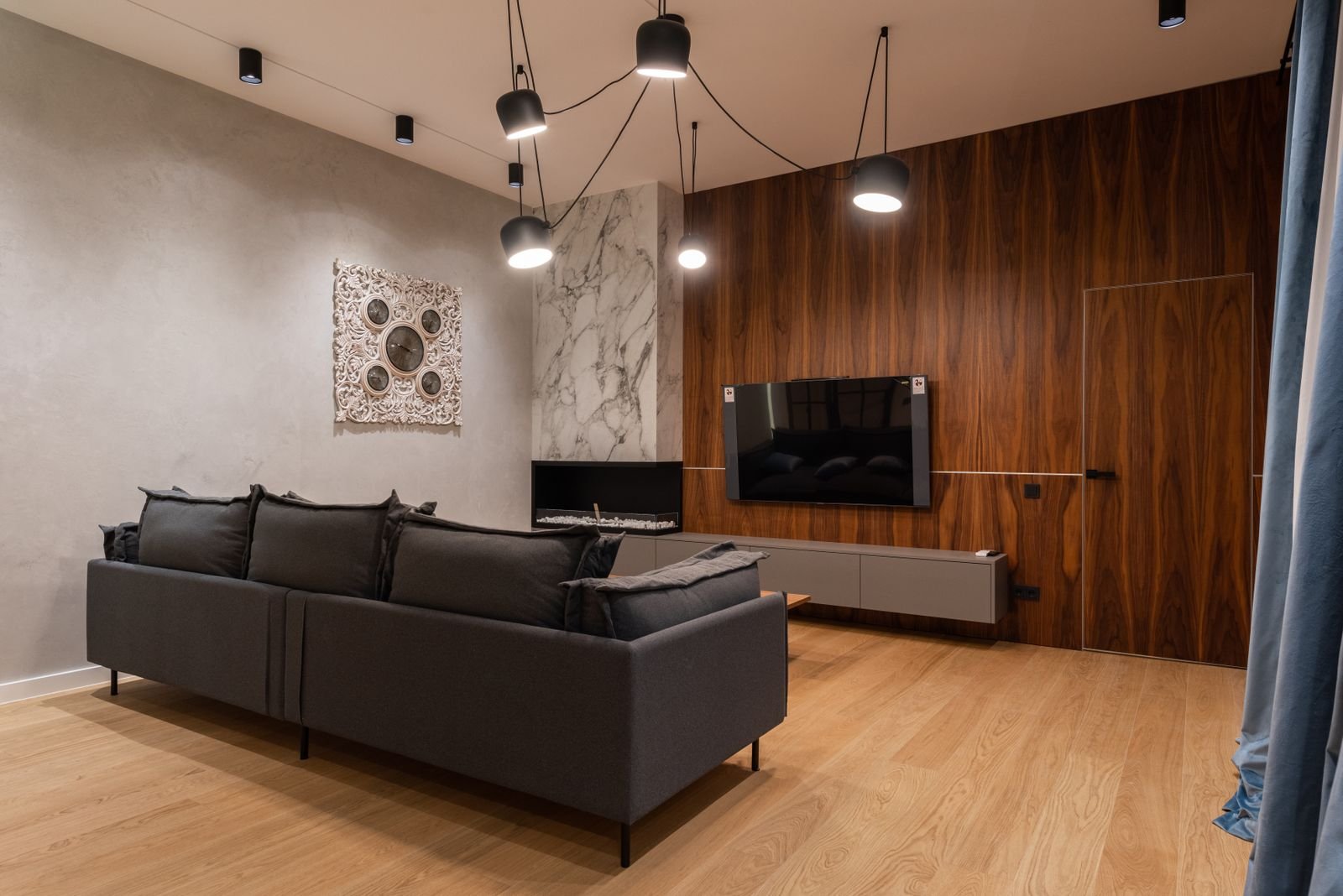
When the TV is the star, the wall behind it should be worth looking at. Wood does this best: its grain gives the eye somewhere to go when the screen is off, and its warmth stops a big black rectangle feeling cold. Full panelling, like the dark walnut wall below, is the committed version. Vertical slats add shadow lines and a little sound softening; applied moulding or board panels, painted the wall colour, give a quieter, classic version for far less.
Practical notes. Slat panels vary a lot in quality; order a sample and check the edge finish, because cut edges are what side seats see. Keep the panel run wider than the console, or end it at a natural break like a door frame — a panel stopping mid-wall looks like a mistake. If a full wall is too much, a panel section just behind the screen and console, a foot beyond them each side, gives most of the effect for a fraction of the cost.
8. TV and Fireplace Together, Plus Frame-Style Tricks
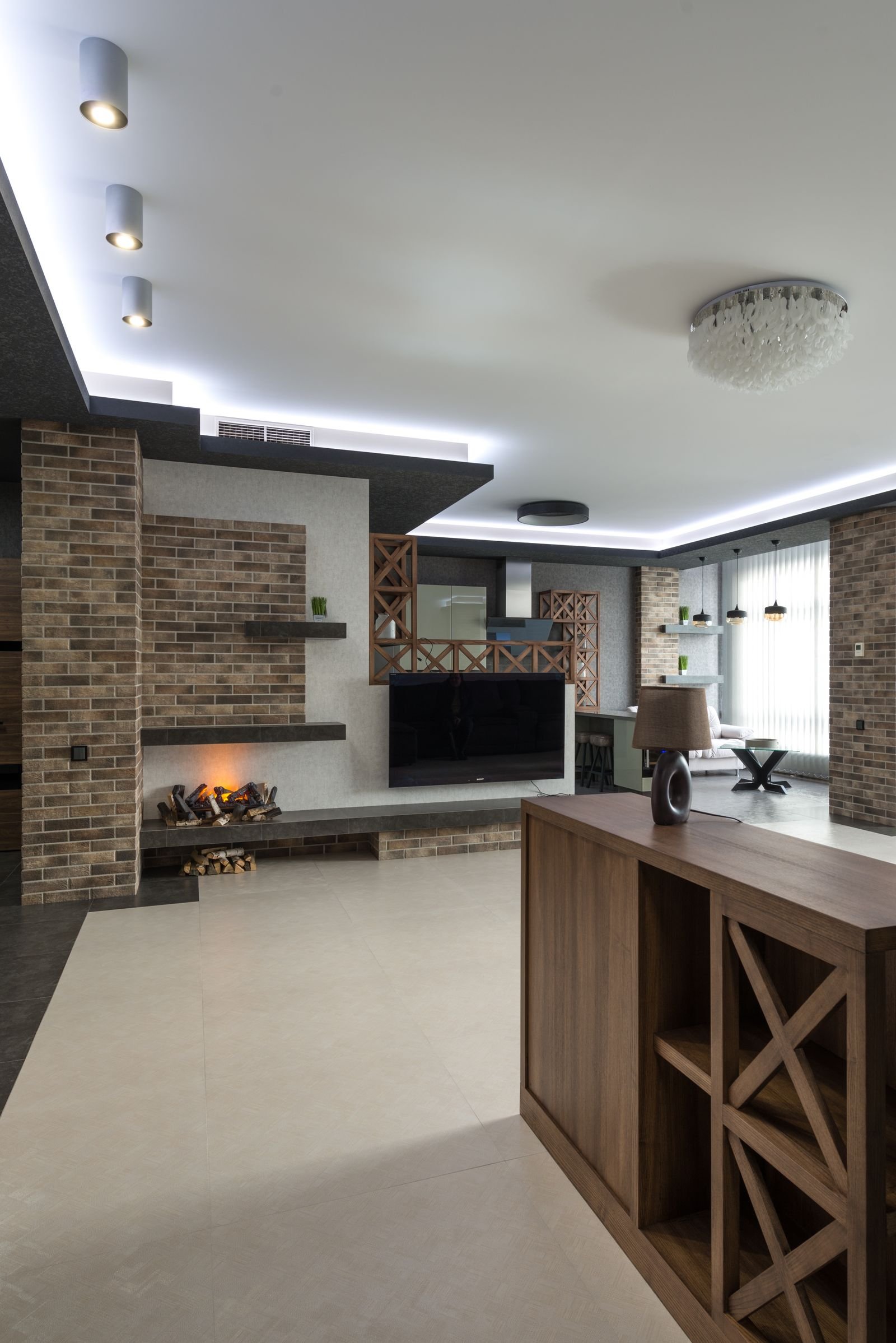
A fireplace and a TV both want to be the centre of the same wall, so be honest about which you use more. Above the mantel is popular, but it breaks the height rule in Section 2 — the screen’s centre lands well above 42 inches. If you go that route, a tilting mount and a mantel deep enough to shield the screen from heat are not optional. The side-by-side answer below avoids the fight: fire on one side, screen on the other, a shared hearth line underneath. Where layout allows, it is the more comfortable wall to live with.
Frame-style tricks help in both layouts. A slim wood frame fitted around the screen’s edge makes the black rectangle read as art at a glance. If your TV has an art or ambient mode, use a matte picture — a landscape, a textile, an old print — with the brightness turned down so it looks like paper, not a glowing poster. Our guide to simple ways to make a living room feel cozy covers the lamps and texture that finish the room around this wall.
9. Plants, Softening, and the Renter-Safe Version
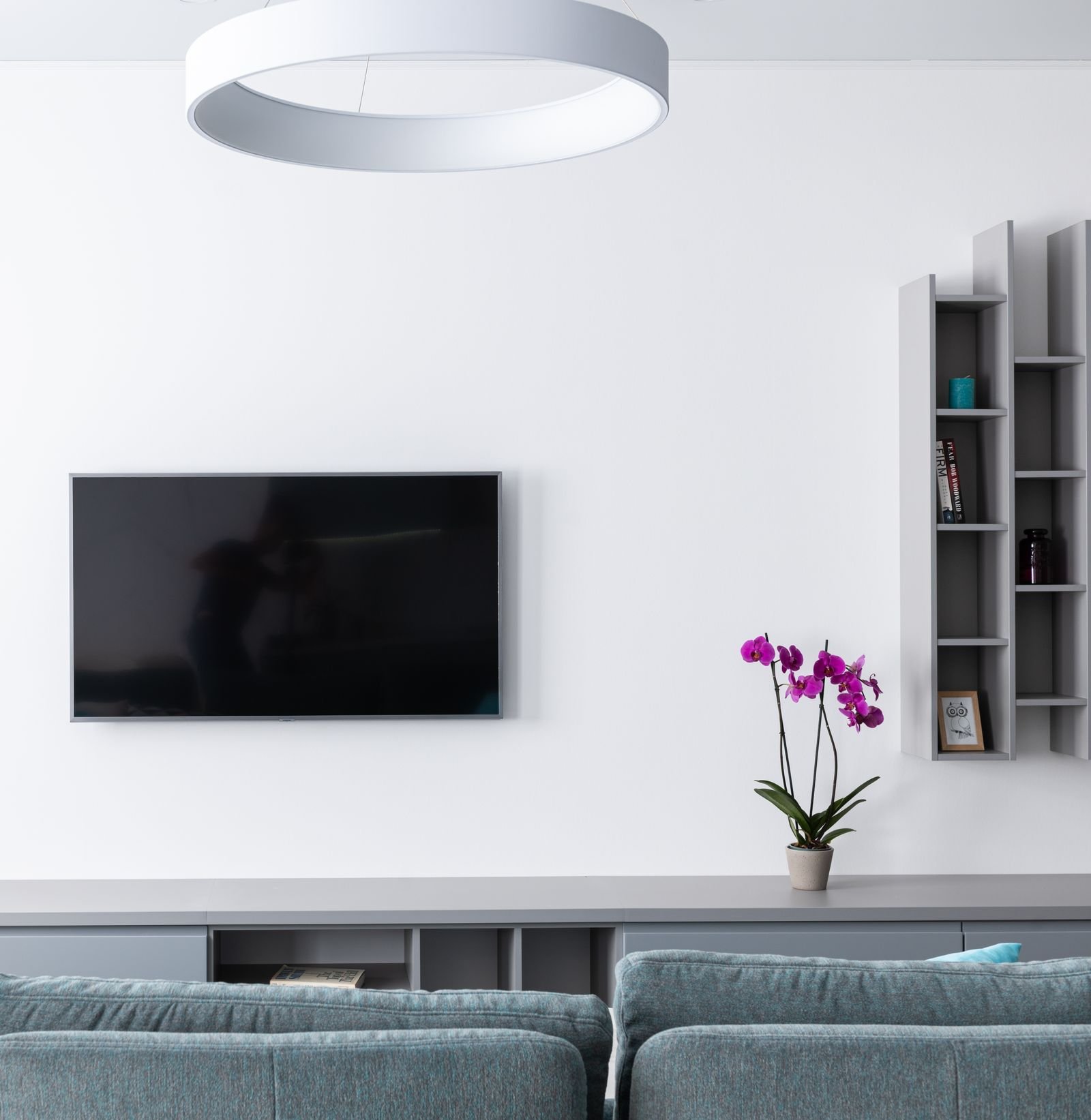
Every TV wall needs one thing that is not rectangular. A trailing plant, a tall plant where the wall ends, a woven basket beside the console — these break up the grid of screen, shelves and soundbar, and they are the cheapest layer in this guide. The bright wall below uses a single orchid; one living thing was enough. Keep plants a hand’s width from the screen’s vents, and pick forgiving kinds — pothos, snake plants — if the wall gets little light.
Renters can do almost everything here without drilling. A sturdy console with the TV on its stand beats a badly mounted TV every time. Lean a framed print beside the screen, use adhesive cord covers, plug-in sconces and peel-and-stick panelling. The no-drill rule that matters is safety: never hang a heavy screen or loaded shelf on adhesive alone. Build from the furniture up, and take the whole arrangement with you when you move.
Pick Your Approach
| Approach | Best room | Effort / cost | How visible the TV stays |
|---|---|---|---|
| Disappear — dark or panelled wall | Sitting rooms, movie rooms, formal living rooms | Medium — paint or panels, one weekend | Lowest — the screen fades into the wall when off |
| Blend in — gallery and shelves around it | Small rooms, family rooms, rentals | Low — frames, ledges and styling you may already own | Medium — one rectangle among many |
| Be the star — centred, symmetrical, lit | Main living rooms, open-plan spaces | Medium to high — console, panelling or built-ins | Highest — the wall is built around the screen on purpose |
| Renter-safe — console-first, no drilling | Rentals, first apartments, temporary homes | Low — furniture and adhesive fixes only | Medium — styled stand setup, nothing hung heavy |
TV Wall Questions
How high should a TV be mounted?
Centre of the screen at seated eye level — about 42 inches from the floor for most sofas. Test with a cardboard cut-out from your real seat before drilling.
What colour should I paint a TV wall?
For disappear: a warm dark — charcoal, deep navy, forest or chocolate — on the TV wall only. For blend-in: keep the wall light and let black frames match the screen. Test in lamplight as well as daylight.
How do I hide TV cords without opening the wall?
Run a paintable cord cover straight down from screen to console, painted the wall colour, with the power strip inside or behind the console. Avoid any cable hanging loose in the gap below the screen.
Can I put a TV above a fireplace?
Yes, with conditions: a mantel deep enough to shield the screen from heat, a tilting mount, and accepting the screen sits higher than ideal. A side-by-side layout, if the room allows it, is more comfortable.
How do I decorate a TV wall in a rental without drilling?
Keep the TV on a wide, low console, lean framed art beside it, add plug-in sconces, adhesive cord covers, plants and baskets. Never hang a heavy screen or loaded shelf on adhesive alone.
A TV wall does not need a renovation. It needs a decision, the right height, and one afternoon of finishing — cords away, something living beside the screen, nothing left looking accidental. Start with the cardboard test tonight, and let the black rectangle finally earn its place.