
The short answer: A green Christmas works when green is the lead colour, not the background. Start with real greenery — fir, cedar, eucalyptus — then pick one shade to build on: soft sage with cream and wood, rich emerald with gold, or deep forest with brass and just a touch of red. Repeat that shade, its partner and its metal room by room, and the tree you already own becomes the best green thing in the house.
Green is the colour Christmas already owns. The tree is green, the wreath is green, the garland is green — yet in most homes that green is treated as scenery while red and gold do the decorating. A green Christmas reverses the jobs: green leads, and everything else — gold, cream, warm wood, a touch of red — makes the green look richer.
Three quick distinctions. This is the green parallel to our pink Christmas decor ideas — same colour-first method, opposite mood. It is not our dark green living room guide, which is year-round decor; this one is Christmas only. And it is not traditional red-and-gold Christmas either: red appears here like salt in cooking, in small amounts, to wake the green up. Work order matters too — real greenery first, bought pieces second.

1. Start With Real Greenery, Not a Shopping Bag
Before any bauble is bought, gather the green itself. Fir or cedar clippings, a few stems of eucalyptus, pinecones dried on a radiator — this is the layer that makes a green Christmas feel grown rather than purchased. Real branches have uneven colour, from blue-green fir to yellow-green cedar, and that variation is what flat, single-shade decor can never copy.
Work in this order: one generous arrangement where people gather, then small sprigs everywhere else — a jug of branches on the table, a stem tied to each chair back, gift and napkin. The photograph below is the whole method: branches trimmed to size, offcuts becoming the sprigs. If you use faux, mix two kinds and bend every stem by hand; uniform branches give faux away.

2. Sage Green: The Softest Way In
Sage is where green begins — grey-soft, pale, and the easiest shade to live with in a bright or small room. It reads almost as a neutral, which suits homes that find full Christmas colour overwhelming. Sage’s partners are cream and pale wood: cream candles, linen napkins, birch, woven placemats, pinecones left their natural brown. Keep metal out of a sage scheme, or use a whisper of brushed brass; shine fights sage’s softness.
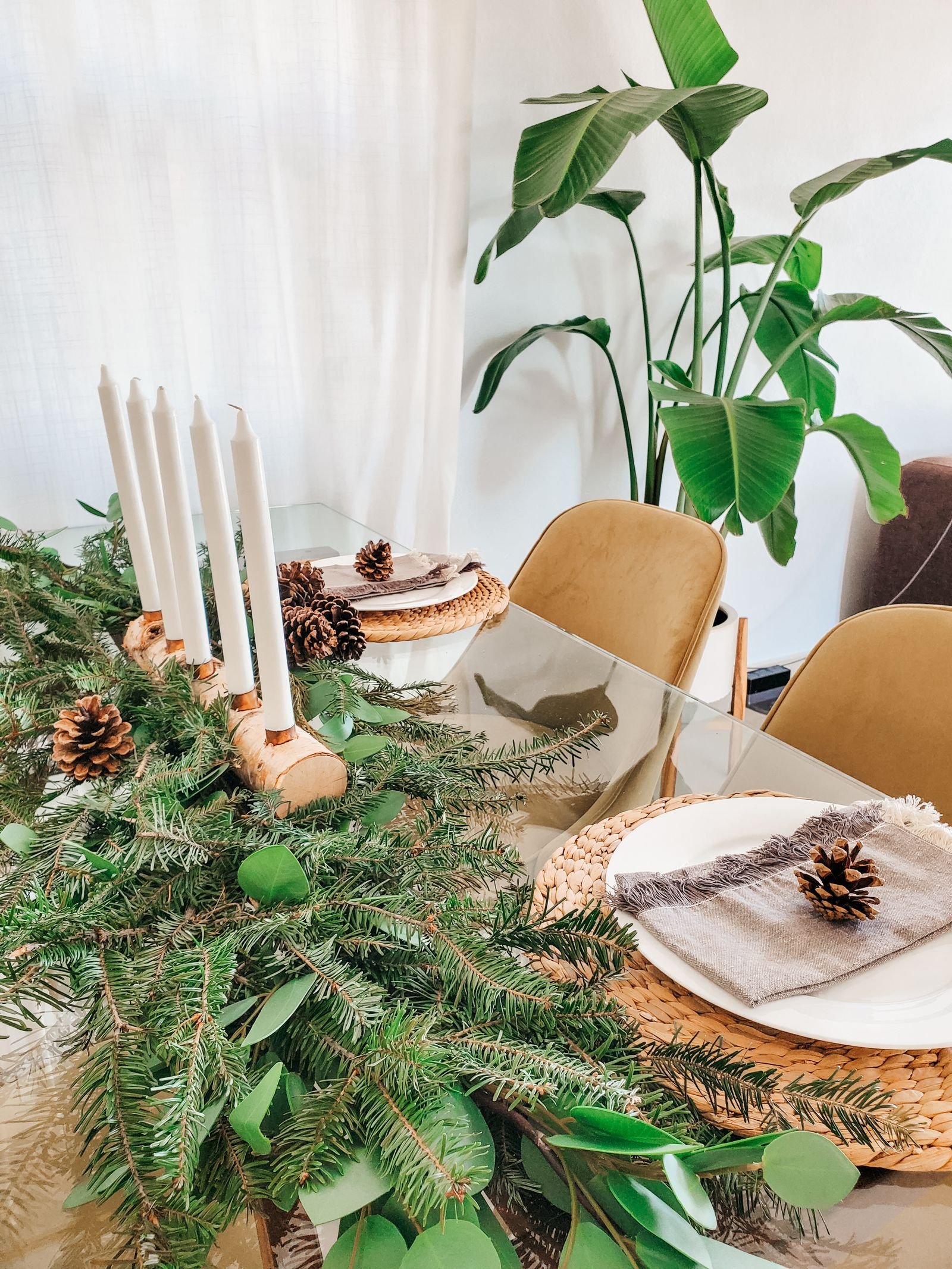
The table below shows the sage mood at full stretch: fir and silvery eucalyptus laid thickly down a glass table, white tapers in a birch log, every setting cream and woven. Nothing in the frame is painted sage — the shade comes from the eucalyptus and the softest fir tips. That is the trick worth copying: at the sage end, let foliage supply the colour and keep everything you add cream, white or wood.
3. Emerald Green: The Jewel in the Middle
Emerald is the shade most people picture when they say “green Christmas” — clear, saturated, jewel-bright — and it has one natural partner: gold. Gold warms emerald and emerald deepens gold, which is why the pairing has carried Christmas for generations. Use it where the evening light lands: the tree, the mantel, the centre of the table. Emerald velvet ribbon is the hardest-working purchase in this guide; one spool ties bows on the tree, the wreath, the gifts and the chair backs, and repetition is what turns a colour into a scheme.
The baubles below show emerald in a textured, almost beaded finish, catching light in points rather than a shine. Texture matters: flat glossy emerald can look plasticky up close, while matte, hammered and velvet finishes read richer. Our featured room runs on this pairing — green-and-gold bows, an emerald throw over a cream sofa — with cream as the supporting act.

4. Deep Forest Green: The Moody End of the Scale
Forest green — bottle green, the green of deep shadow in a fir wood — is the dramatic end of the family. It absorbs light instead of returning it, so it needs light placed against it: warm white fairy lights tucked deep into branches, cream ornaments on the surface, candlelight nearby. Its partners are brass rather than bright gold, dark wood, and cream. This is also the one shade where a touch of red earns its place — berries in a wreath, one red bauble in ten — because red against forest green vibrates as it never does against sage.
The tree below is the forest formula: dark branches against a dark ground, lit by cream baubles, silvered leaves and pinecones. If you love this depth all year, our dark green living room ideas take the same shade into paint and furniture — but keep the Christmas version temporary and light-managed. One warning: in a north-facing or already dark room, forest green can swallow the decor. Test your darkest piece at dusk first.

5. The Tree, Green on Green
A green Christmas tree sounds like a joke — the tree is already green — until you dress one in green on purpose. The method is tonal: ornaments in greens a step lighter and darker than the branches, so the tree reads as layers of one colour rather than a green shape with coloured dots. Sage baubles near the tips, emerald through the middle, forest pieces deep inside where branches shadow. Then one contrast only: warm white lights, and one metal.
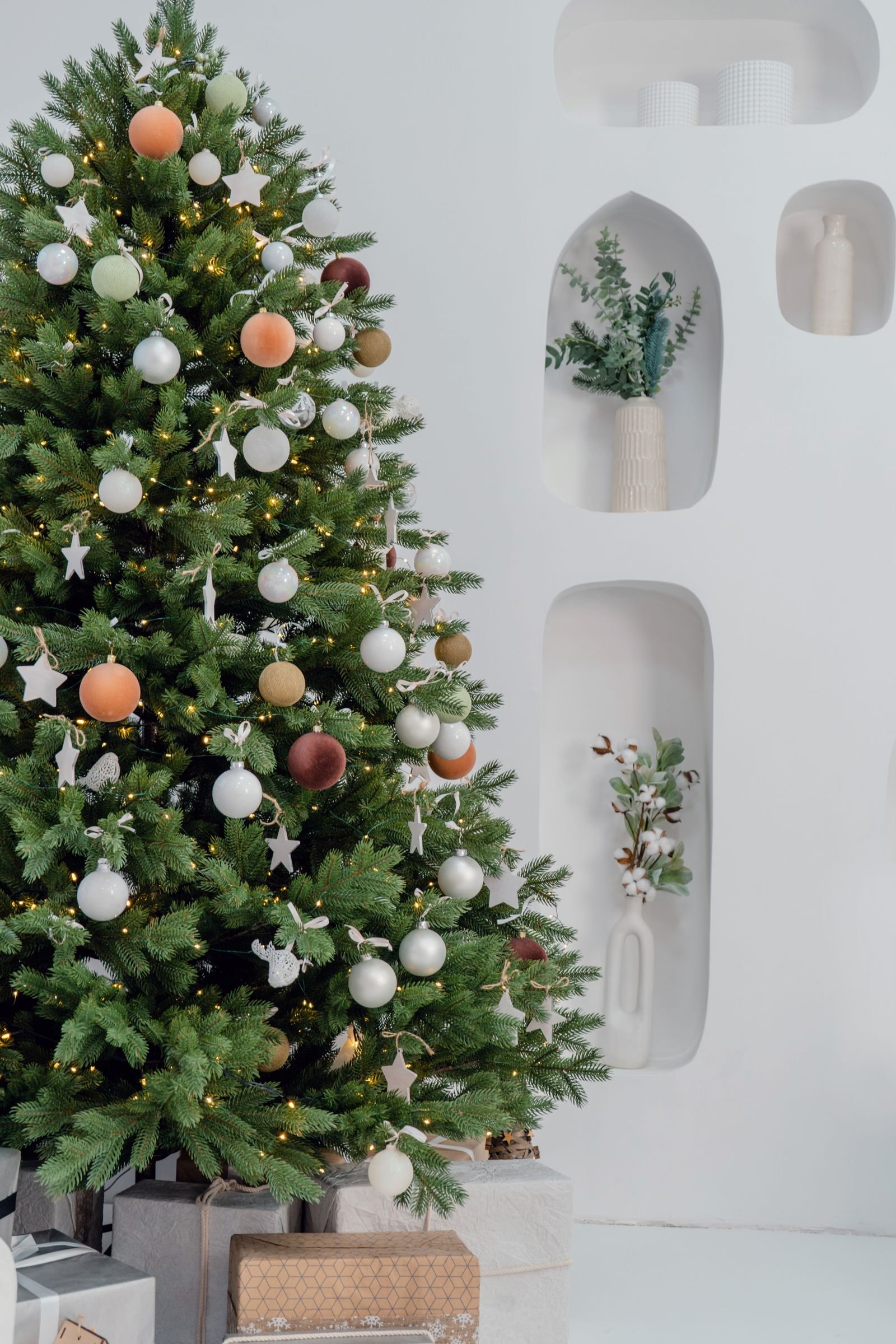
The tree below takes the lighter road — a bright room, cream and white baubles, pale sage-green balls, white stars, and the branches’ own green doing most of the talking. Our Christmas tree decorating ideas cover the full layering order — lights, garland, baubles by size — and a green scheme follows it exactly, with the palette tightened. Finish the base in the scheme too: a woven collar, a linen skirt, or gifts wrapped to match.
6. The Mantel: Garland First, Baubles Second
The mantel is where a green Christmas proves itself, because a mantel has no tree to hide behind — the greenery has to be the decoration. Build it greenery-first: a thick garland, real or good faux with every stem bent, swelling in the middle and trailing at the ends. Then baubles in your shade and metal, clustered in threes. Then height at the back — candlesticks, a mirror, a wreath above — because a garland alone reads flat from across the room.
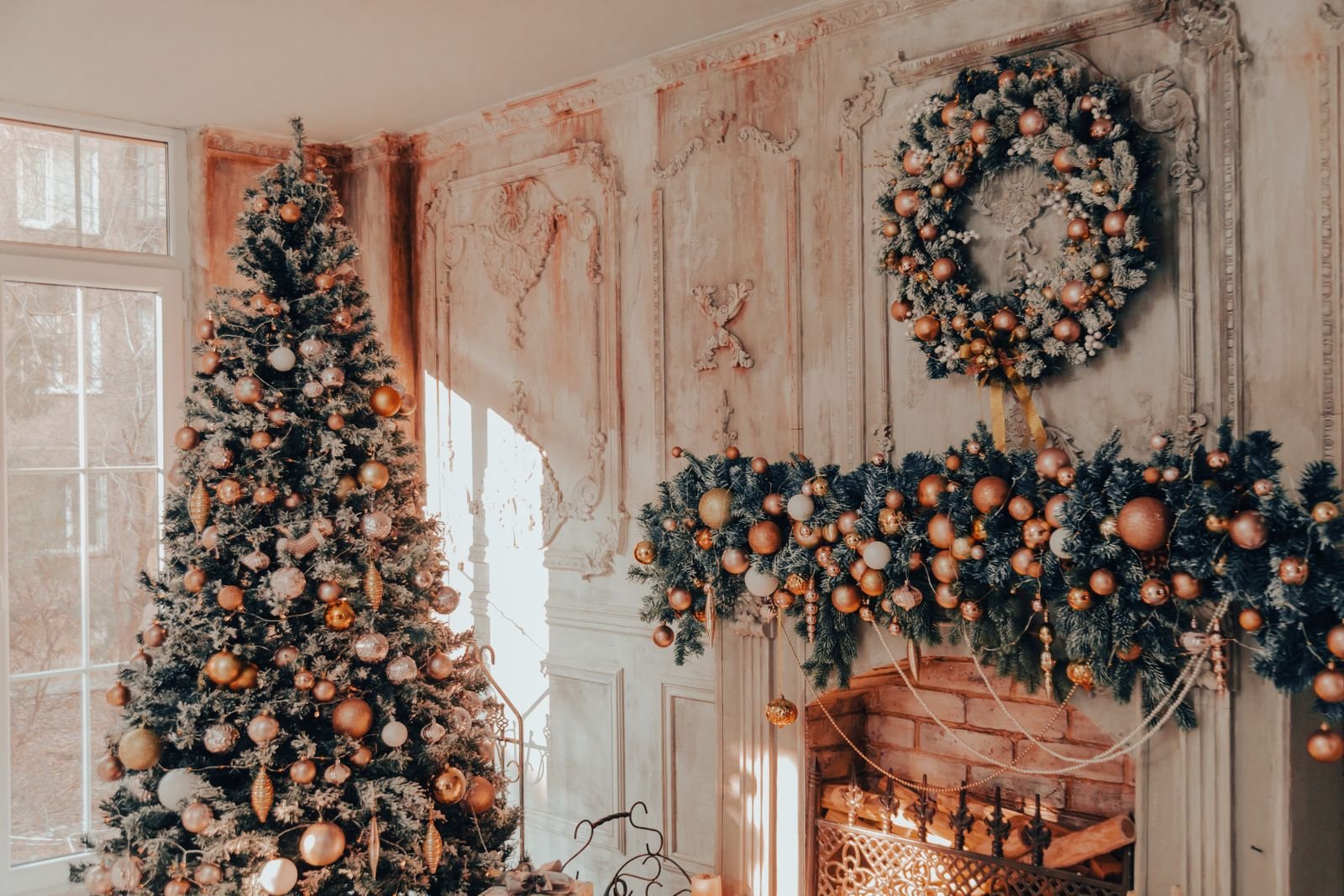
The room below runs the full version: a garland fat with copper and gold baubles under a matching wreath, the tree beside it dressed to rhyme. Copper is gold’s warmer cousin and flatters green exactly as brass does. Our Christmas mantel decor ideas cover garland fixing and stockings in detail. The green rule is simpler: if you can still see the shelf in long stretches, the garland is too thin. Double it.
7. The Green Table
The dining table is the easiest green win, because the centrepiece can be pure greenery. Lay a runner of cedar or fir flat down the middle — loose branches, not a formal garland, overlapping like roof tiles — and set candlesticks straight into it. The photograph below is the deep version: dark wood, cedar runner, brass holders, white plates, not one coloured object. Green, wood, brass, cream — it looks like a restaurant and costs like a walk with secateurs.
Repeat your shade at every seat: a sage napkin, an emerald ribbon around the cutlery, a fir sprig and one pinecone on each plate. Keep greenery below seated eye level and real flame in holders, away from branches — battery tapers give the same line with none of the worry. Small table? Shrink the runner to a wreath laid flat with a candle in its centre.

8. Wreaths and Doors: Green That Greets You
A wreath is the purest green Christmas object there is — a circle of foliage that was green long before it was decorated — so it is the one place to resist over-dressing. The wreath below is nothing but mixed greens: fir, pine, cedar and pale eucalyptus, sage tones woven through deeper ones, hung plain on a white wall. It works precisely because nobody added anything. Hang one like it inside as happily as out — over the mantel, on a kitchen door, above a bed.
When you do dress a wreath, use your one shade and one metal, in a cluster, not all over: cream baubles and cinnamon at one side, the rest left green. On the front door, add your scheme’s ribbon — the emerald velvet again — tied once, with long tails.

9. Wrap It Green: Ribbon and Gifts That Match the Tree
The gifts under the tree are part of the room for weeks, so wrap them in the scheme: emerald or forest paper, kraft paper with green ribbon, cream paper with a green bow. The pile below shows the centre of the palette — one gift in full emerald tied with plain twine, fir sprigs and a few red berries around the kraft parcels beside it. Green leads, wood tones support, red appears as berries and nothing more.
Buy the wrapping in one trip, one palette: a roll of green paper, one of kraft, a spool of emerald velvet ribbon, a ball of twine. Add one living touch per gift — a fir cutting, a cedar sprig, a pinecone on the bow — and the presents repeat the greenery-first rule. The story closes neatly: the first green a guest sees is the wreath, the last is the parcel with their name on it.

The Green Shades, Side by Side
| Shade | Character | Pairs with | Best rooms |
|---|---|---|---|
| Real greenery | Fresh, uneven, blue-green to yellow-green | Everything — it is the base layer | Table, mantel, door, gifts |
| Sage green | Soft, greyed, almost a neutral | Cream, linen, pale wood, pinecones | Bedroom, small or bright living rooms, the table |
| Emerald green | Clear, jewel-bright, festive | Gold, cream, warm white light | The tree, mantel, living room centre |
| Deep forest green | Dark, moody, light-absorbing | Brass, dark wood, cream, a touch of red | Evening living rooms, the tree, the dining table |
Green Christmas Questions
What colours go with green Christmas decor?
Gold is the classic partner for emerald, cream softens every shade, and natural wood keeps green grounded. Sage wants cream and pale wood; deep forest wants brass, dark wood and warm light. Red works only as an accent — berries, a ribbon, one bauble in ten.
How do I stop a green Christmas looking dark or dull?
Light and contrast. Keep warm white lights on the tree, place cream pieces on the surface of dark branches, and leave one pale surface in the room — a cream throw, a white wall, a linen cloth — for the green to stand against. If a corner still glooms, move that piece up a shade, from forest to emerald.
Is sage green Christmassy enough on its own?
Yes, if texture does the work colour is not doing. Sage with real fir, eucalyptus, pinecones, cream candles and woven texture reads unmistakably seasonal. What sage cannot carry is shine and glitter; keep finishes matte and natural.
Can I mix sage, emerald and forest green in one home?
Yes — that gradient is the scheme. Use lighter shades where light is weak or the room is small, deeper shades where you have lamps and candles. Keep the partners constant — the same cream, the same gold or brass — so the rooms read as one house deepening, not three houses arguing.
I already own red decorations. Do I have to replace them?
No. Demote them. Use red the way this guide uses berries: a few pieces, placed deliberately, against the deepest greens, and put the rest away for a traditional year. The red you own becomes the accent instead of the theme.
Green is not the alternative Christmas colour. It is the original one — the tree, the wreath and the garland were green before they were anything else. Choose your shade tonight, tie the first ribbon, and let the green lead this year.