
The short answer: A trinket shelf reads curated when every piece has been chosen, grouped and given space — and cluttered when pieces have simply accumulated. Group small things by material or colour, leave real gaps between groups, lift the tiniest pieces on trays, books and risers, give each shelf one tall piece to anchor it, and rotate the collection instead of adding to it.

Why Small Things Are the Hardest to Display Well
Everyone who collects has the same shelf somewhere: the holiday shell next to the market pottery next to the miniature a friend brought back, each one loved, the whole thing reading as a jumble. Small objects are the hardest decor to get right because they carry meaning out of proportion to their size — you cannot throw them away, but lined up in a row they disappear into visual noise.
The good news is that the difference between a cabinet of curiosities and a cluttered shelf is rarely the objects. It is the editing, the grouping and the space between things. This guide works through those three moves, shelf by shelf. It is the vertical companion to our guide to how to style a coffee table without making it look cluttered — that post handles the flat surface you live around; this one handles the shelves where the collection itself is the point. A table gets cleared; a shelf gets curated.
1. Edit First: Fewer Pieces, Chosen on Purpose
Before anything is rearranged, take everything off the shelf. All of it. A trinket shelf styled around what is already standing there never quite works, because the eye keeps the old order. With the shelf empty, put back only the pieces you would genuinely miss — the shell from the one beach, the pot with the glaze you still pick up and turn over, the miniature with a story attached.
What is left over is not rejected; it is the reserve collection, and Section 9 gives it a job. Most shelves that read as cluttered are carrying roughly a third more than they should, and removing that third does more than any styling trick that follows. If a piece is there only because it has always been there, it is a candidate for the box.
2. Group by Material or Colour, Never by Arrival
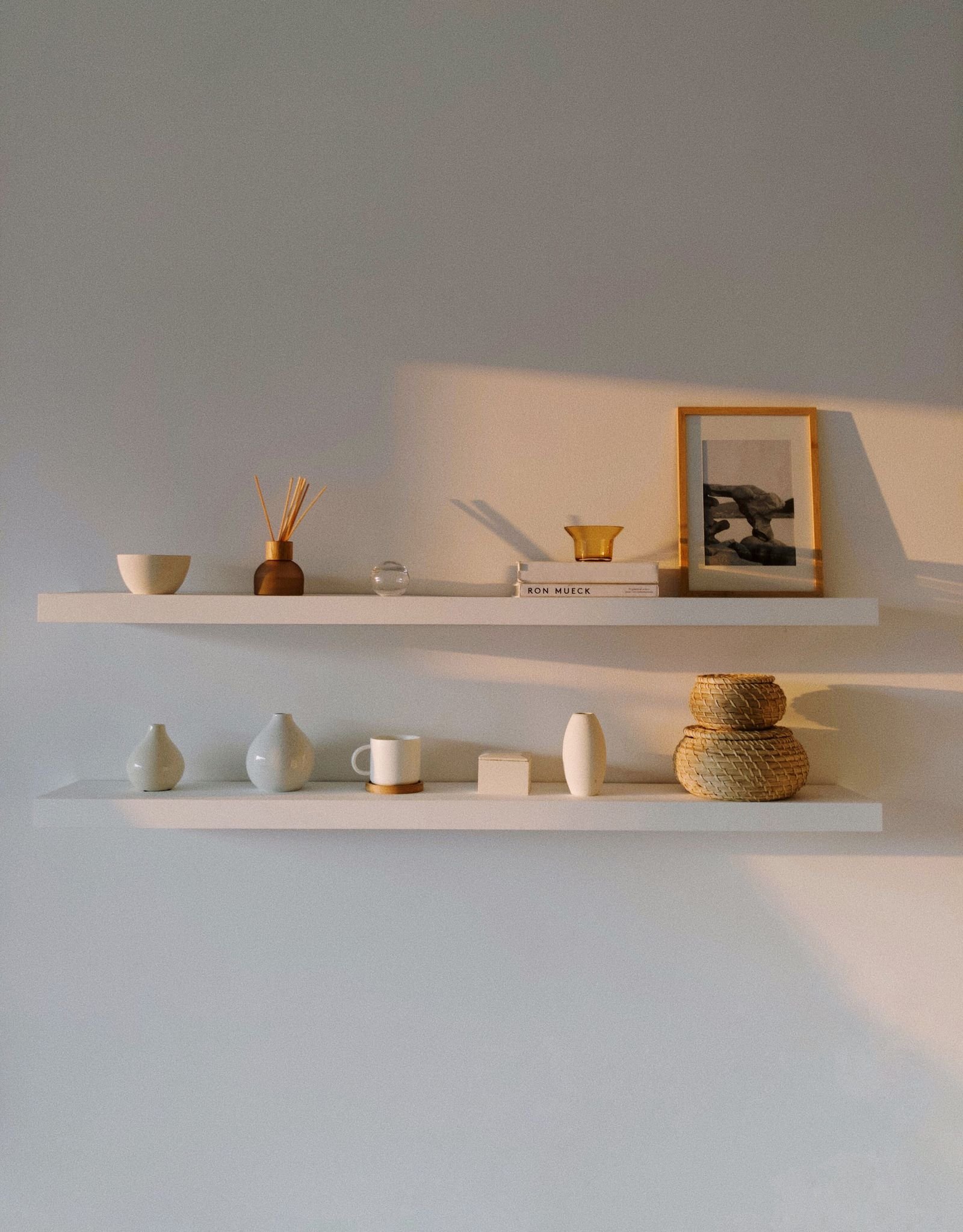
Scattered one by one, small things look random. Gathered into families, the same things look intentional. Choose one organising idea per shelf and hold to it: all the ceramics together, all the glass together, all the shells in one place; or, if the collection is mixed, group by colour instead — the creams and whites on one shelf, the deep greens and browns on another.
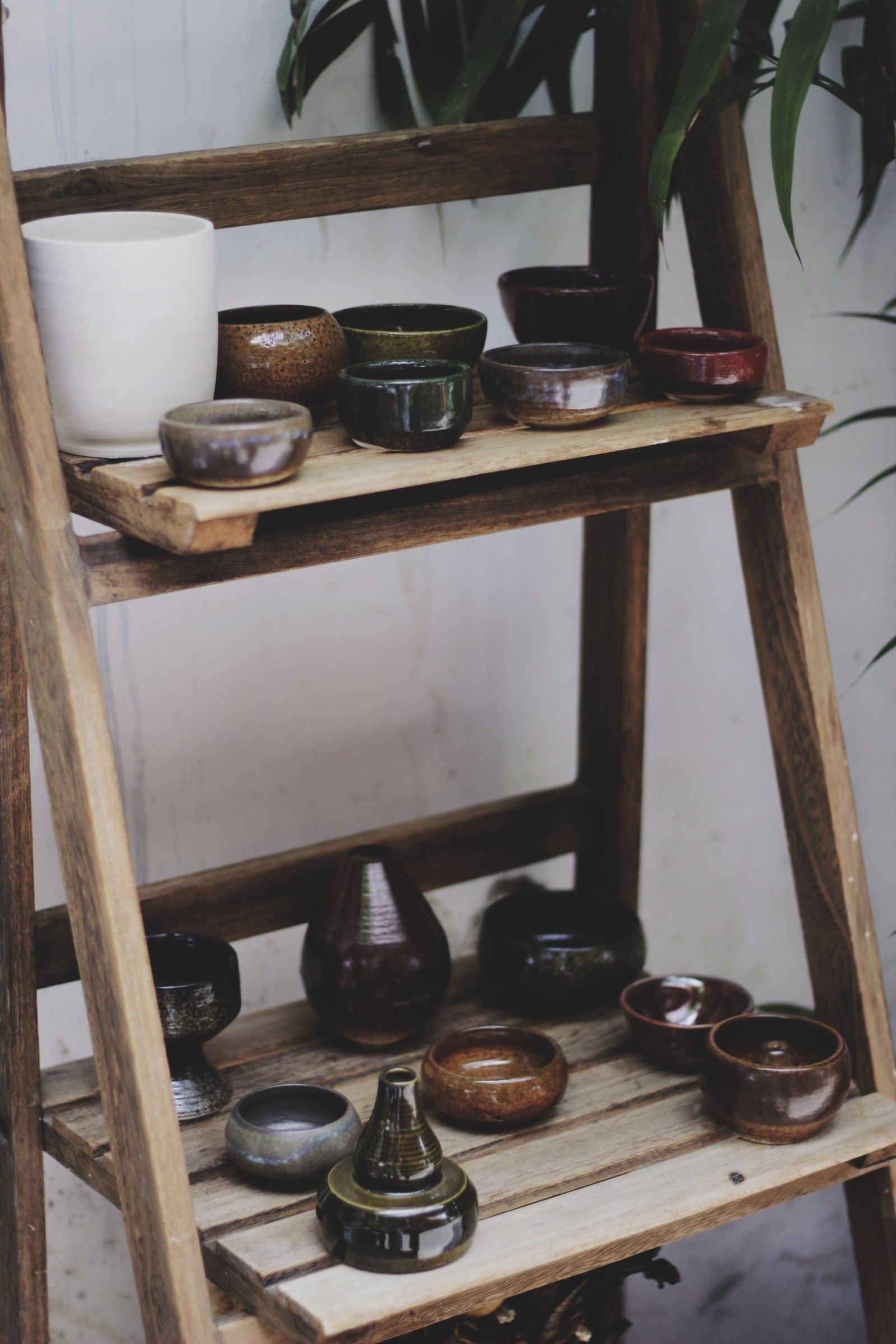
Groups of three and five settle more easily than even numbers, and a group should sit close within itself — pieces nearly touching — so the gaps can open up between groups instead. This is the single most useful habit in this guide: tight inside the group, generous outside it. A row of similar bowls reads as a collection. The same bowls spread evenly along a shelf read as storage.
3. Leave Breathing Room — Empty Space Is Part of the Display
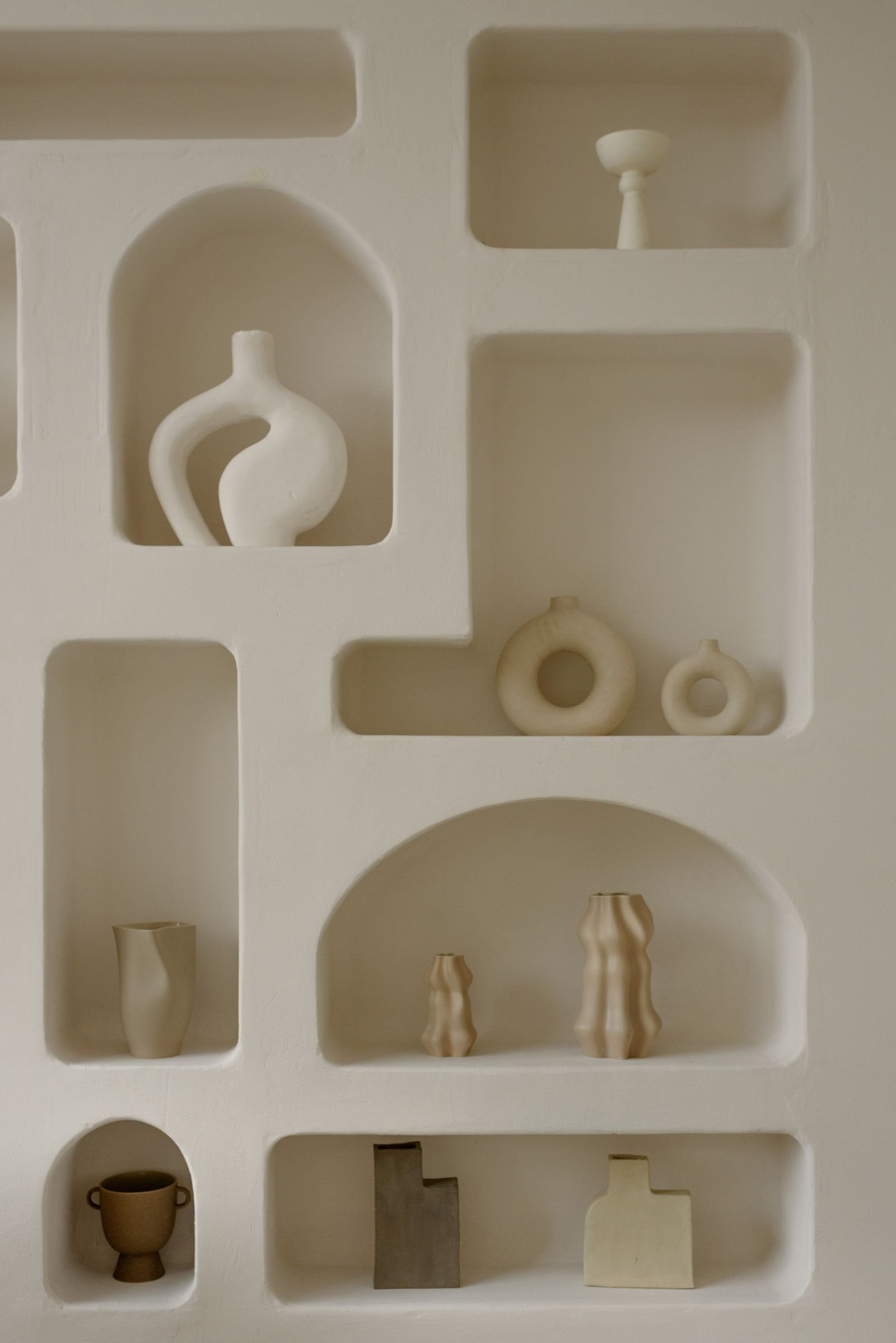
Breathing room is what separates a display from a stockroom. Each group needs a margin of bare shelf around it, and some shelves — or some cubbies — are better left holding one piece, or even nothing at all. That emptiness is not wasted space. It is what lets the eye land on each thing in turn instead of sliding across a continuous band of stuff.
A practical test: stand back and squint. If the shelf reads as one solid stripe of objects, it needs gaps. Take one group off entirely rather than thinning every group a little — a clear gap between two strong groups does more than a slight loosening everywhere. Deep shelves need this most, because they tempt you to fill the front and let a second, invisible row gather behind.
4. Lift the Small Things: Risers, Trays and Books
Tiny objects placed flat on a shelf sit below the eye’s natural path and get overlooked — or worse, they read as dust-catchers waiting to be tidied away. Lifting changes their status. A small stack of two or three books makes a plinth. A tray turns five loose pieces into one composed group that can be moved, dusted and rearranged as a unit. A little wooden riser or cake stand gives a favourite piece a stage of its own.
Use what the house already has: the lidded box, the upturned bowl, the spare frame laid flat under a group. Vary the heights inside each group — one piece raised, one beside it, one in front — and a flat row becomes a small landscape. On a shelf the lift matters even more than on a table, because everything is seen from standing height, slightly from above.
5. Give Every Shelf One Tall Piece
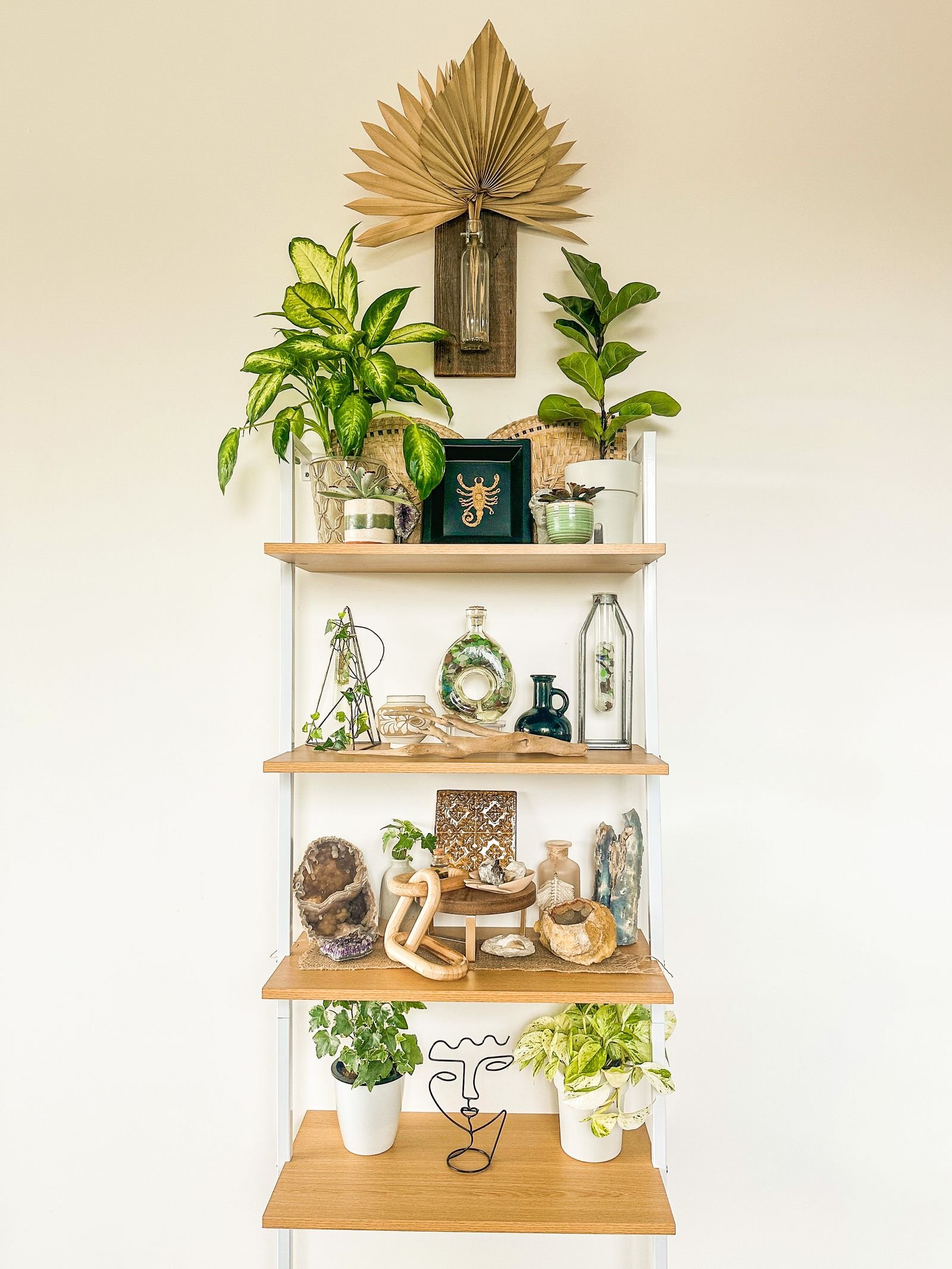
A shelf of only small things has no anchor — the eye finds nowhere to start. One taller piece per shelf fixes that: a vase, a jug, a framed print stood at the back, a plant with some height, even a candlestick. It does not need to be large, just clearly taller than everything around it, and it usually sits best off-centre, with the smaller groups arranged in its orbit.
On a run of shelves, let the tall piece change sides as you go down — left on one shelf, right on the next — so the unit zigzags gently instead of stacking its weight in one column. If nothing you own is tall enough, make height: a small piece on a stack of books counts.
6. Contain the Tiniest Things: Jars, Domes and Dishes
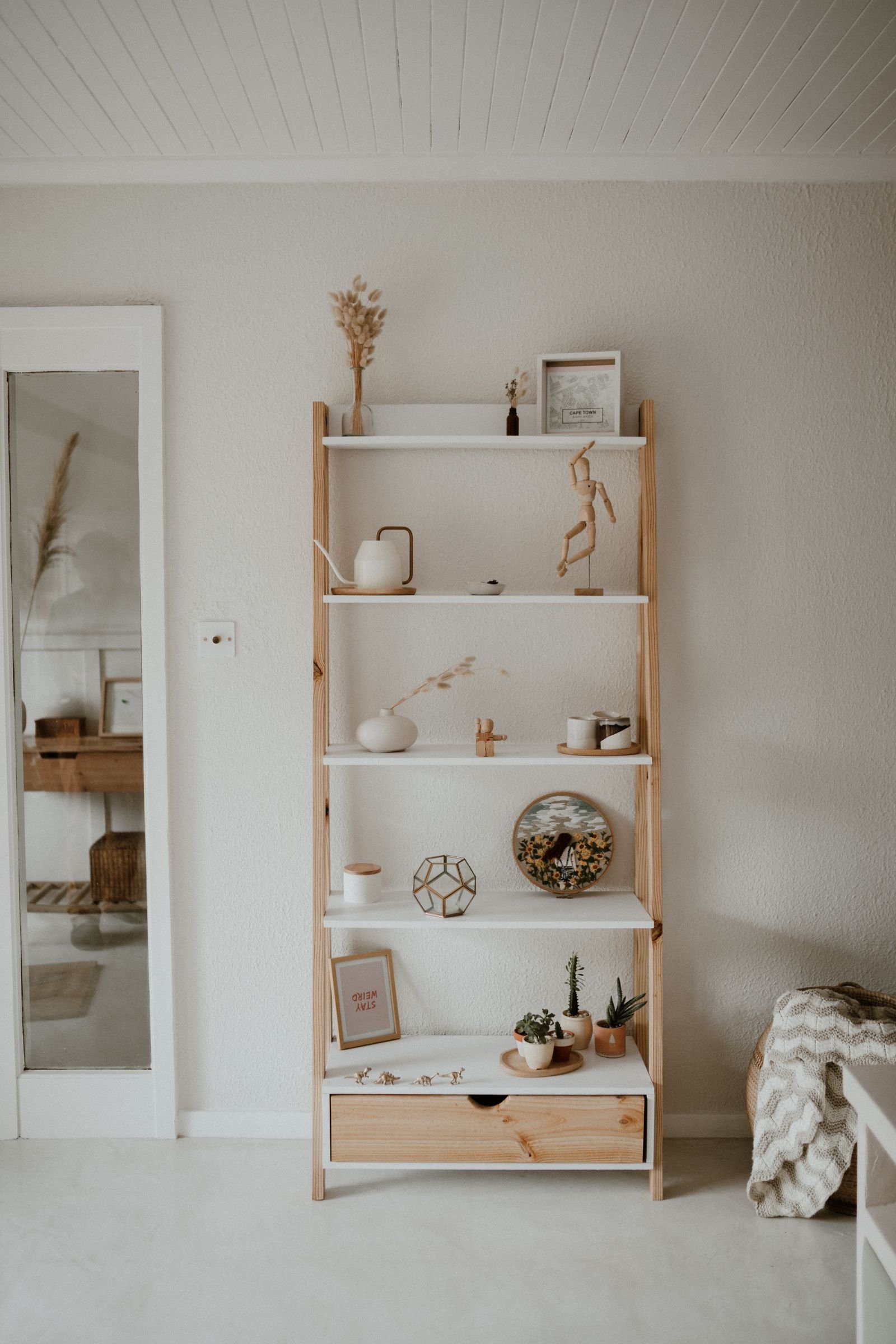
Below a certain size, individual pieces stop reading at all — a handful of shells, a scatter of stones, souvenir coins, tiny bottles. Containment is the answer. A clear glass jar gathers shells into a single sculptural object. A glass dome or cloche promotes one fragile favourite into an exhibit. A shallow dish or small bowl corrals the pieces that are too small and too many to stand alone.
Contained collections have a second virtue: they are finished. A jar with a lid does not invite one more shell every time you pass, the way an open row does. Choose the container with the same care as the contents — plain glass, a wooden lid, nothing novelty-shaped — and group two or three containers together rather than scattering single jars along the shelf.
7. Let Vintage Finds Earn Their Place
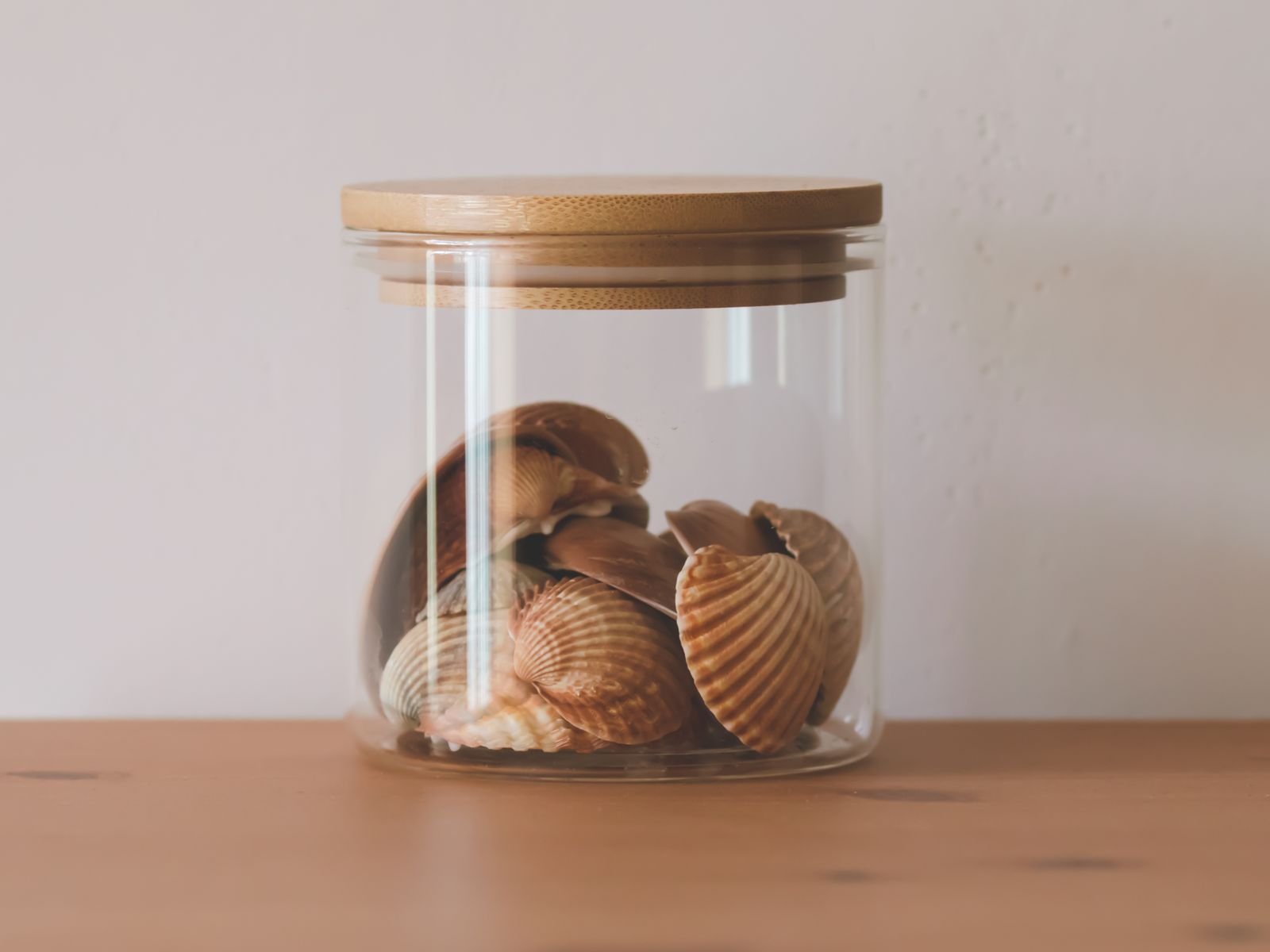
Thrifted and inherited pieces are the soul of a good trinket shelf — the brass, the old glass, the jug with a maker’s mark — but they follow the same rules as everything else. A vintage find earns its place by joining a group (the metal pieces together, the old glass with the glass), not by standing apart as a shrine. Patina mixes happily with new ceramics as long as the grouping idea holds.
Our roundup of affordable vintage finds for a cozy home is full of the kind of pieces that work here. When you bring one home, the shelf question is not “where is there a gap?” but “which family does this join?” If it joins none, it waits in the reserve box for the next rotation — a discipline that keeps a growing collection from becoming a growing problem.
8. Put the Shallow Ledge and the Cubby to Work
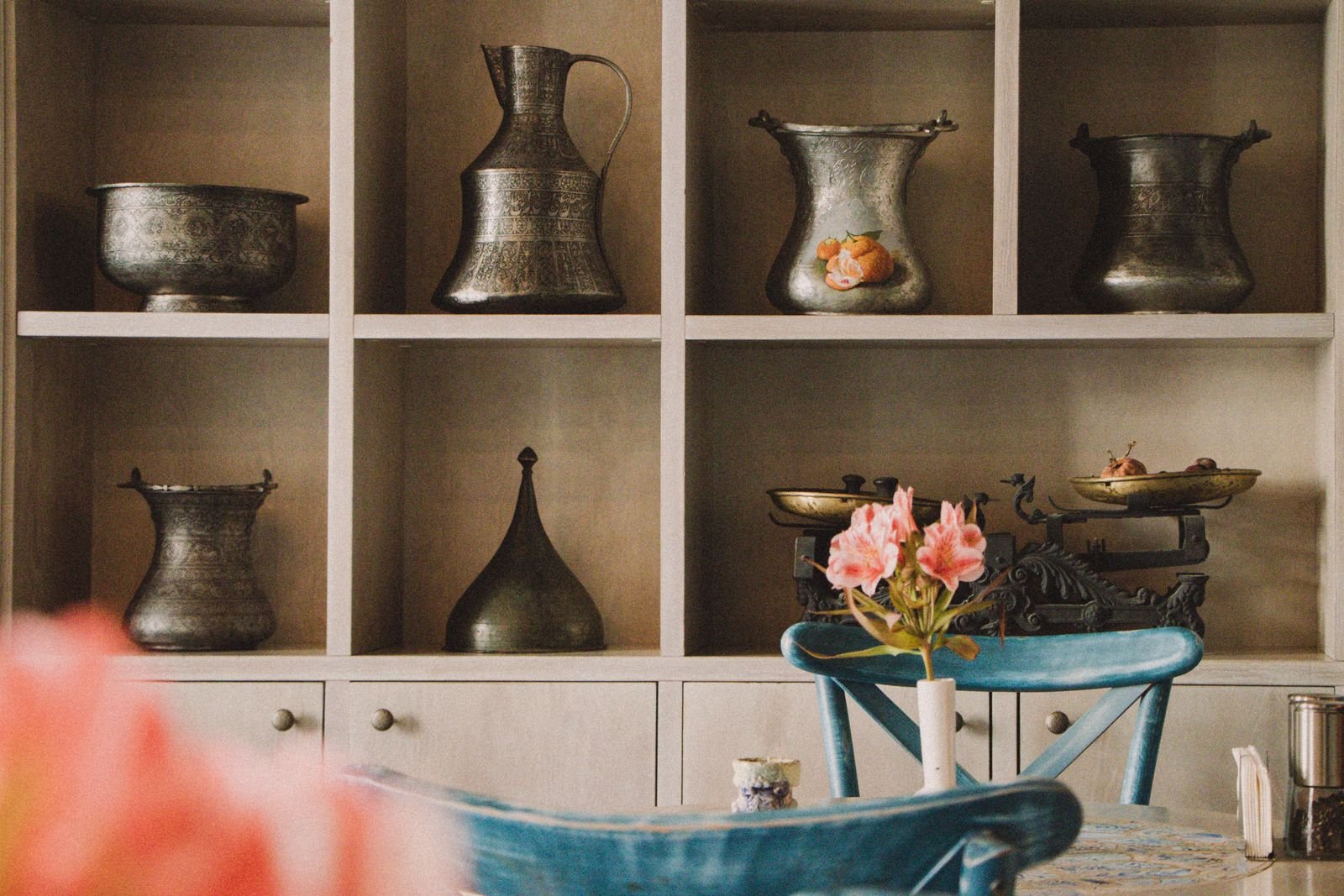
Not every collection belongs on a deep shelf. A shallow ledge — picture-ledge depth — forces a single row, which is exactly right for small framed prints, tiny plants, bottles and the pieces you swap most often; nothing can hide behind anything else, so it stays honest. A cubby shelf or an old printer’s tray does the opposite job: its grid of small compartments gives miniatures and tiny souvenirs one cell each, turning the smallest collection into a deliberate, satisfying pattern.
Match the container to the collection’s habits. Pieces you love handling and rearranging belong on the open ledge. Pieces that are small, numerous and easily lost belong in the cubby, where the grid does the organising for you. The table below pulls the four main shelf types together.
9. Rotate, Don’t Accumulate
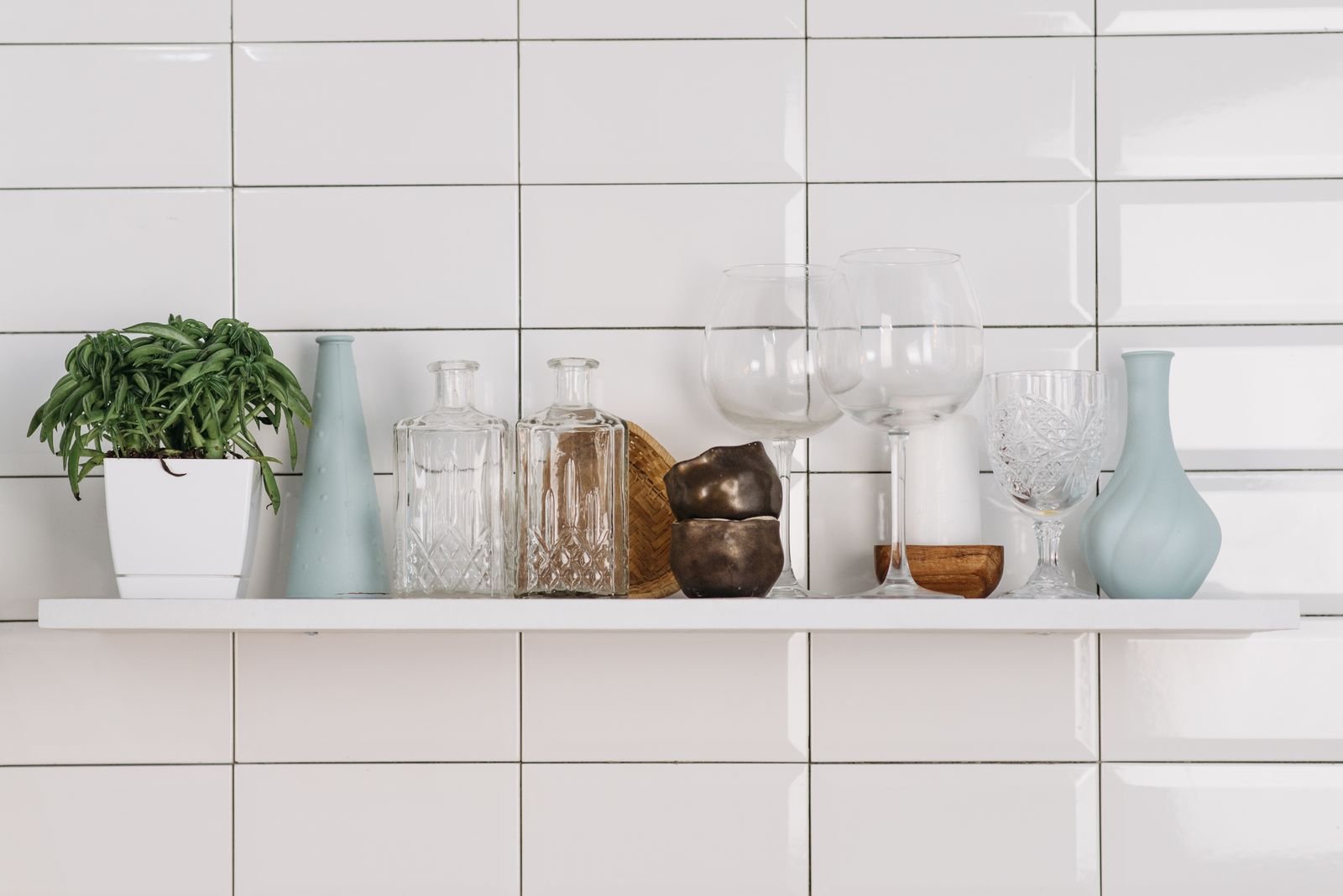
The last rule protects all the others: a trinket shelf should be a rotation, not a total. Keep the reserve box from Section 1, and every couple of months swap a group out and a group in — the shells rest while the stones come out, the summer pottery gives way to the heavier winter pieces. The shelf stays the same size; the collection stays fully loved; nothing new has to be bought and nothing loved has to be discarded.
Rotation also solves the gift problem and the holiday-souvenir problem in one move: new pieces join the reserve and wait their turn like everything else. And a shelf beside a reading chair benefits most of all — our cozy reading nook ideas for small spaces puts a small shelf within arm’s reach of the chair, and a rotated display means the view from that chair quietly changes through the year without a single new purchase.

Which Shelf Suits Which Collection
| Shelf type | Best for | Watch out for |
|---|---|---|
| Shallow ledge | Small framed prints, tiny plants, bottles, pieces you swap often — one honest row | Anything round that can roll, or pieces too deep to sit safely |
| Cubby / printer’s tray | Miniatures, tiny souvenirs, stones, thimbles — one piece per cell | Cells filling just because they are empty; leave a few bare |
| Floating shelf | A few strong groups with space between them; ceramics and glass | Overloading the fixings — keep heavy pieces low and few |
| Bookcase shelf | Mixed displays with books as plinths and bookends; taller pieces | The hidden second row gathering behind the front one |
Trinket Shelf Questions
How many pieces should go on one trinket shelf?
Fewer than you think. Work in groups of three to five, with clear gaps between groups, and stop while the shelf still has visible bare space. If you cannot see shelf surface between groups, there is too much on it.
How do I display a collection without it looking cluttered?
Edit first, then group by material or colour, lift small pieces on trays and books, and give the shelf one tall anchor piece. Clutter usually comes from scattering and accumulation, not from the objects themselves.
What can I use as a riser if I don’t want to buy one?
A stack of two or three books, a lidded box, an upturned bowl, a small wooden board or a cake stand you already own. Anything stable that raises a piece a few inches and suits the group’s materials will do.
My collection keeps growing. How do I stop the shelf overflowing?
Rotate instead of adding. Keep a reserve box, swap groups every couple of months, and let new pieces wait their turn in the box. The shelf stays one size while the whole collection still gets displayed across the year.
What is the best shelf for really tiny items like shells and miniatures?
A cubby shelf or printer’s tray, with one piece per compartment — or containment: a clear glass jar for shells and stones, a small dish for the pieces too tiny to stand alone. Both stop small things scattering into visual noise.
A curated trinket shelf is not a smaller collection — it is the same collection, edited, grouped and given room to be seen. Take everything off, put back what you would miss, and let the rest wait its turn. The shelf will look like it was always meant to look that way.